Govalle, Austin
Updated · 5,601 residents
Govalle is an East Austin enclave characterized by its transition from industrial roots into a hub for creative studios, breweries, and local dining. While the neighborhood provides a distinct cultural identity and high flood safety, it remains a car-dependent area with moderate noise levels from surrounding road traffic.
Key Highlights
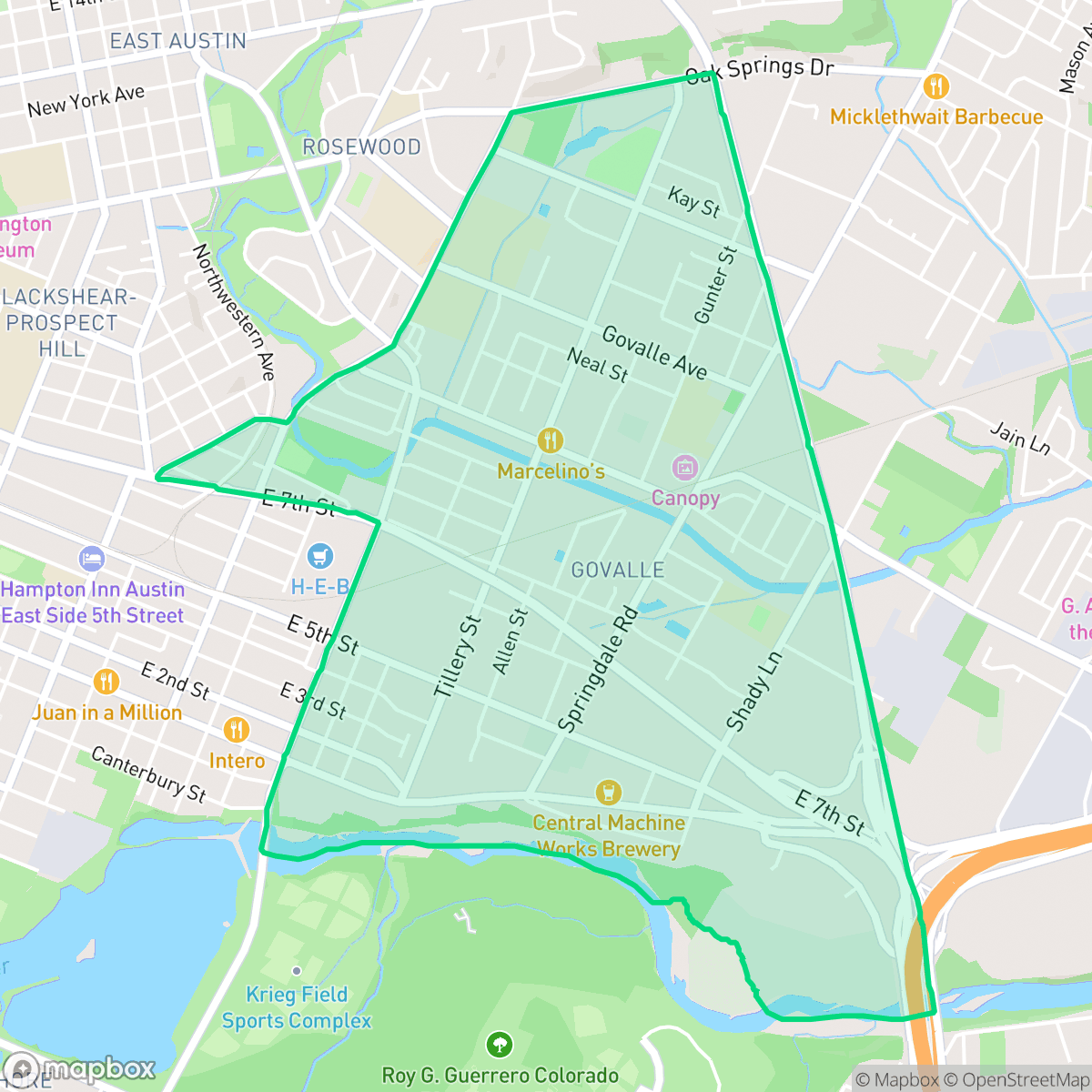
About Govalle
Located in East Austin, Govalle—pronounced "goh-VAL-ee"—derives its name from "GaValla," a Swedish phrase meaning "good grazing land" coined by 1850s Swedish immigrant and rancher Swen Magnus. The neighborhood transitioned from its mid-19th-century ranching roots to a residential area featuring classic 1920s and 1940s cottages. A major cultural landmark is Parque Zaragoza, established on Boggy Creek in 1931 through grassroots activism as a dedicated recreational and gathering space for Austin's Mexican American community. Historically, the neighborhood also hosted the Govalle School, which served as a vital community hub. In recent decades, Govalle has undergone significant transformation; many of its southern industrial spaces have been converted into breweries, art galleries, and creative workspaces that anchor the annual East Austin Studio Tour, alongside historic urban agricultural sites like Boggy Creek Farm.
The current landscape of the neighborhood is defined by a blend of quiet residential streets and light industrial corridors that house art galleries, coffee shops, and diverse eateries. Residents benefit from a high level of health insurance coverage and a strong ideological consensus, contributing to a stable social environment. The area maintains a unique aesthetic that balances green spaces with the functional utility of its industrial past, making it a focal point for those interested in the evolving character of East Austin.
Living in the area requires a reliance on personal vehicles, as daily errands and commutes are not easily managed on foot. Prospective residents should note that acoustic comfort is occasionally affected by road traffic, and air quality metrics suggest a moderate urban environment. While the local elementary schools currently face academic challenges, the neighborhood remains an attractive option for those who prioritize proximity to creative workspaces and a community-oriented atmosphere over high walkability scores.
Neighborhood Scores Across 15 Qualities
Residential spacing offers a moderate level of separation between neighbors. This density is slightly higher than the Austin average, according to iHuus data.
Low traffic volumes and calm streets make for pleasant walking, though the lack of sidewalks makes this area slightly less walkable than the Austin average.
Standard tract housing with tidy but small yards characterizes the area, which offers less visual variety than the Austin average according to iHuus data.
Limited access to large green spaces and wide verges makes pet outings less convenient here than in the rest of Austin. According to iHuus data, the neighborhood offers fewer immediate opportunities for off-leash exercise compared to the city average.
Residential clusters and commercial blocks transition into large industrial yards, presenting a more developed character than the more semi-rural surroundings found elsewhere in Austin. According to iHuus data, this area contains more concentrated urban density than the city average.
Active social hubs and diverse dining options create a more vibrant atmosphere than the Austin average. This liveliness exists alongside quiet, low-density pockets and more industrial, car-dependent areas.
Steady sounds from nearby busy streets are noticeable, though acoustic levels are slightly higher than the Austin average. Residents may encounter a consistent hum of local traffic throughout the day.
Air quality fluctuates between acceptable and unhealthy levels, presenting occasional concerns for sensitive groups. According to iHuus data, the air quality in Govalle is lower than the Austin city average.
Residential life is largely undisturbed by heavy industry, though residents may encounter occasional utility odors or transit traffic near local gas stations. This area contains significantly less industrial activity than the Austin average, consisting primarily of residential streets and light commercial pockets.
Health insurance coverage among residents is lower than the Austin average. According to iHuus data, a significant portion of the population remains uninsured.
Voting patterns and census indicators in Govalle reflect a strongly liberal leaning that is even more pronounced than the Austin average, according to iHuus data.
Residents live alongside a balanced mix of young adults, families, and older individuals. This age distribution is largely in line with the Austin city average, according to iHuus data.
Flood risk in this area is slightly higher than the Austin average, though official FEMA assessments for this specific location remain incomplete.
Address-Level Insights for Govalle


iHuus Neighborhood Intelligence Insights
Get address-level neighborhood insights for Govalle
- Street-level scores — see how individual blocks compare, not just neighborhood averages
- Micro-zone boundaries — identify quiet pockets, flood boundaries, and walkable clusters before you visit
- 15 dimensions in full — walkability, noise, air quality, school quality, insurance coverage, population age profile, urban/rural index, and more
- Boundary risk alerts — know if your address sits near a block boundary where scores drop, the kind of detail no listing will ever mention
- School insights — individual school ratings and insights, not just district-level data
- Compare before you commit — side-by-side data across neighborhoods, down to block precision
No credit card required
Compare with Any Neighborhood
| Dimension | Govalle | Allandale |
|---|---|---|
| 🚶 Walkabilityavg 6.73 | ||
| 🔊 Acoustic Comfortavg 3.73 | ||
| 🤫 Privacy Indexavg 5.87 | ||
| 🎨 Visual Appealavg 6.95 | ||
| 🐕 Dog Friendlinessavg 6.92 | ||
| 🗺️ Urban-Rural Indexavg 7.09 | ||
| ✨ Neighborhood Vibeavg 4.91 | ||
| 🏥 Health Insurance Coverageavg 7.56 | ||
| 🌿 Air Qualityavg 5.17 | ||
| 🏭 Industrial Proximityavg 8.86 | ||
| 🌊 Flood Safetyavg 4.83 | ||
| 🗳️ Ideological Leanavg 9.13 | ||
| 👥 Population Age Profileavg 4.52 | ||
| 🔥 Fire Safety | ||
| 🏫 School Quality |
Govalle Rankings
School Districts Serving Govalle
School Insights for Govalle
Below average outcomes; significant attendance and academic challenges.
School Insights
See what's really behind every school rating near Govalle
- Individual school ratings — each school's own score with outcome context, not just a district average
- Enrollment & class size data — student-to-teacher ratio and how it compares to the state average
- Full demographics breakdown — ethnicity and gender composition for every school in the enrollment zone
- Every school in the district — all schools within the enrollment boundary ranked by rating, not just the closest one
- Grade levels & benchmarks — elementary through high school, with below/above state-average flags
No credit card required