Georgian Acres, Austin
Updated · 10,050 residents
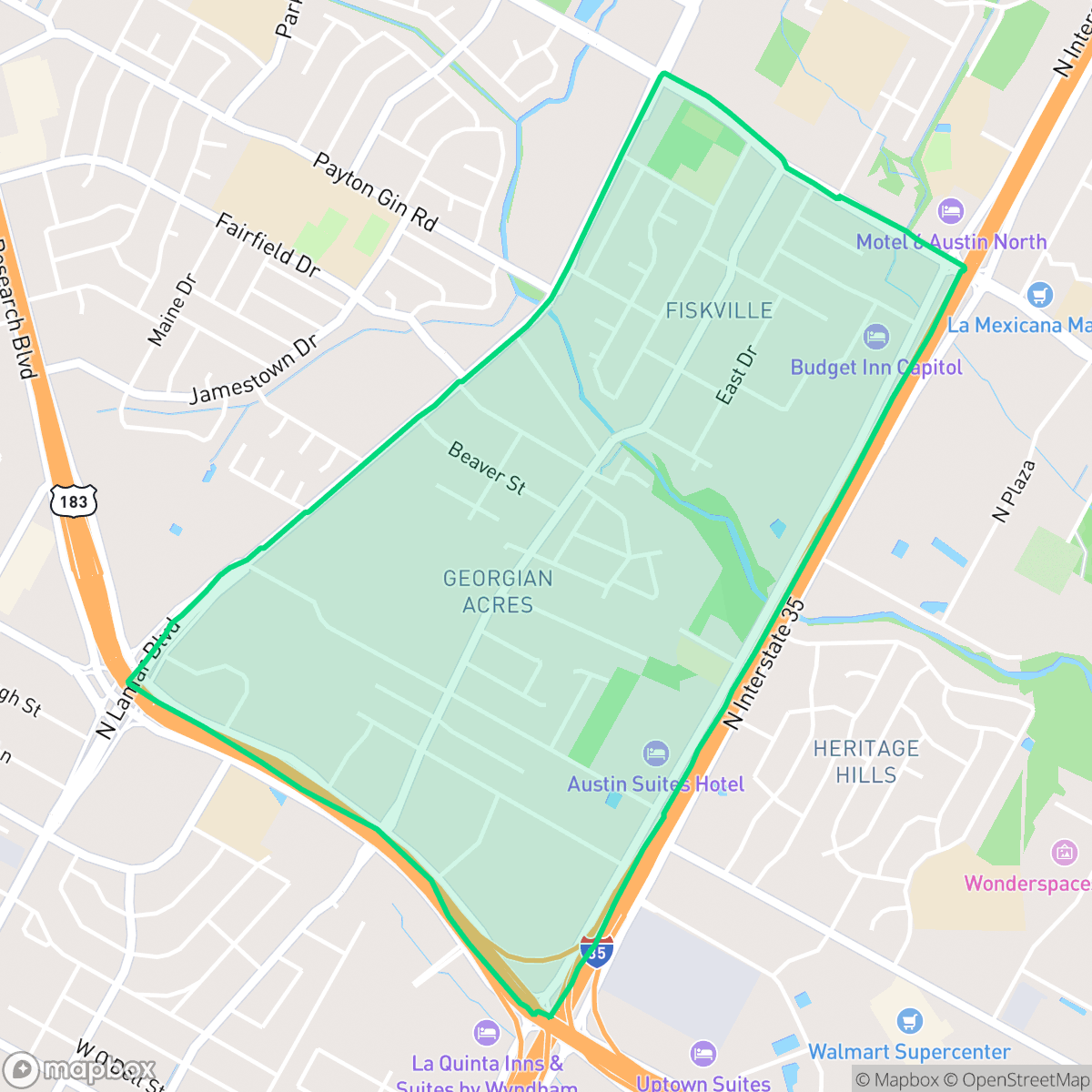
Georgian Acres is a culturally diverse North Austin neighborhood defined by a mix of mid-century suburban homes and multi-family complexes. While the area offers a convenient location near major highway corridors, it is notably car-dependent and exposed to significant traffic noise.
Key Highlights
About Georgian Acres
Bounded by Interstate 35, U.S. Route 183, Lamar Boulevard, and East Rundberg Lane, Georgian Acres in North Austin has a history rooted in the fertile lands surrounding Little Walnut Creek. Historically the territory of the Tonkawa and Comanche, the creek bed was later utilized by early European immigrant farmers and ranchers. Largely unplanned during its early development, the neighborhood was annexed into Austin in stages between 1945 and 1984. Architecturally, the area features mid-century ranch-style single-family homes alongside multi-family housing units built primarily between 1940 and 1999. Since 1990, Georgian Acres has evolved into a vibrant "immigrant gateway," characterized by rich cultural and linguistic diversity, with a prominent Hispanic population alongside notable Arabic- and Jamaican-ancestry communities.
This neighborhood serves as a vibrant cultural hub in North Austin, characterized by its dense mix of residential housing and commercial strips. Residents benefit from close proximity to major transit arteries such as Interstate 35 and Highway 183, which provide direct access to the broader city. The area features a variety of local dining options, including diverse international cuisine, and maintains a distinct suburban atmosphere that balances residential blocks with light industrial and retail zones.
Prospective residents should be aware of specific environmental factors, as iHuus data indicates that the neighborhood experiences high levels of road noise and significant challenges regarding air quality and flood safety. Pedestrian infrastructure remains fragmented, making the area best suited for those who rely on personal vehicles for daily commuting and errands. While the community offers a strong sense of local identity and convenient access to essential services, the lack of extensive public green space and the prevalence of high-traffic commercial zones are important considerations for those prioritizing quiet or outdoor-oriented living.
Neighborhood Scores Across 15 Qualities
Residential spacing varies between dense apartment blocks and detached homes with moderate separation. According to iHuus data, this lack of uniform buffering makes the area slightly less private than much of Austin.
Pedestrian navigation is challenging due to disconnected sidewalks and a high-traffic highway that acts as a major barrier. While residential streets and cul-de-sacs remain relatively safe for walking, the overall connectivity is below the Austin average according to iHuus data.
Uniform rooflines and functional lot layouts characterize this area. The visual landscape is less varied than the Austin average, featuring primarily standard tract housing and mid-range apartment complexes.
Private yards and tree-lined streets provide some space for pets, but the area lacks the large public parks and extensive trail systems found elsewhere in Austin. According to iHuus data, the lack of wide grassy verges and accessible green spaces makes this area less ideal for dog owners compared to the city average.
Open land and woodland pockets provide a more spacious, less dense environment than the typical Austin urban landscape. According to iHuus data, the area features scattered homes and significant greenery compared to the more developed city average.
Diverse dining options and social hubs provide more activity than the typical Austin neighborhood, although the area remains largely car-dependent. According to iHuus data, the presence of light industrial units and suburban greenery creates a balanced mix of suburban life and accessible amenities.
Frequent noise from nearby heavy traffic and transit routes makes this area significantly louder than the Austin average. According to iHuus data, residents may experience consistent acoustic disturbances from a nearby freeway and rail corridor.
Frequent unhealthy air quality levels pose a significant risk to sensitive groups. According to iHuus data, atmospheric conditions in this area are notably worse than the Austin city average.
Residential life is primarily undisturbed by heavy industry, though some areas near larger commercial warehouses may experience increased daytime traffic and noise. According to iHuus data, the presence of large-scale industrial operations is lower here than the city average.
Health insurance access among residents is lower than the Austin average, according to iHuus data. This indicates a higher proportion of uninsured individuals compared to most other parts of the city.
Voting patterns and census indicators in this area reflect a political leaning that is more liberal than the Austin average, according to iHuus data.
Residents will find a balanced mix of young adults, families, and seniors. This demographic spread is slightly more varied than the average seen across Austin.
Significant flood risk exists here due to the neighborhood's location within a 100-year floodplain. According to iHuus data, this area is much more susceptible to flooding than the Austin average, making flood insurance a likely necessity for residents.
Address-Level Insights for Georgian Acres


iHuus Neighborhood Intelligence Insights
Get address-level neighborhood insights for Georgian Acres
- Street-level scores — see how individual blocks compare, not just neighborhood averages
- Micro-zone boundaries — identify quiet pockets, flood boundaries, and walkable clusters before you visit
- 15 dimensions in full — walkability, noise, air quality, school quality, insurance coverage, population age profile, urban/rural index, and more
- Boundary risk alerts — know if your address sits near a block boundary where scores drop, the kind of detail no listing will ever mention
- School insights — individual school ratings and insights, not just district-level data
- Compare before you commit — side-by-side data across neighborhoods, down to block precision
No credit card required
Compare with Any Neighborhood
| Dimension | Georgian Acres | Allandale |
|---|---|---|
| 🚶 Walkabilityavg 6.73 | ||
| 🔊 Acoustic Comfortavg 3.73 | ||
| 🤫 Privacy Indexavg 5.87 | ||
| 🎨 Visual Appealavg 6.95 | ||
| 🐕 Dog Friendlinessavg 6.92 | ||
| 🗺️ Urban-Rural Indexavg 7.09 | ||
| ✨ Neighborhood Vibeavg 4.91 | ||
| 🏥 Health Insurance Coverageavg 7.56 | ||
| 🌿 Air Qualityavg 5.17 | ||
| 🏭 Industrial Proximityavg 8.86 | ||
| 🌊 Flood Safetyavg 4.83 | ||
| 🗳️ Ideological Leanavg 9.13 | ||
| 👥 Population Age Profileavg 4.52 | ||
| 🔥 Fire Safety | ||
| 🏫 School Quality |
Georgian Acres Rankings
School Districts Serving Georgian Acres
School Insights for Georgian Acres
Below average outcomes; significant attendance and academic challenges.
School Insights
See what's really behind every school rating near Georgian Acres
- Individual school ratings — each school's own score with outcome context, not just a district average
- Enrollment & class size data — student-to-teacher ratio and how it compares to the state average
- Full demographics breakdown — ethnicity and gender composition for every school in the enrollment zone
- Every school in the district — all schools within the enrollment boundary ranked by rating, not just the closest one
- Grade levels & benchmarks — elementary through high school, with below/above state-average flags
No credit card required