Garrison Park, Austin
Updated · 13,795 residents
Garrison Park is a peaceful, tree-lined residential community in South Austin defined by its mid-century ranch homes and proximity to extensive green space. With moderate walkability and a quiet atmosphere, the area offers a suburban lifestyle that balances access to local dining with a serene, low-traffic environment.
Key Highlights
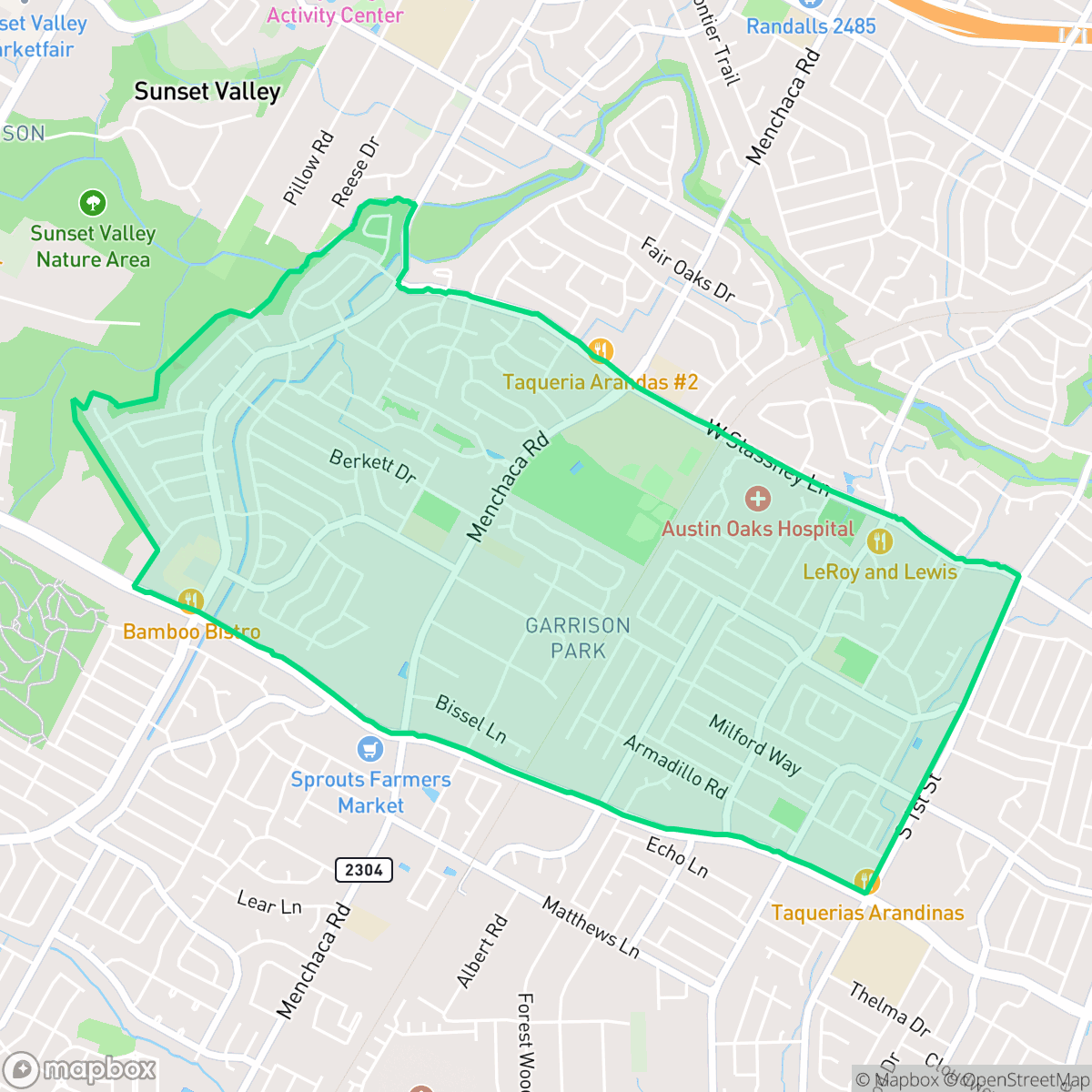
About Garrison Park
Located in South Austin, the Garrison Park neighborhood is centered around the 40-acre James A. Garrison District Park. The park’s land was acquired by the City of Austin in 1961 from the heirs of Thomas Edward Stanley, a pioneer who settled the area in 1849. Tucked within the park is the historic Stanley-Nolen Cemetery, which contains the grave of Holland West Gatlin Stanley, a maternal cousin of Abraham Lincoln. Developed primarily starting in the 1970s, the residential neighborhood is characterized by established mid-century ranch-style homes shaded by mature trees. Today, the area retains its classic South Austin character while welcoming popular local businesses like Leroy and Lewis Barbecue, blending its deep pioneer roots with a vibrant modern community identity.
The neighborhood maintains a distinct suburban character, characterized by a mix of single-family homes and pockets of multi-family housing. Residents benefit from a quiet acoustic environment, with noise levels averaging 58 dB and a complete absence of heavy industrial hazards or large-scale warehouse activity. The streetscape is defined by wide roads and mature tree canopies, which provide significant shade and contribute to the area's visual appeal. Local dining options, such as Leroy and Lewis Barbecue and Cilantro's Mexican Restaurant, provide social hubs for the community, though most commercial amenities remain clustered rather than integrated into every block.
For prospective residents, the area offers a trade-off between suburban tranquility and urban accessibility. While the neighborhood is largely residential and serene, daily errands often require a short drive due to the sparse distribution of businesses. Families are served by the Austin Independent School District, which includes high-performing options like Cunningham Elementary and Wayside Eden Park Academy. The area is best suited for those who prioritize a quiet, green-focused environment and value the stability of an established community over the high-density vibrancy of downtown living.
Neighborhood Scores Across 15 Qualities
Residential spacing is comparable to the Austin average, offering a mix of detached homes with moderate distances between structures. Many lots feature mature tree buffers that provide screening, though some areas in the eastern quadrant have higher density.
Residential streets are generally low-traffic and safe for walking, though heavy tree canopy can occasionally obscure sidewalks or crosswalks. This level of walkability is roughly comparable to the Austin city average according to iHuus data.
Large homes with private pools and well-maintained properties characterize much of the area, though the overall visual appeal sits slightly below the Austin average. Property features vary from affluent estates to standard middle-class tract housing across the neighborhood.
Abundant tree cover and a central wooded corridor provide ample space for outdoor activities. According to iHuus data, the availability of connected green spaces and residential grass verges is slightly below the Austin average.
Dense suburban development characterizes this area, featuring a mix of single-family homes and multi-story apartment complexes. According to iHuus data, the landscape is slightly more developed than the Austin average, showing less open land and fewer rural elements.
Residential life here follows a calm and predictable pace, matching the typical activity levels found across Austin. While various dining options and social spots are scattered throughout the area, most services require a short drive as walkable amenities are relatively sparse.
Local traffic from nearby thoroughfares creates a consistent hum throughout the area. This level of acoustic activity is slightly higher than the Austin average, according to iHuus data.
Frequent unhealthy air quality levels pose significant risks to sensitive groups. According to iHuus data, the air quality in this area is considerably worse than the Austin city average.
Industrial activity and large warehouses are entirely absent from the area. According to iHuus data, this neighborhood is more free of industrial hazards than the Austin average.
Health insurance coverage among residents is slightly below the Austin average. According to iHuus data, most members of the community are covered, though access levels are marginally lower than in other parts of the city.
Voting patterns and census indicators show a very strong liberal leaning that is even more pronounced than the Austin city average, according to iHuus data.
Residents experience a diverse demographic spread ranging from young professionals to older adults. This age distribution is slightly more varied than the typical Austin profile, according to iHuus data.
Flood risk levels in this area are difficult to assess because a detailed federal study has not yet been completed. According to iHuus data, the potential for flooding in Garrison Park is higher than the average for Austin.
Address-Level Insights for Garrison Park


iHuus Neighborhood Intelligence Insights
Get address-level neighborhood insights for Garrison Park
- Street-level scores — see how individual blocks compare, not just neighborhood averages
- Micro-zone boundaries — identify quiet pockets, flood boundaries, and walkable clusters before you visit
- 15 dimensions in full — walkability, noise, air quality, school quality, insurance coverage, population age profile, urban/rural index, and more
- Boundary risk alerts — know if your address sits near a block boundary where scores drop, the kind of detail no listing will ever mention
- School insights — individual school ratings and insights, not just district-level data
- Compare before you commit — side-by-side data across neighborhoods, down to block precision
No credit card required
Compare with Any Neighborhood
| Dimension | Garrison Park | Allandale |
|---|---|---|
| 🚶 Walkabilityavg 6.73 | ||
| 🔊 Acoustic Comfortavg 3.73 | ||
| 🤫 Privacy Indexavg 5.87 | ||
| 🎨 Visual Appealavg 6.95 | ||
| 🐕 Dog Friendlinessavg 6.92 | ||
| 🗺️ Urban-Rural Indexavg 7.09 | ||
| ✨ Neighborhood Vibeavg 4.91 | ||
| 🏥 Health Insurance Coverageavg 7.56 | ||
| 🌿 Air Qualityavg 5.17 | ||
| 🏭 Industrial Proximityavg 8.86 | ||
| 🌊 Flood Safetyavg 4.83 | ||
| 🗳️ Ideological Leanavg 9.13 | ||
| 👥 Population Age Profileavg 4.52 | ||
| 🔥 Fire Safety | ||
| 🏫 School Quality |
Garrison Park Rankings
School Districts Serving Garrison Park
School Insights for Garrison Park
Below average outcomes; significant attendance and academic challenges.
School Insights
See what's really behind every school rating near Garrison Park
- Individual school ratings — each school's own score with outcome context, not just a district average
- Enrollment & class size data — student-to-teacher ratio and how it compares to the state average
- Full demographics breakdown — ethnicity and gender composition for every school in the enrollment zone
- Every school in the district — all schools within the enrollment boundary ranked by rating, not just the closest one
- Grade levels & benchmarks — elementary through high school, with below/above state-average flags
No credit card required