Galindo, Austin
Updated · 5,197 residents
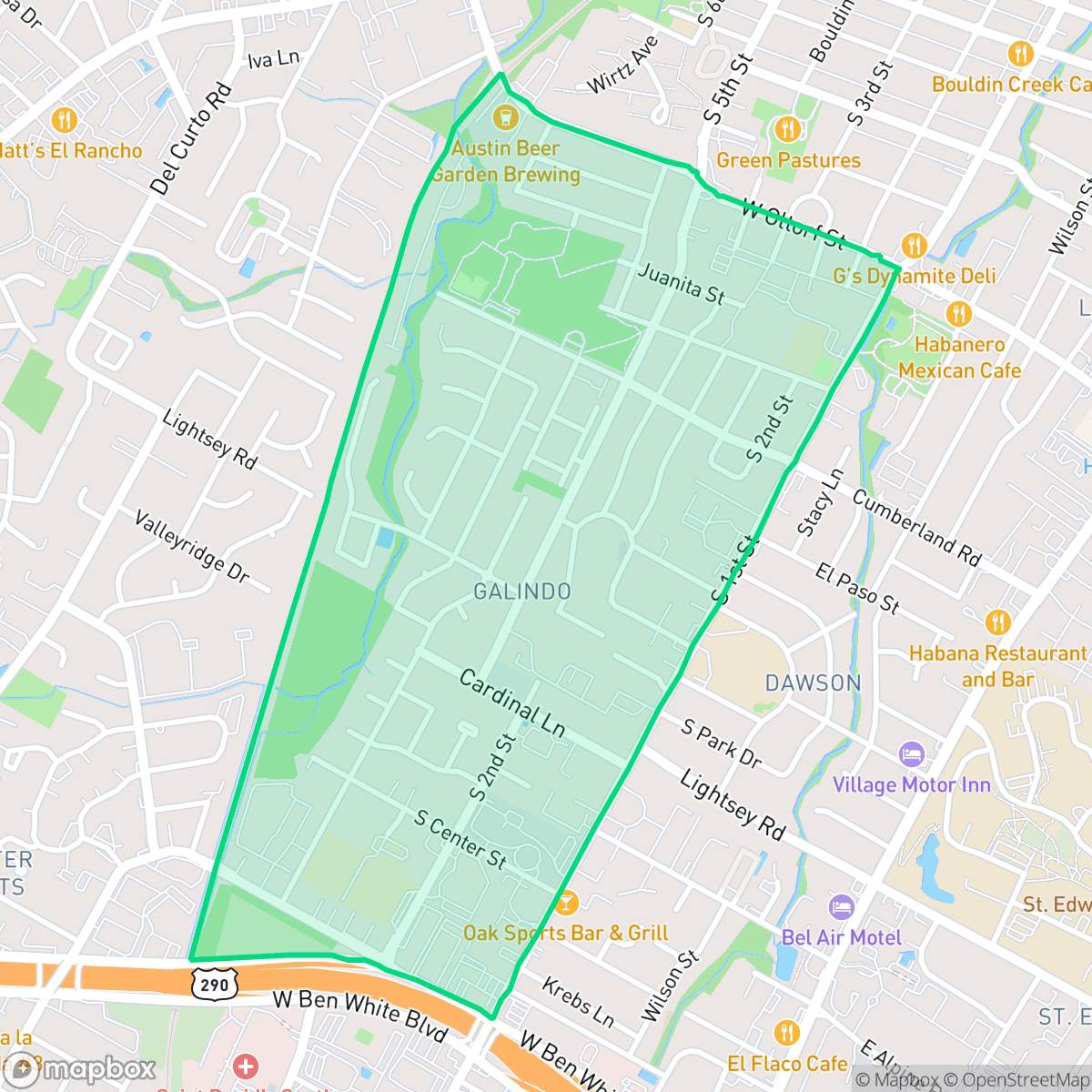
Galindo is a South Austin neighborhood defined by its mid-century ranch-style homes and proximity to the South Austin Tennis Center. While the area offers decent walkability and access to local green spaces, residents often experience higher noise levels due to nearby transit corridors.
Key Highlights
About Galindo
Located in South Austin, the Galindo neighborhood was primarily farmland and woods before its full annexation by the city in 1951. Early residential development began with the Oak Ridge Heights subdivision in 1945, followed by Southwood and La Perla in the 1950s. This era established Galindo’s signature architectural stock of modest, mid-century ranch-style homes and bungalows. A central community anchor is the 11-acre South Austin Park and Recreation Center, opened in 1974 following local activism by resident Velia Sanchez. The park features the South Austin Tennis Center, the only city-owned tennis center south of the Colorado River. In 1996, neighbors organized the Galindo Elementary Neighborhood Association (GENA) under its first president, Rolando Piña, who was famous for hosting grassroots 'Patriotic Porch Parties' to connect residents.
The area maintains a dense suburban character, blending single-family residential streets with various multi-family housing options. According to iHuus data, the neighborhood benefits from a connected grid that supports pedestrian activity, though the presence of major arterial highways introduces significant noise and impacts overall acoustic comfort. The local landscape features a mix of standard tract housing and apartment complexes, providing a variety of living arrangements for a diverse population.
For those considering a move, the neighborhood is well-suited for residents who prioritize proximity to South Austin amenities and community-focused recreation. While the area offers solid dog-friendliness and access to neighborhood parks, prospective residents should be aware of the trade-offs regarding air quality and traffic-related noise. The local elementary school provides a stable educational option, reflecting the broader, complex transition of the Austin Independent School District.
Neighborhood Scores Across 15 Qualities
Residential spacing varies significantly throughout the area, ranging from tightly packed apartment blocks to single-family homes with moderate buffers. This level of privacy is roughly in line with the Austin average, according to iHuus data.
Residential streets feature a consistent sidewalk network and shaded paths that offer better walking conditions than the Austin average. Pedestrian movement is primarily concentrated in the interior streets, as a major high-speed highway limits southern access.
Standard tract housing and dense apartment complexes define the area, providing a mix of uniform rooflines and shared amenities. This visual variety is slightly below the Austin average for aesthetic diversity.
Residential streets feature consistent tree canopies and grassy verges that provide decent walking routes for pets. While some areas include accessible park trails and open green spaces, the overall accessibility is below the Austin average due to limited immediate proximity to large dedicated public parks.
Residential areas feature a mix of single-family homes and multi-story apartment complexes. This landscape feels slightly less developed than the typical Austin urban core, offering a transition between dense city life and more open suburban terrain.
Social activity is higher than the Austin average due to a notable concentration of diverse eateries and local gathering spots. While various dining and coffee hubs provide a lively atmosphere, the area remains largely car-dependent for most errands.
Frequent traffic and transit noise is a notable characteristic of this area due to its proximity to a major freeway and railroad. According to iHuus data, acoustic comfort in Galindo is lower than the Austin average.
Frequent periods of unhealthy air levels pose significant risks to sensitive groups. According to iHuus data, air quality in this area is notably worse than the Austin average.
Heavy industrial activity is minimal here, though some light commercial buildings and utility structures are present. According to iHuus data, the area has slightly more industrial presence than the Austin average.
Health insurance enrollment among Galindo residents is consistent with the Austin city average. According to iHuus data, most people living in this area have access to health coverage.
Voting patterns and census indicators show a deeply progressive political leaning that is even more pronounced than the Austin city average, according to iHuus data.
Residents live alongside a balanced demographic of young professionals, families, and seniors. This age distribution is very similar to the typical profile found across Austin.
Flood risk in this area is slightly higher than the Austin average. According to iHuus data, the lack of a detailed FEMA study means residents should remain cautious during heavy rain events.
Address-Level Insights for Galindo


iHuus Neighborhood Intelligence Insights
Get address-level neighborhood insights for Galindo
- Street-level scores — see how individual blocks compare, not just neighborhood averages
- Micro-zone boundaries — identify quiet pockets, flood boundaries, and walkable clusters before you visit
- 15 dimensions in full — walkability, noise, air quality, school quality, insurance coverage, population age profile, urban/rural index, and more
- Boundary risk alerts — know if your address sits near a block boundary where scores drop, the kind of detail no listing will ever mention
- School insights — individual school ratings and insights, not just district-level data
- Compare before you commit — side-by-side data across neighborhoods, down to block precision
No credit card required
Compare with Any Neighborhood
| Dimension | Galindo | Allandale |
|---|---|---|
| 🚶 Walkabilityavg 6.73 | ||
| 🔊 Acoustic Comfortavg 3.73 | ||
| 🤫 Privacy Indexavg 5.87 | ||
| 🎨 Visual Appealavg 6.95 | ||
| 🐕 Dog Friendlinessavg 6.92 | ||
| 🗺️ Urban-Rural Indexavg 7.09 | ||
| ✨ Neighborhood Vibeavg 4.91 | ||
| 🏥 Health Insurance Coverageavg 7.56 | ||
| 🌿 Air Qualityavg 5.17 | ||
| 🏭 Industrial Proximityavg 8.86 | ||
| 🌊 Flood Safetyavg 4.83 | ||
| 🗳️ Ideological Leanavg 9.13 | ||
| 👥 Population Age Profileavg 4.52 | ||
| 🔥 Fire Safety | ||
| 🏫 School Quality |
Galindo Rankings
School Districts Serving Galindo
School Insights for Galindo
Below average outcomes; significant attendance and academic challenges.
School Insights
See what's really behind every school rating near Galindo
- Individual school ratings — each school's own score with outcome context, not just a district average
- Enrollment & class size data — student-to-teacher ratio and how it compares to the state average
- Full demographics breakdown — ethnicity and gender composition for every school in the enrollment zone
- Every school in the district — all schools within the enrollment boundary ranked by rating, not just the closest one
- Grade levels & benchmarks — elementary through high school, with below/above state-average flags
No credit card required