Easton Park, Austin
Updated · 731 residents
Easton Park is a master-planned community in Southeast Austin defined by its extensive green spaces, interconnected trail systems, and a focus on outdoor recreation. While the neighborhood offers higher-than-average acoustic comfort and excellent dog-friendliness, residents generally rely on personal vehicles to access local businesses and amenities.
Key Highlights
About Easton Park
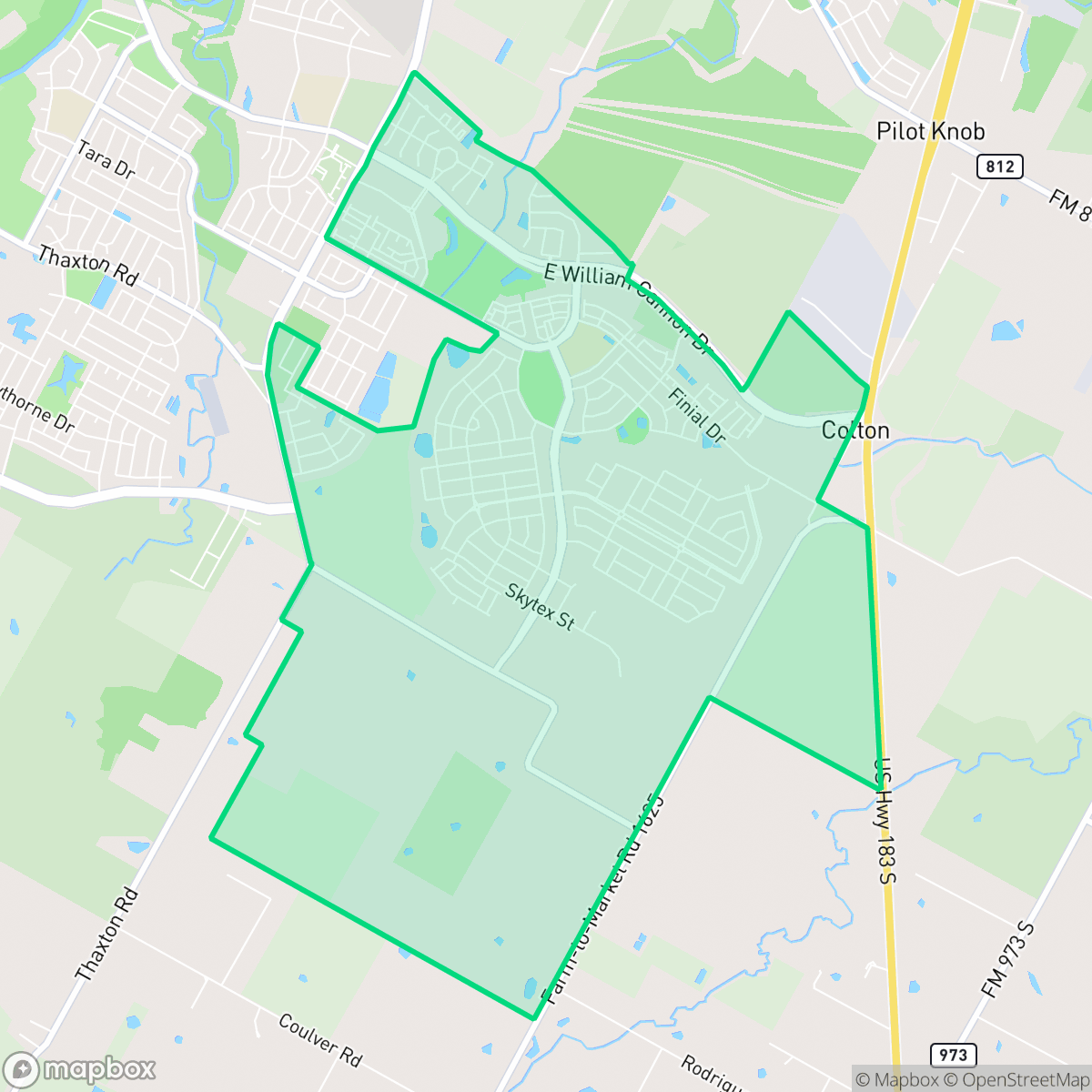
Easton Park is a 2,700-acre master-planned community in Southeast Austin, built on land historically owned by the Collins family. Patriarch Newton Isaac Collins Sr., a formerly enslaved master carpenter, became one of the first African American landowners in Texas and built local schools in the late 1800s. His legacy is honored by the neighborhood's Newton Collins Elementary School, which opened in 2018. Developed by Brookfield Residential, Easton Park broke ground in 2016 at Bryant Park. The community is designed around extensive green spaces and interconnected trails. It features unique local landmarks, including a retired "Austin Dillo" trolley converted into a play structure at Knob Hill Park, and lies adjacent to Pilot Knob, an extinct, 80-million-year-old volcanic cluster.
The neighborhood functions as a quiet, low-density residential area that blends suburban living with significant open space. It features a mix of modern residential blocks and natural landscapes, including proximity to the geological landmark Pilot Knob. According to iHuus data, the area maintains a high level of acoustic comfort compared to the broader Austin region, providing a tranquil environment for those who prioritize peace and quiet over high-density urban activity. While the community provides a serene atmosphere, it is best suited for those who do not mind a car-dependent lifestyle. Daily errands and local dining options are present but scattered, requiring travel beyond the immediate residential blocks. The local school, Newton Collins Elementary, serves as a high-performing anchor for families, though prospective residents should note the broader challenges facing the Del Valle Independent School District. The area is particularly well-suited for dog owners and those seeking an active outdoor lifestyle, provided they are comfortable with the trade-offs of a developing suburban landscape.
Neighborhood Scores Across 15 Qualities
Residential lots feature significant separation between homes, providing more seclusion than the average Austin neighborhood. According to iHuus data, this area offers greater privacy due to the larger distances between neighboring properties.
Sidewalks and safe crossings facilitate easy movement on foot, offering better walkability than the Austin average according to iHuus data.
Residential views consist of traditional tract housing with modest yards and simple rooflines. According to iHuus data, the visual variety in this area is lower than the Austin average.
Abundant green spaces and wide, traffic-safe paths make this area more accommodating for pets than much of Austin. According to iHuus data, the connected trail systems provide reliable environments for walking dogs.
Vast open fields and natural scrubland characterize this area. According to iHuus data, the landscape features significantly more low-density structures and unpaved terrain than the Austin average.
Low-density residential blocks and scattered industrial pockets create a serene but largely automobile-dependent environment. This area lacks the concentrated commercial energy found in much of Austin, as most dining and social hubs require a vehicle to access.
Steady traffic sounds from a nearby busy street are present. According to iHuus data, acoustic comfort in this area is notably higher than the Austin average.
Air quality in this area fluctuates between acceptable and unhealthy levels. According to iHuus data, the air quality here is lower than the Austin city average, which may cause occasional concern for sensitive groups.
Residential life here is undisturbed by warehouses, heavy machinery, or hazardous facilities. This neighborhood matches the city average for being purely residential and free from industrial proximity.
Health insurance enrollment among residents is lower than the average seen across Austin. According to iHuus data, a significant portion of the population remains uninsured.
Political leanings in this area are strongly liberal, though slightly less so than the Austin city average according to iHuus data.
Residents inhabit a varied demographic landscape consisting of young adults, families, and older populations. This age distribution is slightly more concentrated toward a single demographic than the Austin average, according to iHuus data.
Residual flood risk exists within this area due to its location in a 500-year floodplain. According to iHuus data, flood safety levels here are notably higher than the Austin city average.
Address-Level Insights for Easton Park


iHuus Neighborhood Intelligence Insights
Get address-level neighborhood insights for Easton Park
- Street-level scores — see how individual blocks compare, not just neighborhood averages
- Micro-zone boundaries — identify quiet pockets, flood boundaries, and walkable clusters before you visit
- 15 dimensions in full — walkability, noise, air quality, school quality, insurance coverage, population age profile, urban/rural index, and more
- Boundary risk alerts — know if your address sits near a block boundary where scores drop, the kind of detail no listing will ever mention
- School insights — individual school ratings and insights, not just district-level data
- Compare before you commit — side-by-side data across neighborhoods, down to block precision
No credit card required
Compare with Any Neighborhood
| Dimension | Easton Park | Allandale |
|---|---|---|
| 🚶 Walkabilityavg 6.73 | ||
| 🔊 Acoustic Comfortavg 3.73 | ||
| 🤫 Privacy Indexavg 5.87 | ||
| 🎨 Visual Appealavg 6.95 | ||
| 🐕 Dog Friendlinessavg 6.92 | ||
| 🗺️ Urban-Rural Indexavg 7.09 | ||
| ✨ Neighborhood Vibeavg 4.91 | ||
| 🏥 Health Insurance Coverageavg 7.56 | ||
| 🌿 Air Qualityavg 5.17 | ||
| 🏭 Industrial Proximityavg 8.86 | ||
| 🌊 Flood Safetyavg 4.83 | ||
| 🗳️ Ideological Leanavg 9.13 | ||
| 👥 Population Age Profileavg 4.52 | ||
| 🔥 Fire Safety | ||
| 🏫 School Quality |
Easton Park Rankings
School Districts Serving Easton Park
School Insights for Easton Park
Below average outcomes; significant attendance and academic challenges.
School Insights
See what's really behind every school rating near Easton Park
- Individual school ratings — each school's own score with outcome context, not just a district average
- Enrollment & class size data — student-to-teacher ratio and how it compares to the state average
- Full demographics breakdown — ethnicity and gender composition for every school in the enrollment zone
- Every school in the district — all schools within the enrollment boundary ranked by rating, not just the closest one
- Grade levels & benchmarks — elementary through high school, with below/above state-average flags
No credit card required