East Cesar Chavez, Austin
Updated · 4,451 residents
East Cesar Chavez is a high-energy, culturally rich neighborhood in Austin known for its vibrant dining scene and high walkability. Residents enjoy close proximity to the waterfront and a dense, urban environment that balances historic character with modern development.
Key Highlights
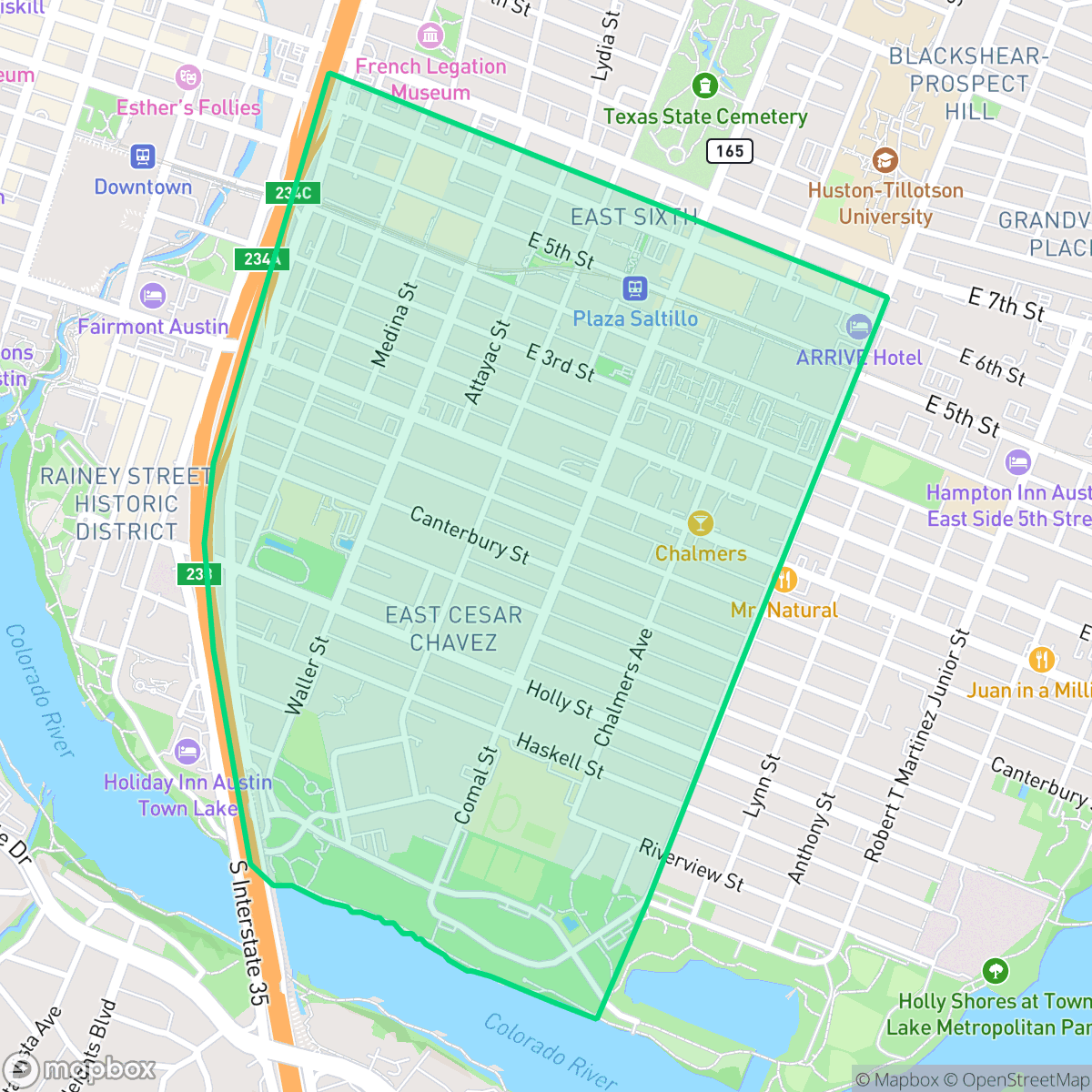
About East Cesar Chavez
As one of Austin’s oldest neighborhoods, East Cesar Chavez was originally settled by freed African Americans after the Emancipation Proclamation and was known as Masontown. In the 1880s, Eastern European immigrants arrived, building Victorian-style homes. By the early 20th century, the area transitioned into a vibrant, working-class Mexican American enclave. This cultural identity was solidified by landmarks like Cristo Rey Catholic Church, which became a hub for the 1960s Chicano labor movement, and the historic Willow-Spence Streets Historic District, which showcases National Folk and Craftsman architecture. The neighborhood is also home to the historic Scoot Inn, established in 1871. Today, the neighborhood's rich heritage is preserved and celebrated along the National Recreation Trail-designated Tejano Walking Trail.
The area functions as a central hub for Austin's social life, characterized by a dense mix of mid-rise apartments, local eateries, and popular coffee shops. Its layout promotes a pedestrian-friendly lifestyle, with grid-based streets that connect residents to both the downtown core and nearby recreational spaces along the river. According to iHuus data, the neighborhood maintains a strong sense of place, blending its deep-rooted cultural identity with a modern, high-energy atmosphere that attracts a diverse demographic of urban professionals and long-term residents.
Living here involves certain trade-offs, particularly regarding acoustic comfort and school performance. While the neighborhood offers excellent access to amenities, road traffic contributes to higher noise levels compared to quieter suburban districts. Prospective residents should also note that local schools, including Martin Middle and Sanchez Elementary, currently face significant performance challenges. Despite these factors, the area remains a desirable location for those prioritizing walkability and immediate access to the city's most active social and culinary corridors as highlighted by iHuus research.
Neighborhood Scores Across 15 Qualities
Residential spacing is comparable to the Austin average, featuring a mix of detached homes with moderate buffers and denser apartment complexes with shared walls. According to iHuus data, privacy varies depending on whether you are located near single-family residences or multi-unit developments.
Pedestrian accessibility is strong due to a grid street pattern and visible sidewalks. According to iHuus data, walking ease in this area is notably higher than the Austin average.
A mix of historic bungalows and modern, high-density complexes creates a diverse streetscape. According to iHuus data, the visual landscape is slightly less polished than the Austin average due to standard urban density and smaller lot sizes.
Abundant access to Lady Bird Lake trails and local green pockets provides much better opportunities for dog walking than the Austin average. According to iHuus data, the presence of large public parks and safe, connected paths makes this area highly suitable for pet owners.
Streetscapes feature a blend of single-family homes and low-rise apartments with a distribution of green space and infrastructure that is less dense than the Austin average. This mix of residential and commercial structures creates a transitional environment between dense urban cores and suburban layouts.
Diverse dining and social hubs create a high-energy atmosphere that is significantly more active than the Austin average. Residents can access a variety of local destinations ranging from coffee shops to established restaurants, though some areas remain car-dependent near major highways.
Consistent noise from nearby thoroughfares is present; this level of acoustic activity is slightly higher than the Austin average.
Air quality fluctuates between acceptable and unhealthy levels, presenting occasional risks for sensitive groups. According to iHuus data, conditions here are slightly lower than the Austin city average.
Residential life remains largely undisturbed by heavy industry, as the area consists primarily of housing, light commercial zones, and green spaces. While a rail corridor and electrical substation are present, the lack of significant industrial activity is very similar to the Austin average.
Health insurance accessibility is slightly above the Austin average, according to iHuus data. Most residents in this area have access to comprehensive medical coverage.
Voting patterns and census indicators show a predominantly liberal political landscape that is more pronounced than the Austin city average, according to iHuus data.
A balanced mix of young professionals, families, and older residents characterizes the area. According to iHuus data, this demographic spread is slightly more varied than the Austin average.
Flood safety levels in East Cesar Chavez are notably higher than the Austin average, though some residual risk exists due to proximity to the 500-year floodplain. Residents should remain aware of localized drainage patterns during extreme weather events.
Address-Level Insights for East Cesar Chavez


iHuus Neighborhood Intelligence Insights
Get address-level neighborhood insights for East Cesar Chavez
- Street-level scores — see how individual blocks compare, not just neighborhood averages
- Micro-zone boundaries — identify quiet pockets, flood boundaries, and walkable clusters before you visit
- 15 dimensions in full — walkability, noise, air quality, school quality, insurance coverage, population age profile, urban/rural index, and more
- Boundary risk alerts — know if your address sits near a block boundary where scores drop, the kind of detail no listing will ever mention
- School insights — individual school ratings and insights, not just district-level data
- Compare before you commit — side-by-side data across neighborhoods, down to block precision
No credit card required
Compare with Any Neighborhood
| Dimension | East Cesar Chavez | Allandale |
|---|---|---|
| 🚶 Walkabilityavg 6.73 | ||
| 🔊 Acoustic Comfortavg 3.73 | ||
| 🤫 Privacy Indexavg 5.87 | ||
| 🎨 Visual Appealavg 6.95 | ||
| 🐕 Dog Friendlinessavg 6.92 | ||
| 🗺️ Urban-Rural Indexavg 7.09 | ||
| ✨ Neighborhood Vibeavg 4.91 | ||
| 🏥 Health Insurance Coverageavg 7.56 | ||
| 🌿 Air Qualityavg 5.17 | ||
| 🏭 Industrial Proximityavg 8.86 | ||
| 🌊 Flood Safetyavg 4.83 | ||
| 🗳️ Ideological Leanavg 9.13 | ||
| 👥 Population Age Profileavg 4.52 | ||
| 🔥 Fire Safety | ||
| 🏫 School Quality |
East Cesar Chavez Rankings
School Districts Serving East Cesar Chavez
School Insights for East Cesar Chavez
Below average outcomes; significant attendance and academic challenges.
School Insights
See what's really behind every school rating near East Cesar Chavez
- Individual school ratings — each school's own score with outcome context, not just a district average
- Enrollment & class size data — student-to-teacher ratio and how it compares to the state average
- Full demographics breakdown — ethnicity and gender composition for every school in the enrollment zone
- Every school in the district — all schools within the enrollment boundary ranked by rating, not just the closest one
- Grade levels & benchmarks — elementary through high school, with below/above state-average flags
No credit card required