Downtown, Austin
Updated · 10,664 residents
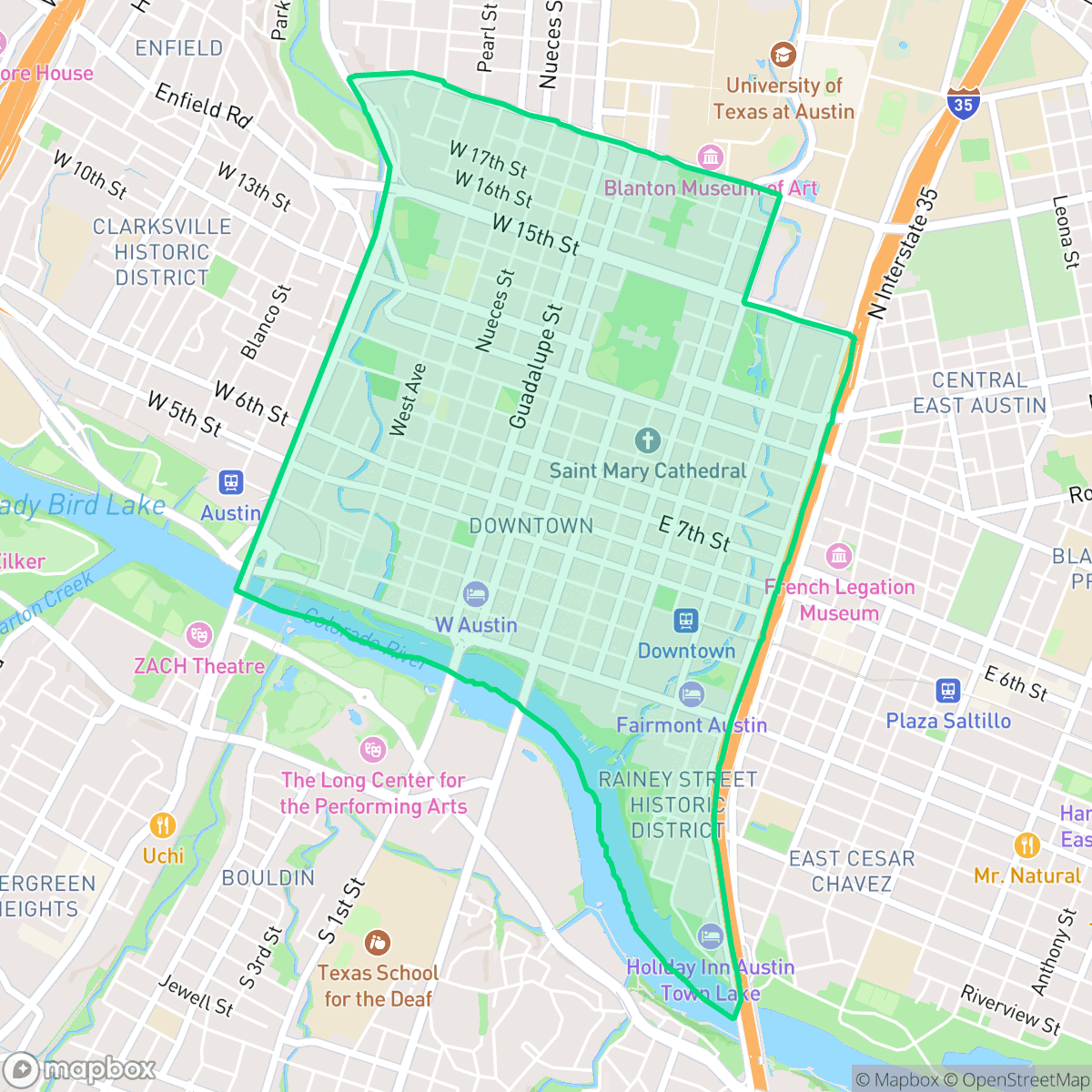
Downtown Austin is a high-energy urban core defined by its grid layout, dense high-rise architecture, and proximity to the Colorado River. It offers exceptional walkability and immediate access to diverse dining, cultural landmarks, and public green spaces. Residents experience a bustling environment with significant road noise and limited privacy due to the high-density nature of the district.
Key Highlights
About Downtown
Laid out in 1839 by Edwin Waller under the direction of Republic of Texas President Mirabeau B. Lamar, Downtown Austin was designed as a 640-acre grid situated on a bluff above the Colorado River. Waller platted Congress Avenue as the central axis, running north to the Texas State Capitol. Historically, the neighborhood developed as a commercial and civic hub, anchored by historic public squares like Republic and Wooldridge. Its rich architectural legacy features Late Victorian commercial buildings along the Sixth Street Historic District, the Romanesque Revival Driskill Hotel (1886), and early 20th-century landmarks like the Paramount Theatre (1915) and the Littlefield Building (1910). By the early 20th century, the neighborhood boasted diverse ethnic businesses, evolving from a dusty frontier outpost into a vibrant cultural and economic center.
The area functions as the primary commercial and cultural engine of the city, characterized by its dense concentration of high-rise residential towers, government offices, and entertainment venues. According to iHuus data, the neighborhood maintains a high level of connectivity for those prioritizing walkability and immediate access to amenities like the Lady Bird Lake trail system and various museums. The streetscape is dominated by a mix of modern glass towers and historic commercial architecture, creating a vibrant, concrete-heavy environment that remains active throughout the day and night.
Prospective residents should anticipate a fast-paced lifestyle where the benefits of a central location are balanced against the realities of urban living. Acoustic comfort is moderate, as road traffic remains a constant presence, and the high-density design means that private outdoor space is often limited to shared building amenities. While the neighborhood provides excellent access to parks and dog-friendly trails, it is best suited for individuals who prefer proximity to transit and entertainment over the quiet of a suburban setting.
Neighborhood Scores Across 15 Qualities
Urban density and close proximity to large multi-story structures result in lower privacy levels than the Austin average. While some areas feature mature tree buffers, many residents live in high-density buildings with shared walls or minimal physical separation from neighbors.
Wide sidewalks, marked crosswalks, and pedestrian-priority trails make navigating this area on foot exceptionally easy. According to iHuus data, the dense grid and low-traffic interior streets offer much higher walkability than the Austin average.
Modern high-rises with rooftop amenities and high-quality architecture provide a visually elevated environment that is more polished than the Austin average. According to iHuus data, the area features a mix of significant institutional buildings and upscale residential features like large balconies and manicured grounds.
Abundant green spaces along the river and within the urban grid offer excellent exercise areas for pets. According to iHuus data, these connected parks and wide walking paths provide significantly more pet-friendly space than the Austin average.
High-rise structures and significant commercial density characterize this area, resulting in a much more built-up environment than the city average. Residents will experience a dense urban landscape featuring large institutional buildings and major highway infrastructure.
Constant movement and a dense concentration of commercial attractions create an environment far more active than the Austin average. Residents can expect a high-energy landscape defined by dense high-rises, diverse dining, and significant pedestrian activity.
Persistent street noise from local traffic is common here, though levels remain slightly above the Austin average according to iHuus data.
Air quality levels in this area fluctuate between acceptable and unhealthy, specifically for sensitive groups. According to iHuus data, the air quality here is slightly better than the Austin city average.
Industrial activity and heavy warehouses are entirely absent from this area. According to iHuus data, the neighborhood consists exclusively of residential, commercial, and institutional spaces, providing a cleaner environment than the city average.
Health insurance access among residents is notably lower than the Austin city average. According to iHuus data, a significant portion of the population lacks coverage.
Voting patterns and census indicators reflect a deeply liberal political landscape that is even more pronounced than the Austin city average.
Residents primarily consist of young adults, representing a slightly younger age profile than the Austin average. This demographic trend results in a concentrated population of working professionals rather than a heavy presence of families or seniors.
Frequent flood risk exists here as parts of the area fall within the 100-year floodplain; according to iHuus data, this level of vulnerability is significantly higher than the Austin average.
Address-Level Insights for Downtown


iHuus Neighborhood Intelligence Insights
Get address-level neighborhood insights for Downtown
- Street-level scores — see how individual blocks compare, not just neighborhood averages
- Micro-zone boundaries — identify quiet pockets, flood boundaries, and walkable clusters before you visit
- 15 dimensions in full — walkability, noise, air quality, school quality, insurance coverage, population age profile, urban/rural index, and more
- Boundary risk alerts — know if your address sits near a block boundary where scores drop, the kind of detail no listing will ever mention
- School insights — individual school ratings and insights, not just district-level data
- Compare before you commit — side-by-side data across neighborhoods, down to block precision
No credit card required
Compare with Any Neighborhood
| Dimension | Downtown | Allandale |
|---|---|---|
| 🚶 Walkabilityavg 6.73 | ||
| 🔊 Acoustic Comfortavg 3.73 | ||
| 🤫 Privacy Indexavg 5.87 | ||
| 🎨 Visual Appealavg 6.95 | ||
| 🐕 Dog Friendlinessavg 6.92 | ||
| 🗺️ Urban-Rural Indexavg 7.09 | ||
| ✨ Neighborhood Vibeavg 4.91 | ||
| 🏥 Health Insurance Coverageavg 7.56 | ||
| 🌿 Air Qualityavg 5.17 | ||
| 🏭 Industrial Proximityavg 8.86 | ||
| 🌊 Flood Safetyavg 4.83 | ||
| 🗳️ Ideological Leanavg 9.13 | ||
| 👥 Population Age Profileavg 4.52 | ||
| 🔥 Fire Safety | ||
| 🏫 School Quality |
Downtown Rankings
School Districts Serving Downtown
School Insights for Downtown
Below average outcomes; significant attendance and academic challenges.
School Insights
See what's really behind every school rating near Downtown
- Individual school ratings — each school's own score with outcome context, not just a district average
- Enrollment & class size data — student-to-teacher ratio and how it compares to the state average
- Full demographics breakdown — ethnicity and gender composition for every school in the enrollment zone
- Every school in the district — all schools within the enrollment boundary ranked by rating, not just the closest one
- Grade levels & benchmarks — elementary through high school, with below/above state-average flags
No credit card required