Dawson, Austin
Updated · 3,588 residents
Dawson is a highly walkable South Austin enclave defined by its mix of mid-century bungalows and modern apartment complexes. Residents benefit from a lively local dining scene and proximity to major corridors, though the area experiences notable noise levels from regional road traffic.
Key Highlights
About Dawson
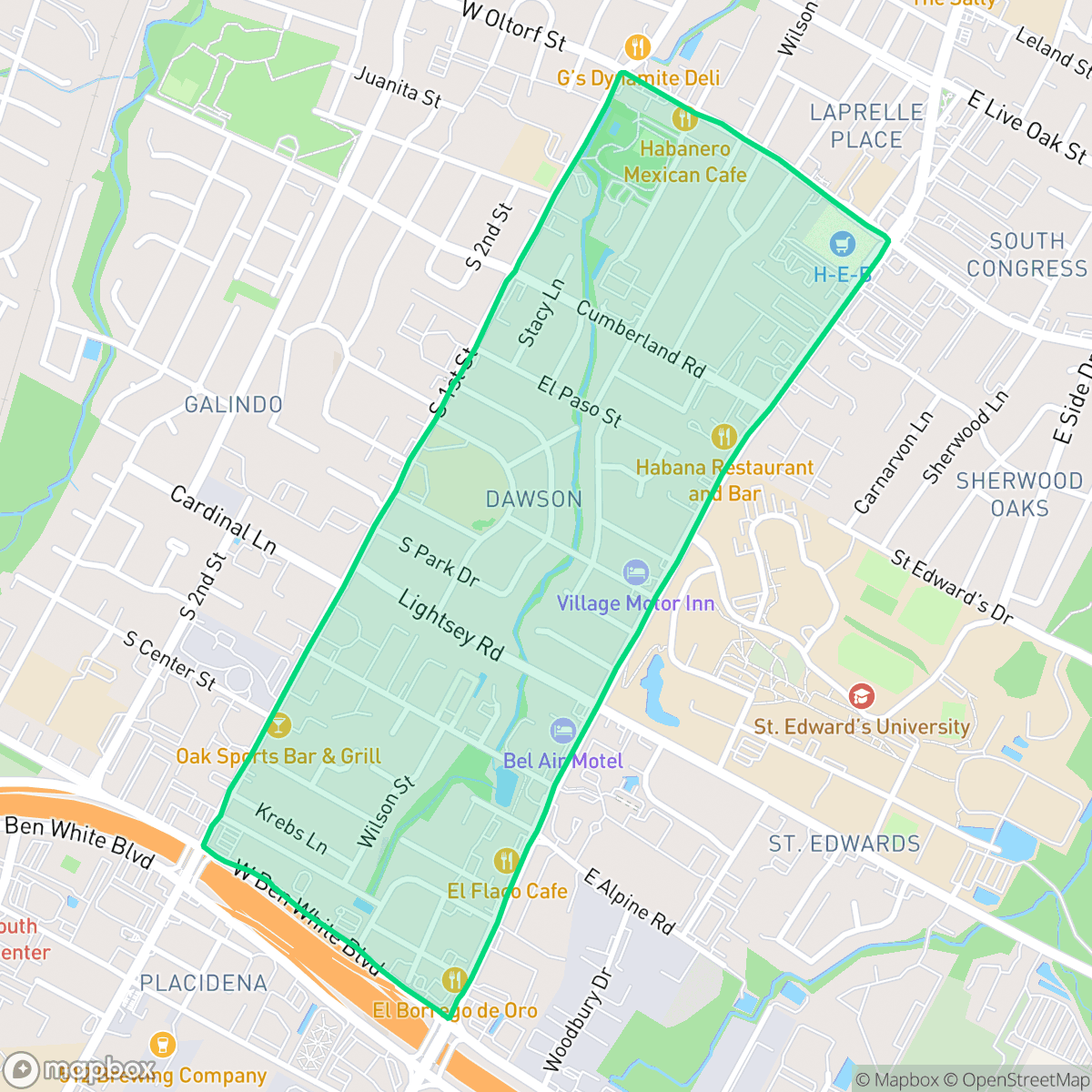
Bounded by Oltorf Road, Ben White Boulevard, South 1st Street, and South Congress Avenue, Austin’s Dawson neighborhood emerged in the mid-20th century as a residential suburb of mid-century bungalows. The neighborhood is named after Dawson Elementary School, which opened in 1954 and was named for pioneer educator Mary Jane "Mollie" Dawson. In the 1970s, the school pioneered South Austin's first bilingual and progressive education programs, with future First Lady Laura Bush serving as its librarian. In 1994, residents formed the Dawson Neighborhood Association to protect the East Bouldin Creek watershed from highway runoff. This activism led to Dawson becoming the first Austin neighborhood to adopt an official master plan under the city’s pilot program in 1998. Today, the community maintains its retro residential character, anchored by Gillis Neighborhood Park.
This neighborhood offers a dense, urban-suburban atmosphere that appeals to those seeking convenience and a strong sense of community. Its layout features a clear grid of residential streets with consistent sidewalk access, making it one of the more walkable areas in the city. The local culture is bolstered by a diverse array of eateries and cafes, such as Taste of Ethiopia II and El Tacorrido, which provide vibrant social hubs for residents. The area maintains a progressive character and high levels of health insurance coverage, reflecting the stable, active population that characterizes this part of South Austin.
Prospective residents should weigh the benefits of this central location against specific environmental trade-offs. The neighborhood experiences higher ambient noise levels due to its proximity to major thoroughfares like Ben White Boulevard and Oltorf Road. Additionally, air quality metrics remain lower than the city average, and the local elementary school currently faces significant performance challenges within the broader Austin Independent School District. It is best suited for individuals or small households who prioritize walkability and access to urban amenities over quiet seclusion or expansive private outdoor space.
Neighborhood Scores Across 15 Qualities
Building proximity varies significantly across the area, ranging from dense apartment blocks and dormitory clusters to single-family homes with moderate spacing. According to iHuus data, this level of privacy is roughly consistent with the Austin average.
Residential streets feature a navigable grid with sidewalks and tree cover, though a major high-speed highway restricts pedestrian movement through the southern edge. Pedestrian connectivity is slightly below the Austin average due to these high-traffic arterial boundaries.
Standard tract housing and apartment complexes define the landscape, offering modest yards and shared amenities. This area is less visually varied than the Austin average, featuring primarily utilitarian architecture and consistent roof geometries.
Abundant green belts and wooded patches provide decent walking areas for pets, though the area is slightly below the Austin average for dog friendliness. Wide grassy verges and residential lawns are common, but proximity to the highway may impact safety during outdoor activities.
A mix of low-rise residential pockets and open greenery provides a more relaxed environment than the more densely urbanized parts of Austin. According to iHuus data, the area features a blend of multi-family housing and significant landscape coverage that feels less developed than the city average.
Social activity and dining variety are notably higher here than the Austin average. While the area features a diverse selection of local eateries and coffee shops, the suburban layout remains primarily car-dependent.
Constant noise from nearby freeways and rail lines makes this area significantly louder than the Austin average. Residents can expect frequent acoustic disturbances due to the proximity of major transit corridors.
Frequent unhealthy air quality levels pose a significant risk to sensitive groups. According to iHuus data, the air quality in Dawson is notably worse than the Austin average.
Largely residential and commercial in nature, this area contains some light utility and warehouse structures but lacks the heavy industrial presence found more frequently elsewhere in Austin. According to iHuus data, residents can expect mostly low-impact commercial activity with no significant hazardous infrastructure nearby.
Health insurance coverage among residents is consistent with the Austin average. According to iHuus data, most people living in this area have access to employer or private medical coverage.
Voting patterns and census indicators show a highly progressive political climate that is more liberal than the Austin average, according to iHuus data.
A varied mix of young adults, families, and seniors characterizes the area. This demographic spread is slightly lower than the Austin city average, according to iHuus data.
Flood risk in this area is difficult to determine because FEMA has not completed a detailed study for this neighborhood. According to iHuus data, the level of risk appears slightly higher than the Austin average.
Address-Level Insights for Dawson


iHuus Neighborhood Intelligence Insights
Get address-level neighborhood insights for Dawson
- Street-level scores — see how individual blocks compare, not just neighborhood averages
- Micro-zone boundaries — identify quiet pockets, flood boundaries, and walkable clusters before you visit
- 15 dimensions in full — walkability, noise, air quality, school quality, insurance coverage, population age profile, urban/rural index, and more
- Boundary risk alerts — know if your address sits near a block boundary where scores drop, the kind of detail no listing will ever mention
- School insights — individual school ratings and insights, not just district-level data
- Compare before you commit — side-by-side data across neighborhoods, down to block precision
No credit card required
Compare with Any Neighborhood
| Dimension | Dawson | Allandale |
|---|---|---|
| 🚶 Walkabilityavg 6.73 | ||
| 🔊 Acoustic Comfortavg 3.73 | ||
| 🤫 Privacy Indexavg 5.87 | ||
| 🎨 Visual Appealavg 6.95 | ||
| 🐕 Dog Friendlinessavg 6.92 | ||
| 🗺️ Urban-Rural Indexavg 7.09 | ||
| ✨ Neighborhood Vibeavg 4.91 | ||
| 🏥 Health Insurance Coverageavg 7.56 | ||
| 🌿 Air Qualityavg 5.17 | ||
| 🏭 Industrial Proximityavg 8.86 | ||
| 🌊 Flood Safetyavg 4.83 | ||
| 🗳️ Ideological Leanavg 9.13 | ||
| 👥 Population Age Profileavg 4.52 | ||
| 🔥 Fire Safety | ||
| 🏫 School Quality |
Dawson Rankings
School Districts Serving Dawson
School Insights for Dawson
Below average outcomes; significant attendance and academic challenges.
School Insights
See what's really behind every school rating near Dawson
- Individual school ratings — each school's own score with outcome context, not just a district average
- Enrollment & class size data — student-to-teacher ratio and how it compares to the state average
- Full demographics breakdown — ethnicity and gender composition for every school in the enrollment zone
- Every school in the district — all schools within the enrollment boundary ranked by rating, not just the closest one
- Grade levels & benchmarks — elementary through high school, with below/above state-average flags
No credit card required