Coronado Hills, Austin
Updated · 4,232 residents
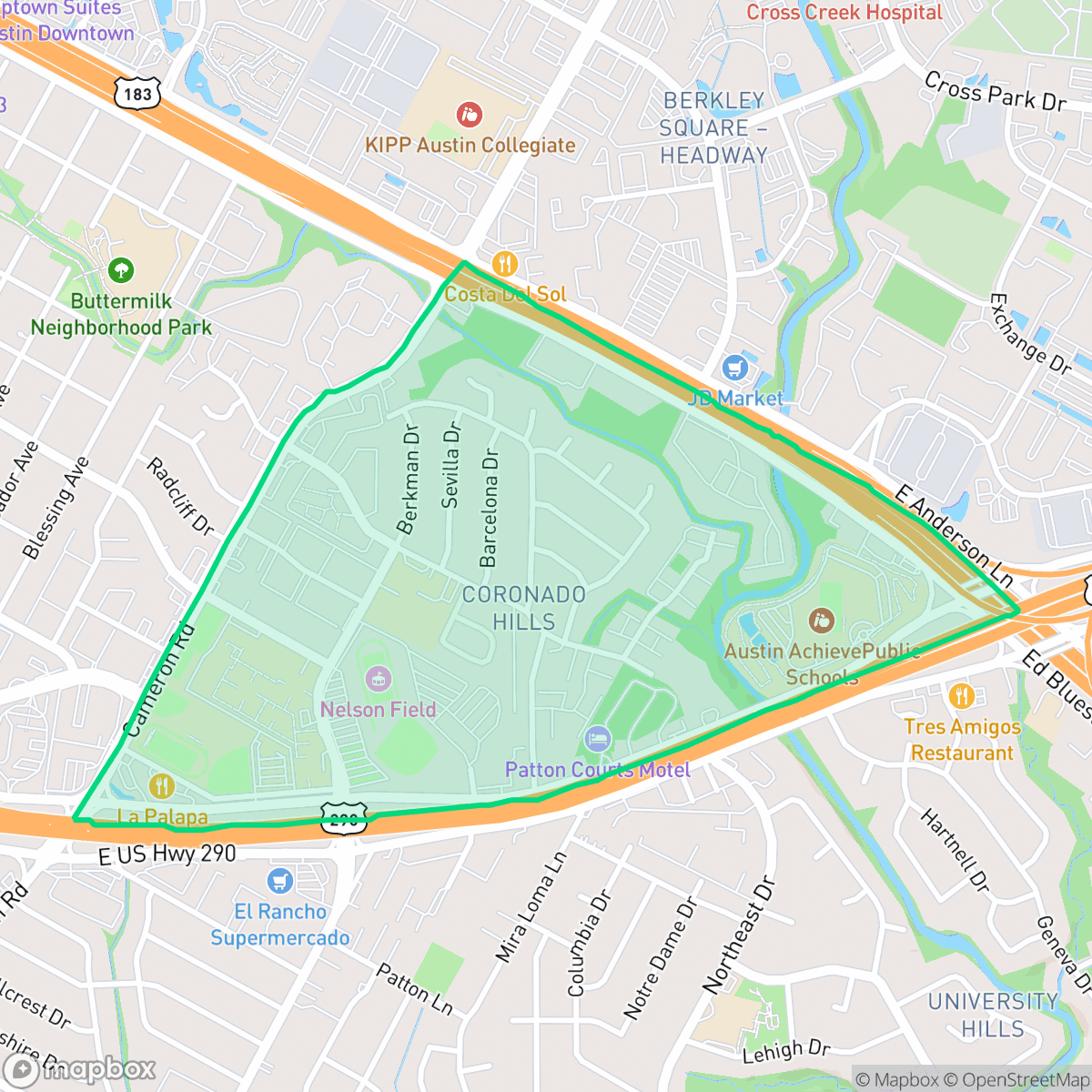
Coronado Hills is a diverse, transit-oriented neighborhood in Northeast Austin featuring a mix of mid-century suburban homes and multi-family complexes. While the area offers high walkability and abundant green space for pets, residents should expect significant noise levels due to its proximity to major highway corridors.
Key Highlights
About Coronado Hills
Before its mid-century development, the land comprising Coronado Hills in Northeast Austin served as rural farm and pasture land for dairy cattle, a history preserved in the name of Buttermilk Creek, which flows through the area. The neighborhood emerged during the 1960s and 1970s suburban housing boom. Anticipating this rapid residential growth, the Austin Independent School District built Reagan High School (now Northeast Early College High School) in 1965, which quickly established a strong reputation for academics and athletics. Today, Coronado Hills is bounded by major transit corridors, including US Route 290 and Highway 183, and is characterized by its late 20th-century residential housing stock, high renter population, and rich cultural diversity.
The neighborhood functions as a dense suburban hub characterized by its location near US Route 290 and Highway 183. This position provides residents with convenient access to regional transit routes, though it contributes to elevated ambient noise levels. The area maintains a balanced urban and rural feel, with residential streets interspersed with institutional facilities and local dining options. According to iHuus data, the community benefits from high rates of health insurance coverage and a strong sense of ideological cohesion among its residents.
Prospective residents will find a neighborhood that prioritizes accessibility and community amenities over quiet seclusion. The presence of expansive athletic fields and local parks makes the area suitable for dog owners and active individuals. While the local school landscape is varied, with options ranging from specialized early college programs to traditional campuses, the area remains a practical choice for those seeking a central location within the Austin metropolitan area. The neighborhood requires a trade-off between its central connectivity and the acoustic impact of nearby highway traffic.
Neighborhood Scores Across 15 Qualities
Residential spacing varies between single-family homes and shared-wall apartment blocks, resulting in slightly less privacy than the Austin average. According to iHuus data, homes are often situated within a few meters of neighbors.
Continuous sidewalks and low-traffic streets provide a safer environment for pedestrians than the Austin average. While the southern highway acts as a barrier, many residential and commercial needs can be met on foot according to iHuus data.
Uniform tract housing and mid-density apartment complexes define the landscape, offering less visual variety than the Austin average. Residential lots are typically modest with small yards and shared community amenities.
Residential lawns and nearby athletic fields offer decent areas for exercise, though the neighborhood falls below the Austin average for accessible green verges. Walking routes feature continuous sidewalks, but the lack of wide grassy strips or immediate park access is noted in iHuus data.
Frequent open land and scattered homes amid woodland characterize this area. The landscape feels more open and less densely urbanized than the Austin average, according to iHuus data.
Local dining spots and social hubs provide a noticeable level of activity, making this area more lively than the Austin average. While the neighborhood offers a suburban feel with plenty of green space, the presence of light industrial units and highway proximity means much of the energy is centered around specific roadside destinations.
Frequent noise from nearby major roadways and transit corridors makes this area louder than most of Austin. According to iHuus data, residents can expect significant acoustic disturbances due to the neighborhood's proximity to heavy traffic patterns.
Air quality in this area fluctuates between acceptable and unhealthy levels, which is slightly lower than the Austin average. Sensitive groups may experience occasional concern during periods of poor air quality according to iHuus data.
Residential and light commercial uses dominate the area with very few heavy industrial hazards. This landscape is slightly cleaner than the Austin average, as noted by iHuus data regarding the lack of significant industrial stacks or heavy manufacturing.
Health insurance access remains consistent with the Austin average. According to iHuus data, a majority of residents in this area are covered.
Voting patterns and census indicators show a much more liberal leaning than the Austin average, according to iHuus data.
Residents live alongside a balanced variety of young adults, families, and older individuals. This demographic spread is consistent with the broader Austin area according to iHuus data.
Flood risk in this area is significantly higher than the Austin average. Properties are located within a designated floodplain, which typically necessitates the purchase of flood insurance.
Address-Level Insights for Coronado Hills


iHuus Neighborhood Intelligence Insights
Get address-level neighborhood insights for Coronado Hills
- Street-level scores — see how individual blocks compare, not just neighborhood averages
- Micro-zone boundaries — identify quiet pockets, flood boundaries, and walkable clusters before you visit
- 15 dimensions in full — walkability, noise, air quality, school quality, insurance coverage, population age profile, urban/rural index, and more
- Boundary risk alerts — know if your address sits near a block boundary where scores drop, the kind of detail no listing will ever mention
- School insights — individual school ratings and insights, not just district-level data
- Compare before you commit — side-by-side data across neighborhoods, down to block precision
No credit card required
Compare with Any Neighborhood
| Dimension | Coronado Hills | Allandale |
|---|---|---|
| 🚶 Walkabilityavg 6.73 | ||
| 🔊 Acoustic Comfortavg 3.73 | ||
| 🤫 Privacy Indexavg 5.87 | ||
| 🎨 Visual Appealavg 6.95 | ||
| 🐕 Dog Friendlinessavg 6.92 | ||
| 🗺️ Urban-Rural Indexavg 7.09 | ||
| ✨ Neighborhood Vibeavg 4.91 | ||
| 🏥 Health Insurance Coverageavg 7.56 | ||
| 🌿 Air Qualityavg 5.17 | ||
| 🏭 Industrial Proximityavg 8.86 | ||
| 🌊 Flood Safetyavg 4.83 | ||
| 🗳️ Ideological Leanavg 9.13 | ||
| 👥 Population Age Profileavg 4.52 | ||
| 🔥 Fire Safety | ||
| 🏫 School Quality |
Coronado Hills Rankings
School Districts Serving Coronado Hills
School Insights for Coronado Hills
Below average outcomes; significant attendance and academic challenges.
School Insights
See what's really behind every school rating near Coronado Hills
- Individual school ratings — each school's own score with outcome context, not just a district average
- Enrollment & class size data — student-to-teacher ratio and how it compares to the state average
- Full demographics breakdown — ethnicity and gender composition for every school in the enrollment zone
- Every school in the district — all schools within the enrollment boundary ranked by rating, not just the closest one
- Grade levels & benchmarks — elementary through high school, with below/above state-average flags
No credit card required