Chestnut, Austin
Updated · 2,157 residents
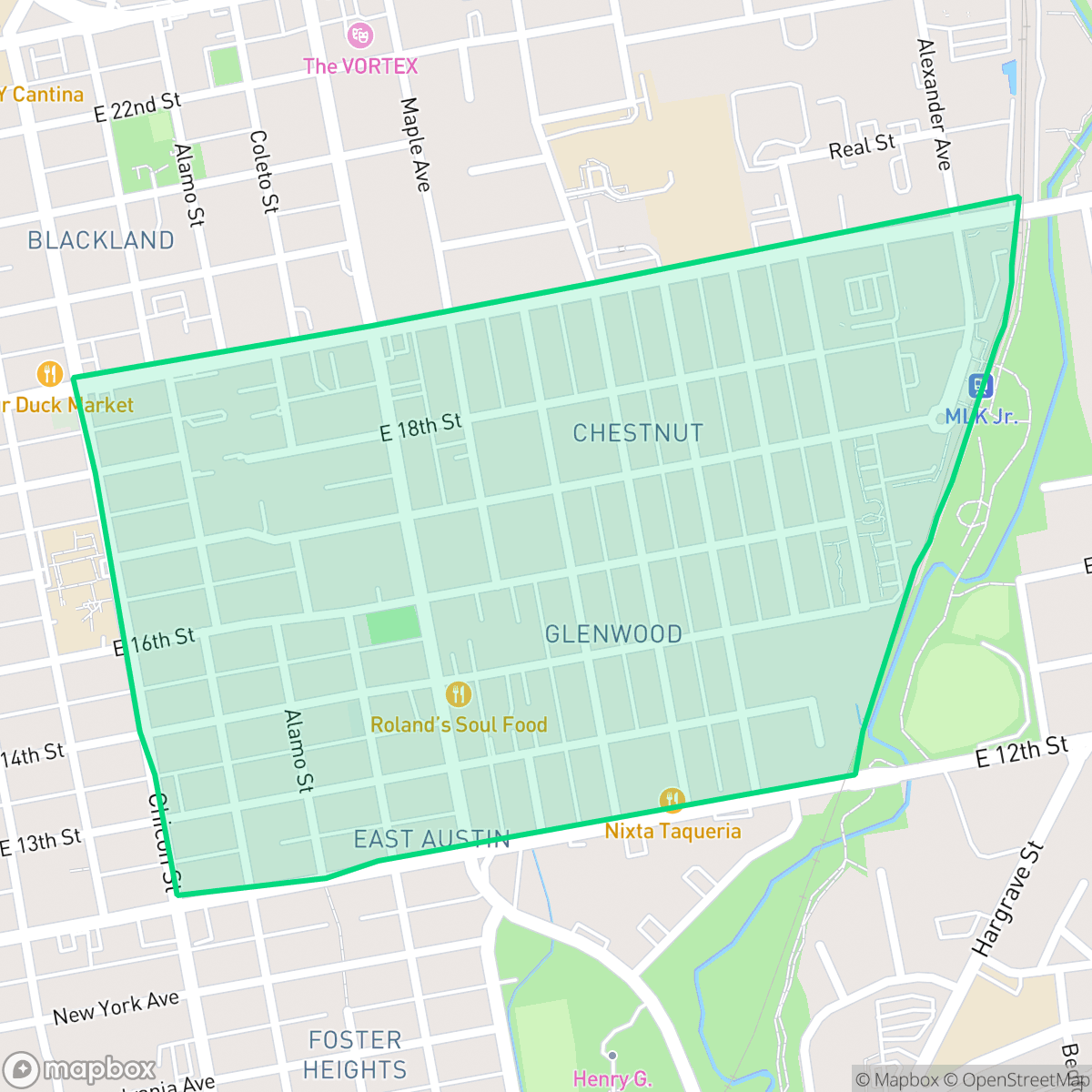
Chestnut is a vibrant East Austin enclave known for its historic Craftsman-style homes and a lively, community-focused atmosphere. Residents benefit from high walkability and proximity to popular local eateries, though the area experiences moderate noise levels from nearby road traffic.
Key Highlights
About Chestnut
Established during Reconstruction as a freedman's community, the Chestnut neighborhood in East Austin evolved into a thriving cultural and commercial hub for Black residents, particularly after the city’s 1928 master plan enforced segregation. The neighborhood’s historic streetcar line terminated at 12th and Chicon, a bustling intersection once anchored by Black-owned businesses like the Harlem Theater, Yates Drug Store, and Galloway’s Barber Shop. Originally agricultural, featuring sites like the Meyers goat farm, Chestnut transitioned to industrial use in the mid-20th century. In the 1970s and 1980s, local activists successfully campaigned to remove the polluting Featherlite cement factory. Today, Chestnut is characterized by historic Craftsman bungalows, a legacy of community resilience, and ongoing preservation efforts by organizations like the Chestnut Neighborhood Revitalization Corporation.
The area serves as a dense suburban hub characterized by its grid-pattern streets and a collection of single-family residences. It maintains a distinct identity driven by local institutions like Bennu Coffee, Nixta Taqueria, and El Coqui, which contribute to a higher-than-average level of local activity. The neighborhood layout encourages pedestrian movement, making it a convenient choice for those who prefer to navigate their surroundings on foot.
Prospective residents should consider that the area presents specific trade-offs regarding acoustic comfort and pet amenities. While the residential streets are generally quiet, ambient noise from road traffic is a consistent factor. Additionally, the neighborhood features limited public park space, which may impact pet owners who rely on nearby green areas. Families should also note that the local school district is currently navigating significant budgetary and operational transitions.
Neighborhood Scores Across 15 Qualities
Residential spacing provides a moderate level of separation between neighbors. Houses are typically positioned with consistent setbacks and backyard fencing, resulting in a privacy level that is comparable to the Austin average.
Pedestrians benefit from continuous sidewalk networks and frequent crosswalks near local parks and schools. This level of accessibility is significantly higher than the Austin city average according to iHuus data.
Uniform rooflines and modest yards characterize this area. According to iHuus data, the neighborhood features less visual variety and fewer private luxury amenities than the Austin average.
Access to large public parks and wooded walking paths is available, though some areas feature narrower sidewalks and more private green space. According to iHuus data, the area is slightly below the Austin average for pet-friendly infrastructure.
Open land and woodland are frequently interspersed with scattered homes, providing a setting that is less urbanized than the Austin average according to iHuus data.
Concentrated clusters of coffee shops, local eateries, and community hubs create a social atmosphere that is notably more active than the Austin average. According to iHuus data, these lively blocks offer a diverse mix of dining and green spaces alongside more quiet, suburban residential streets.
Steady sounds from nearby busy streets are present, though the level of acoustic disturbance is slightly higher than the Austin average.
Air quality levels in Chestnut are consistent with the Austin average, featuring a mix of acceptable and unhealthy days. Sensitive groups should remain aware of occasional concerns for respiratory health according to iHuus data.
Industrial activity is virtually nonexistent here, as the area consists almost entirely of residential and light commercial spaces. According to iHuus data, this lack of heavy industry and warehouses makes the neighborhood even quieter than the Austin average.
Health insurance accessibility is high in this area, with coverage rates sitting above the Austin average according to iHuus data.
Voting patterns and census indicators show a deeply liberal political leaning that is even more pronounced than the Austin average, according to iHuus data.
A balanced mix of young adults, families, and older residents characterizes the area. This demographic spread is roughly in line with the average across Austin.
Flood risk levels in this area are difficult to assess because official FEMA studies for this neighborhood have not been completed. According to iHuus data, the level of certainty regarding flood safety is slightly lower than the Austin average.
Address-Level Insights for Chestnut


iHuus Neighborhood Intelligence Insights
Get address-level neighborhood insights for Chestnut
- Street-level scores — see how individual blocks compare, not just neighborhood averages
- Micro-zone boundaries — identify quiet pockets, flood boundaries, and walkable clusters before you visit
- 15 dimensions in full — walkability, noise, air quality, school quality, insurance coverage, population age profile, urban/rural index, and more
- Boundary risk alerts — know if your address sits near a block boundary where scores drop, the kind of detail no listing will ever mention
- School insights — individual school ratings and insights, not just district-level data
- Compare before you commit — side-by-side data across neighborhoods, down to block precision
No credit card required
Compare with Any Neighborhood
| Dimension | Chestnut | Allandale |
|---|---|---|
| 🚶 Walkabilityavg 6.73 | ||
| 🔊 Acoustic Comfortavg 3.73 | ||
| 🤫 Privacy Indexavg 5.87 | ||
| 🎨 Visual Appealavg 6.95 | ||
| 🐕 Dog Friendlinessavg 6.92 | ||
| 🗺️ Urban-Rural Indexavg 7.09 | ||
| ✨ Neighborhood Vibeavg 4.91 | ||
| 🏥 Health Insurance Coverageavg 7.56 | ||
| 🌿 Air Qualityavg 5.17 | ||
| 🏭 Industrial Proximityavg 8.86 | ||
| 🌊 Flood Safetyavg 4.83 | ||
| 🗳️ Ideological Leanavg 9.13 | ||
| 👥 Population Age Profileavg 4.52 | ||
| 🔥 Fire Safety | ||
| 🏫 School Quality |
Chestnut Rankings
School Districts Serving Chestnut
School Insights for Chestnut
Below average outcomes; significant attendance and academic challenges.
School Insights
See what's really behind every school rating near Chestnut
- Individual school ratings — each school's own score with outcome context, not just a district average
- Enrollment & class size data — student-to-teacher ratio and how it compares to the state average
- Full demographics breakdown — ethnicity and gender composition for every school in the enrollment zone
- Every school in the district — all schools within the enrollment boundary ranked by rating, not just the closest one
- Grade levels & benchmarks — elementary through high school, with below/above state-average flags
No credit card required