Central East Austin, Austin
Updated · 4,982 residents
Central East Austin is a high-energy neighborhood defined by its exceptional walkability and a vibrant mix of local eateries and cultural landmarks. Residents enjoy a dense grid of streets that provide easy access to community parks and diverse dining, though the area experiences moderate noise levels due to its proximity to major traffic corridors.
Key Highlights
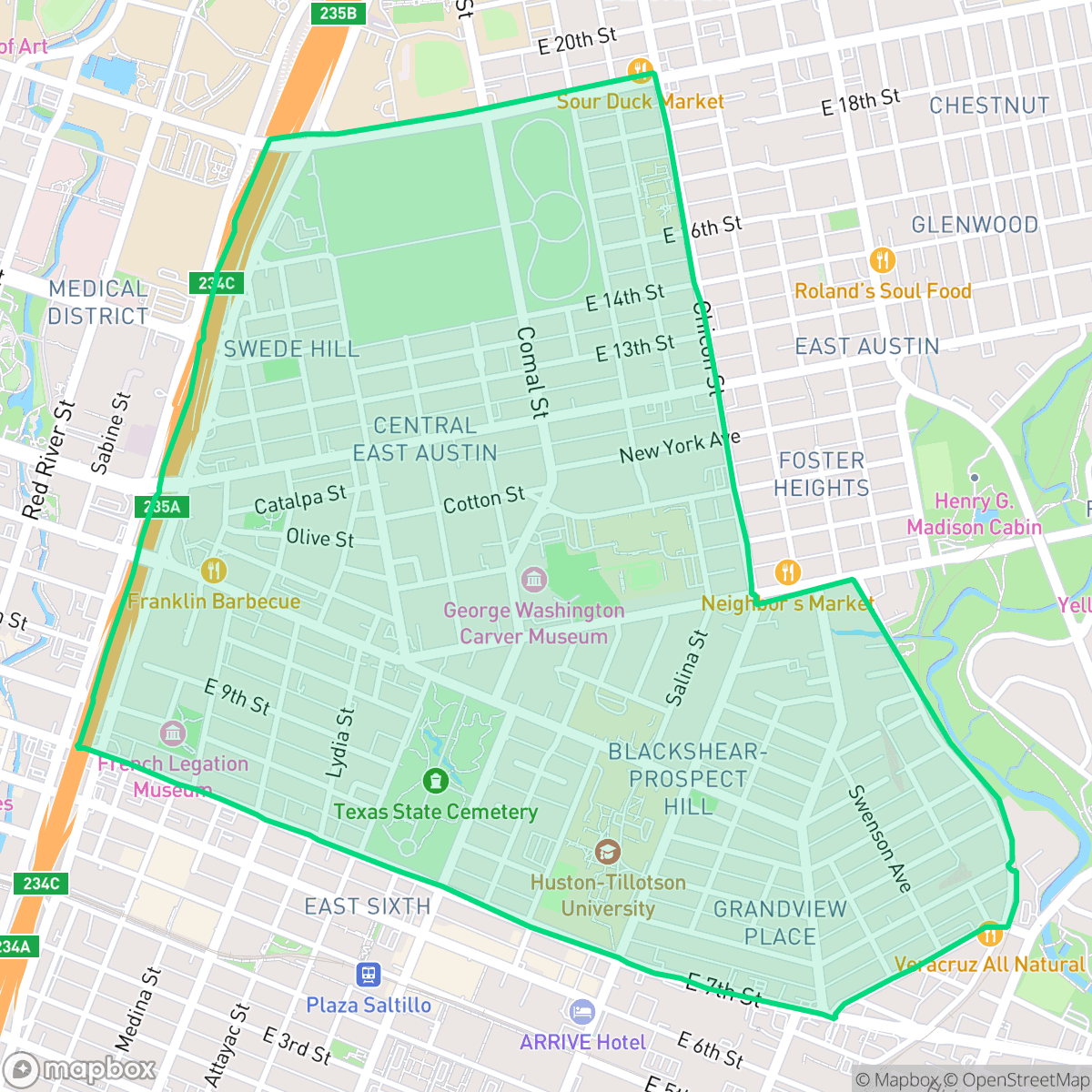
About Central East Austin
Central East Austin’s identity was profoundly shaped by Austin's 1928 city plan, which established East Avenue (now Interstate 35) as a racial dividing line, forcing African American residents to relocate to the east side. Despite this forced segregation, the neighborhood became a thriving hub of Black culture, commerce, and education. It is home to Huston-Tillotson University, Austin’s oldest institution of higher learning, and the historic Victory Grill, a legendary stop on the Chitlin’ Circuit. Other notable landmarks include the George Washington Carver Museum, the 1841 French Legation, and the Swedish Hill Historic District. Today, the nonprofit Six Square works to preserve the neighborhood's rich African American heritage amid ongoing gentrification.
This neighborhood serves as a dynamic hub where historic roots meet modern urban living. The area maintains a high level of walkability, allowing residents to easily access popular local spots such as Nickel City, Sour Duck Market, and various independent coffee shops. The streetscape is characterized by a dense grid of residential homes and institutional buildings, fostering a sense of community engagement. With multiple public parks and green spaces, the district offers ample room for outdoor recreation and remains a focal point for those seeking an active, central lifestyle.
Prospective residents should consider the specific trade-offs of living in such a central, high-traffic location. According to iHuus data, the area experiences moderate noise levels, largely attributed to road traffic near the highway. While the neighborhood is primarily residential and free from industrial hazards, the air quality and noise environment reflect its urban position. Families may also weigh the mixed performance of the Austin Independent School District, which offers both high-performing campuses like Kealing Middle School alongside broader institutional challenges facing the district.
Neighborhood Scores Across 15 Qualities
Residential spacing varies between dense multi-story developments and traditional houses with moderate setbacks. Privacy levels are slightly lower than the Austin average due to the presence of high-density structures and closer neighbor proximity in certain pockets.
Pedestrian navigation is efficient due to a dense grid pattern and frequent marked crosswalks. This neighborhood offers significantly better walkability than the Austin average, featuring sidewalk networks that support safe movement near parks and schools.
Uniform rooflines and small yards define this area, which offers less visual variety than the Austin average. While the institutional core features high-quality architecture, most residential pockets consist of standard middle-class density with few private luxury amenities.
Access to large public parks and expansive green spaces provides reliable areas for pet exercise. According to iHuus data, the level of dog friendliness is roughly in line with the Austin city average.
A blend of single-family homes and large-scale institutional structures creates a landscape with more greenery and open space than the dense urban core of Austin. According to iHuus data, this area offers a balance of suburban-style streets and high-density infrastructure.
Dense urban infrastructure and diverse local destinations create a much more active atmosphere than the Austin average. Residents have access to a wide variety of dining, parks, and cultural landmarks within a concentrated, vibrant landscape.
Steady sound from nearby busy streets creates a consistent background hum. This level of acoustic activity is slightly higher than the Austin average.
Air quality levels in this area fluctuate between acceptable and unhealthy, often presenting occasional concerns for sensitive groups. According to iHuus data, these conditions are slightly higher than the Austin average.
Industrial activity is nonexistent in this area, providing a clean urban environment characterized by residential, educational, and institutional uses. According to iHuus data, this lack of heavy industry and warehouse facilities is notably better than the Austin average.
Health insurance access among residents is lower than the Austin city average, according to iHuus data. This indicates a higher proportion of uninsured individuals compared to most other parts of the city.
Voting patterns and census indicators reflect a very liberal political leaning that is even more pronounced than the Austin city average, according to iHuus data.
Residents live alongside a balanced spread of young adults, families, and older populations. This demographic distribution is largely in line with the broader Austin area, according to iHuus data.
Residual flood risk exists within certain areas of the neighborhood, though the safety level remains notably higher than the Austin average according to iHuus data.
Address-Level Insights for Central East Austin


iHuus Neighborhood Intelligence Insights
Get address-level neighborhood insights for Central East Austin
- Street-level scores — see how individual blocks compare, not just neighborhood averages
- Micro-zone boundaries — identify quiet pockets, flood boundaries, and walkable clusters before you visit
- 15 dimensions in full — walkability, noise, air quality, school quality, insurance coverage, population age profile, urban/rural index, and more
- Boundary risk alerts — know if your address sits near a block boundary where scores drop, the kind of detail no listing will ever mention
- School insights — individual school ratings and insights, not just district-level data
- Compare before you commit — side-by-side data across neighborhoods, down to block precision
No credit card required
Compare with Any Neighborhood
| Dimension | Central East Austin | Allandale |
|---|---|---|
| 🚶 Walkabilityavg 6.73 | ||
| 🔊 Acoustic Comfortavg 3.73 | ||
| 🤫 Privacy Indexavg 5.87 | ||
| 🎨 Visual Appealavg 6.95 | ||
| 🐕 Dog Friendlinessavg 6.92 | ||
| 🗺️ Urban-Rural Indexavg 7.09 | ||
| ✨ Neighborhood Vibeavg 4.91 | ||
| 🏥 Health Insurance Coverageavg 7.56 | ||
| 🌿 Air Qualityavg 5.17 | ||
| 🏭 Industrial Proximityavg 8.86 | ||
| 🌊 Flood Safetyavg 4.83 | ||
| 🗳️ Ideological Leanavg 9.13 | ||
| 👥 Population Age Profileavg 4.52 | ||
| 🔥 Fire Safety | ||
| 🏫 School Quality |
Central East Austin Rankings
School Districts Serving Central East Austin
School Insights for Central East Austin
Below average outcomes; significant attendance and academic challenges.
School Insights
See what's really behind every school rating near Central East Austin
- Individual school ratings — each school's own score with outcome context, not just a district average
- Enrollment & class size data — student-to-teacher ratio and how it compares to the state average
- Full demographics breakdown — ethnicity and gender composition for every school in the enrollment zone
- Every school in the district — all schools within the enrollment boundary ranked by rating, not just the closest one
- Grade levels & benchmarks — elementary through high school, with below/above state-average flags
No credit card required