Brentwood, Austin
Updated · 9,649 residents
Brentwood is a well-established Austin community defined by its mid-century residential character and a strong sense of local identity. It provides residents with a blend of suburban tranquility and convenient access to diverse dining options, supported by highly-rated local schools and a walkable grid layout.
Key Highlights
About Brentwood
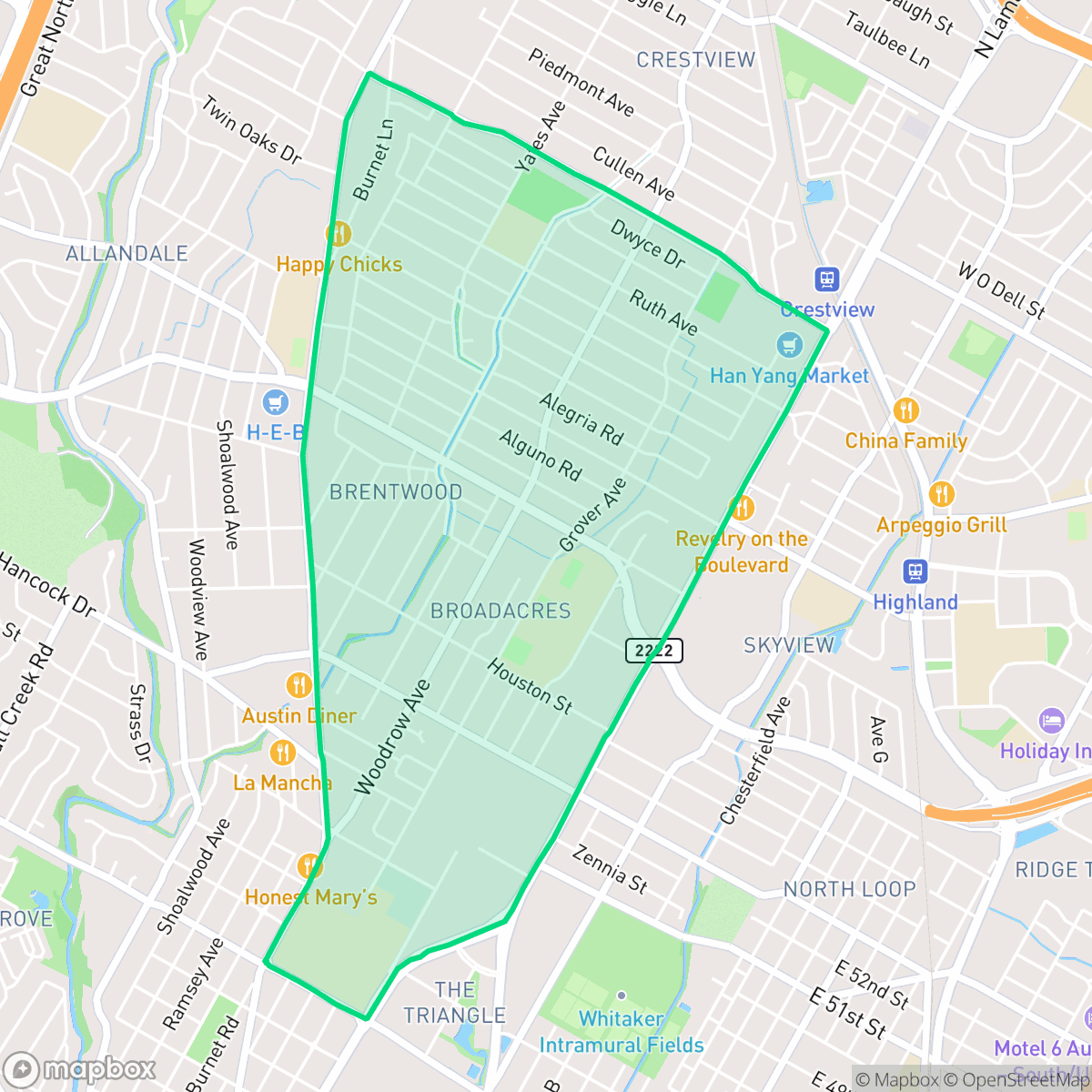
Once a cotton and dairy farm on Austin's northern outskirts, Brentwood was annexed by the city in 1946 and rapidly developed in the late 1940s and 1950s. Financed largely by the G.I. Bill, returning World War II veterans purchased the neighborhood's signature mid-century, single-story bungalow and ranch-style homes. In 1951, the city purchased a former cornfield from the local Pease family to establish Brentwood Elementary School and the adjacent nine-acre Brentwood Park. The neighborhood is defined by Arroyo Seco, a central, tree-lined street built along Hancock Creek, where residents continue a decades-long holiday tradition of lining the canal with luminarias. Other local landmarks include the 120-foot-long mosaic Wall of Welcome, dedicated in 2008, and Woodrow Avenue, historically nicknamed "Church Row".
The area maintains a calm, suburban atmosphere characterized by a mix of single-family homes and light commercial corridors. Residents benefit from access to popular local spots like Merit Coffee and various international eateries, contributing to a stable and engaged community vibe. According to iHuus data, the neighborhood features a high level of health insurance coverage and a strong ideological alignment among its residents, reflecting a stable demographic profile. The presence of well-regarded educational institutions, including the highly-rated Brentwood Elementary and McCallum High School, makes the area a notable destination for families.
The neighborhood presents a few notable trade-offs for prospective residents to consider. While the grid-based street pattern and established sidewalks offer a walkability score of 7.6, the heavy tree canopy can occasionally obscure pedestrian paths. Acoustic comfort is influenced by consistent road traffic, resulting in an average noise level of 60 decibels. Additionally, while the area is well-regarded for its schools, it is important for prospective residents to review the local flood safety profile when considering property investments in the area.
Neighborhood Scores Across 15 Qualities
Residential lots feature a consistent buffer between neighbors, providing a level of separation that is roughly in line with the Austin average. According to iHuus data, the mix of single-family homes and multi-family units results in moderate density throughout the area.
Sidewalks are established along main roads and residential blocks, providing more walkable conditions than the Austin average. While a heavy tree canopy occasionally obscures paths, the grid layout and safe crossings facilitate easy movement through the area.
Residential views consist of typical middle-class housing and various apartment complexes with shared amenities. This level of visual variety is roughly in line with the Austin city average, according to iHuus data.
Tree-lined streets and school tracks offer pleasant routes for walking pets, though the area lacks large public parks. According to iHuus data, the available green space is slightly below the Austin average.
Frequent open land and scattered greenery provide a more open feel than the more densely developed Austin average. According to iHuus data, the area features a mix of single-family homes and institutional buildings set among woodland and fields.
A mix of quiet, green residential streets and pockets of active dining exists here, making the area more lively than the Austin average. While many local favorites are accessible via short trips, most commercial amenities are concentrated in specific hubs rather than being spread throughout the neighborhood.
Frequent noise from nearby major freeways and transit corridors is a common feature here. According to iHuus data, acoustic levels in this area are consistent with the city average.
Air quality levels in Brentwood are generally acceptable, though they occasionally reach levels that may cause concern for sensitive groups. According to iHuus data, the air quality in this area is better than the Austin city average.
Industrial presence is minimal in this area, as the neighborhood consists almost entirely of residential and light commercial structures. According to iHuus data, this lack of heavy industry and warehouse facilities is slightly better than the Austin average.
Health insurance access is exceptionally high among residents, significantly surpassing the Austin city average according to iHuus data.
Voting patterns and census indicators show a highly liberal leaning that is more pronounced than the Austin city average, according to iHuus data.
A diverse range of age groups resides here, including young professionals, families, and seniors. This demographic spread is slightly more varied than the average seen across Austin.
Flood safety levels in this area are slightly below the Austin average. According to iHuus data, the lack of a detailed FEMA study means the exact level of flood risk remains undetermined for this neighborhood.
Address-Level Insights for Brentwood


iHuus Neighborhood Intelligence Insights
Get address-level neighborhood insights for Brentwood
- Street-level scores — see how individual blocks compare, not just neighborhood averages
- Micro-zone boundaries — identify quiet pockets, flood boundaries, and walkable clusters before you visit
- 15 dimensions in full — walkability, noise, air quality, school quality, insurance coverage, population age profile, urban/rural index, and more
- Boundary risk alerts — know if your address sits near a block boundary where scores drop, the kind of detail no listing will ever mention
- School insights — individual school ratings and insights, not just district-level data
- Compare before you commit — side-by-side data across neighborhoods, down to block precision
No credit card required
Compare with Any Neighborhood
| Dimension | Brentwood | Allandale |
|---|---|---|
| 🚶 Walkabilityavg 6.73 | ||
| 🔊 Acoustic Comfortavg 3.73 | ||
| 🤫 Privacy Indexavg 5.87 | ||
| 🎨 Visual Appealavg 6.95 | ||
| 🐕 Dog Friendlinessavg 6.92 | ||
| 🗺️ Urban-Rural Indexavg 7.09 | ||
| ✨ Neighborhood Vibeavg 4.91 | ||
| 🏥 Health Insurance Coverageavg 7.56 | ||
| 🌿 Air Qualityavg 5.17 | ||
| 🏭 Industrial Proximityavg 8.86 | ||
| 🌊 Flood Safetyavg 4.83 | ||
| 🗳️ Ideological Leanavg 9.13 | ||
| 👥 Population Age Profileavg 4.52 | ||
| 🔥 Fire Safety | ||
| 🏫 School Quality |
Brentwood Rankings
School Districts Serving Brentwood
School Insights for Brentwood
Below average outcomes; significant attendance and academic challenges.
School Insights
See what's really behind every school rating near Brentwood
- Individual school ratings — each school's own score with outcome context, not just a district average
- Enrollment & class size data — student-to-teacher ratio and how it compares to the state average
- Full demographics breakdown — ethnicity and gender composition for every school in the enrollment zone
- Every school in the district — all schools within the enrollment boundary ranked by rating, not just the closest one
- Grade levels & benchmarks — elementary through high school, with below/above state-average flags
No credit card required