Bouldin, Austin
Updated · 7,173 residents
Bouldin is a vibrant, highly walkable neighborhood characterized by a mix of historic bungalows and modern residential architecture. Residents enjoy a lively atmosphere with diverse dining options along South First Street, though the area experiences notable noise from road traffic.
Key Highlights
About Bouldin
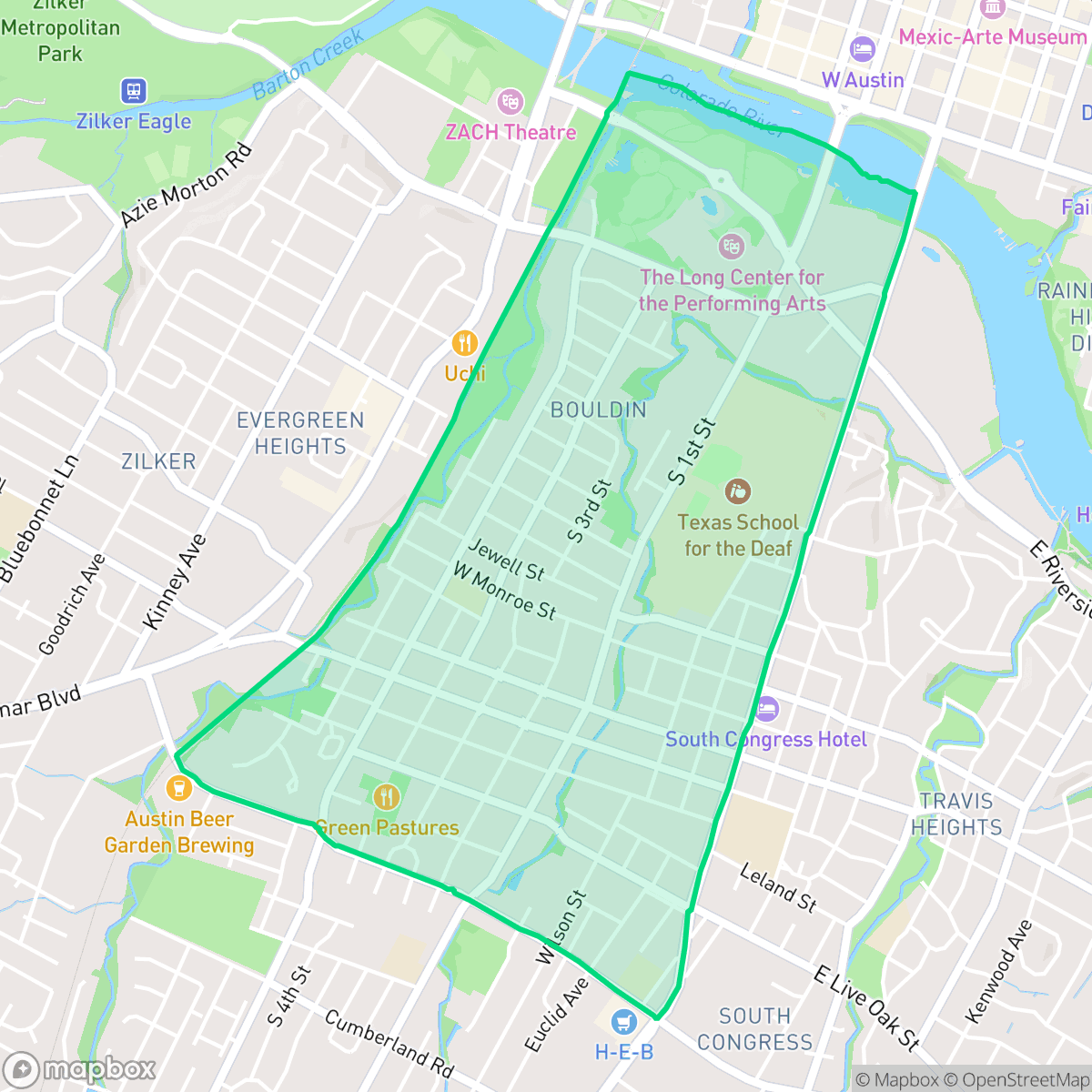
Bouldin (or Bouldin Creek) is one of Austin’s oldest neighborhoods, originating from an 1835 land grant to Isaac Decker before James E. Bouldin Sr. purchased the tract in 1852. Developed as one of the city's first suburbs around the turn of the 20th century, it experienced rapid growth in the 1920s and 1930s. Because the area south of the river was prone to flooding, it remained affordable, allowing diverse communities to establish roots. This includes Black residents who founded historic institutions like the St. Anne AME Church in 1916. Notable landmarks include the Texas School for the Deaf (founded in 1856), the Victorian mansion Green Pastures (boyhood home of activist John Henry Faulk), and the iconic "Greetings from Austin" mural. Today, Bouldin’s historic 1920s bungalows blend with modern architecture along the vibrant South First Street and South Congress commercial corridors.
The area offers a distinct urban-suburban blend, featuring a strong network of sidewalks and crosswalks that connect residential streets to local commercial corridors. It maintains a high level of visual appeal through well-kept athletic grounds and established greenery, while also boasting high health insurance coverage rates among residents. According to iHuus data, the neighborhood provides a central, accessible lifestyle that balances its academic and institutional presence with popular social hubs.
Prospective residents should note that the neighborhood faces challenges with acoustic comfort due to road traffic noise and lower air quality scores compared to city averages. While the area is generally safe from industrial hazards, the flood safety profile is lower than the city average. It is well-suited for those who prioritize walkability and proximity to Austin's cultural landmarks over absolute quiet or low-density living, according to iHuus observations.
Neighborhood Scores Across 15 Qualities
Housing layouts provide a blend of closely spaced single-family homes and larger multi-family complexes, offering a sense of privacy that is roughly comparable to the Austin average. Neighboring structures are typically separated by modest buffers of greenery and trees according to iHuus data.
Pedestrian access is well-established through a dense grid of sidewalks and safe crossings that connect residential and commercial sectors. This network provides much better walkability than the Austin average, though some paths are partially obscured by mature tree canopy.
Large homes with private pools and well-maintained athletic grounds characterize much of the area, making the visual landscape slightly more polished than the Austin average. According to iHuus data, the neighborhood features a mix of high-end residential estates and dense apartment developments.
Continuous green verges and accessible public park trails provide reliable walking areas for pets. This level of access is slightly below the Austin city average.
Residential streets feature a balance of greenery and low-rise apartments, though the area is less urbanized than the Austin average according to iHuus data.
Diverse dining options and frequent social activity create a much more energetic atmosphere than the typical Austin neighborhood. Residents have access to a dense concentration of coffee shops, parks, and local eateries according to iHuus data.
Frequent noise from nearby transit corridors and infrastructure is a notable characteristic of this area. According to iHuus data, acoustic comfort in Bouldin is lower than the Austin average.
Frequent unhealthy air quality levels pose a significant risk to sensitive groups; according to iHuus data, the air quality in Bouldin is notably worse than the Austin average.
Industrial activity, warehouses, and hazardous sites are entirely absent from this area. According to iHuus data, the neighborhood consists exclusively of residential, commercial, and institutional zones, which is more purely residential than the Austin average.
Health insurance access is more prevalent here than in the rest of Austin. According to iHuus data, a significant majority of the local population maintains medical coverage.
Voting patterns and census indicators reflect a deeply progressive political leaning that is even more pronounced than the Austin city average, according to iHuus data.
Residents live alongside a balanced mix of young professionals, families, and older adults. According to iHuus data, this demographic spread is very similar to the broader Austin area.
Flood risk in this area is comparable to the Austin average, though precise assessments are currently unavailable due to incomplete federal studies. Residents should remain cautious as official flood maps for this specific location have not been fully updated by FEMA.
Address-Level Insights for Bouldin


iHuus Neighborhood Intelligence Insights
Get address-level neighborhood insights for Bouldin
- Street-level scores — see how individual blocks compare, not just neighborhood averages
- Micro-zone boundaries — identify quiet pockets, flood boundaries, and walkable clusters before you visit
- 15 dimensions in full — walkability, noise, air quality, school quality, insurance coverage, population age profile, urban/rural index, and more
- Boundary risk alerts — know if your address sits near a block boundary where scores drop, the kind of detail no listing will ever mention
- School insights — individual school ratings and insights, not just district-level data
- Compare before you commit — side-by-side data across neighborhoods, down to block precision
No credit card required
Compare with Any Neighborhood
| Dimension | Bouldin | Allandale |
|---|---|---|
| 🚶 Walkabilityavg 6.73 | ||
| 🔊 Acoustic Comfortavg 3.73 | ||
| 🤫 Privacy Indexavg 5.87 | ||
| 🎨 Visual Appealavg 6.95 | ||
| 🐕 Dog Friendlinessavg 6.92 | ||
| 🗺️ Urban-Rural Indexavg 7.09 | ||
| ✨ Neighborhood Vibeavg 4.91 | ||
| 🏥 Health Insurance Coverageavg 7.56 | ||
| 🌿 Air Qualityavg 5.17 | ||
| 🏭 Industrial Proximityavg 8.86 | ||
| 🌊 Flood Safetyavg 4.83 | ||
| 🗳️ Ideological Leanavg 9.13 | ||
| 👥 Population Age Profileavg 4.52 | ||
| 🔥 Fire Safety | ||
| 🏫 School Quality |
Bouldin Rankings
School Districts Serving Bouldin
School Insights for Bouldin
Below average outcomes; significant attendance and academic challenges.
School Insights
See what's really behind every school rating near Bouldin
- Individual school ratings — each school's own score with outcome context, not just a district average
- Enrollment & class size data — student-to-teacher ratio and how it compares to the state average
- Full demographics breakdown — ethnicity and gender composition for every school in the enrollment zone
- Every school in the district — all schools within the enrollment boundary ranked by rating, not just the closest one
- Grade levels & benchmarks — elementary through high school, with below/above state-average flags
No credit card required