Barton Hills, Austin
Updated · 9,993 residents
Barton Hills is a scenic, nature-integrated enclave characterized by its mid-century architecture and direct access to the Barton Creek Greenbelt. While the area offers high visual appeal and is well-suited for dog owners, residents should expect a car-dependent lifestyle with limited commercial density. According to iHuus data, the neighborhood provides a quiet, low-density environment that balances suburban residential life with proximity to major Austin landmarks.
Key Highlights
About Barton Hills
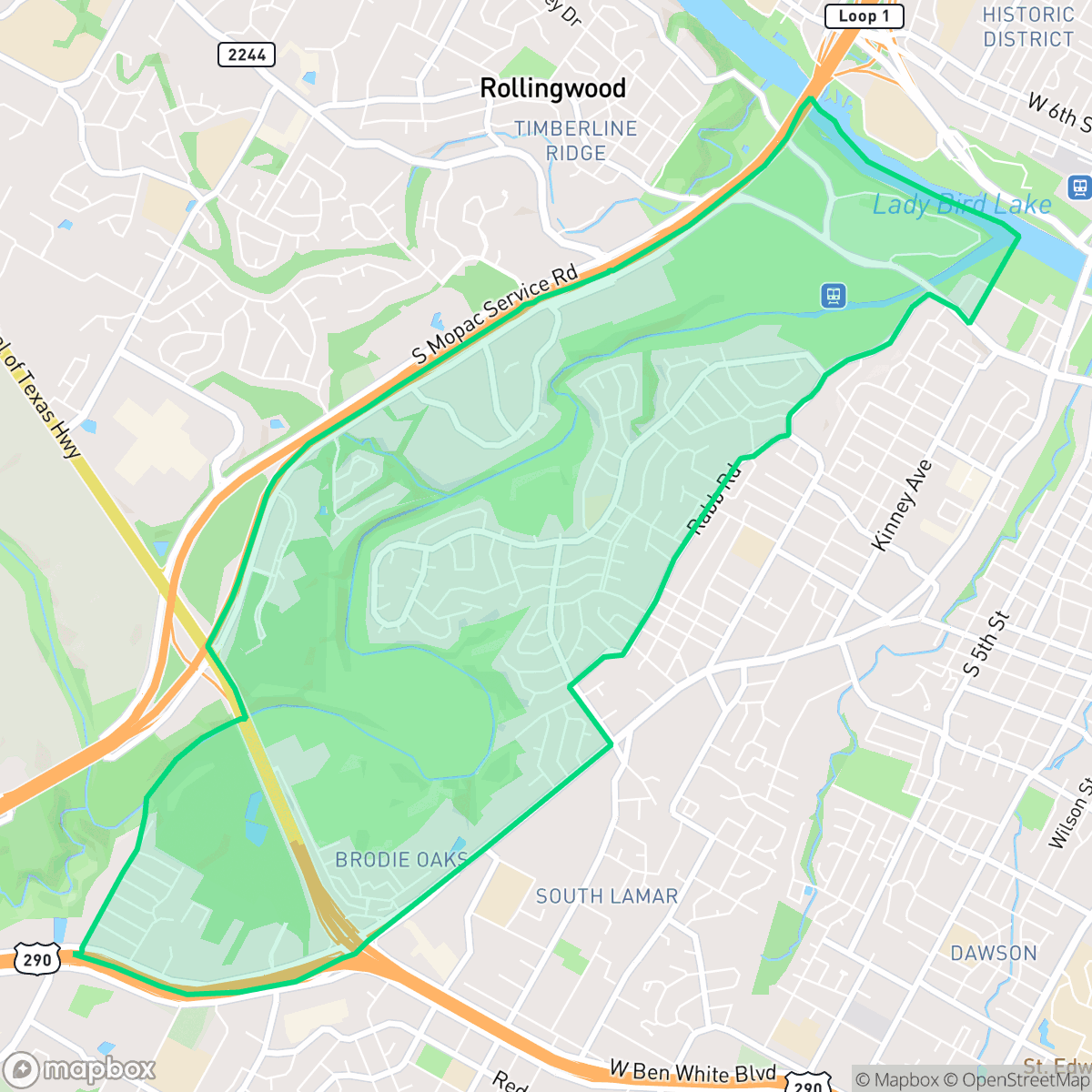
Named after 1830s pioneer William "Uncle Billy" Barton, the Barton Hills neighborhood in south Austin evolved from historic homesteads into a premier mid-century residential enclave. Development began in earnest during the 1940s and 1950s, highlighted by a collection of contemporary mid-century modern homes designed by prominent local architect A.D. Stenger. In 1956, the neighborhood gained national attention when the Austin Parade of Homes featured it as the "world's largest air-conditioned subdivision". Barton Hills is defined by its integration with nature; in the late 1970s, passionate community protests successfully blocked a proposed bridge over Barton Creek, preserving the land that was eventually absorbed into the beloved Barton Creek Greenbelt. Today, the neighborhood remains celebrated for its scenic topography, ranch-style homes, and proximity to Zilker Park and Barton Springs Pool.
The area is defined by its topographical variety and integration with the outdoors, featuring quiet, winding streets that contrast with the busier corridors of South Austin. Residents benefit from high levels of flood safety and strong health insurance coverage, contributing to a stable, residential atmosphere. The neighborhood maintains a distinct identity through its architectural heritage and proximity to significant natural assets like the Zilker Botanical Garden and the Austin Nature and Science Center.
Prospective residents should note that the neighborhood is primarily car-dependent, with limited walkability to daily amenities despite its pleasant aesthetic. While the surroundings are visually striking and highly dog-friendly, acoustic comfort is lower than the city average due to road traffic noise. The area is best suited for those prioritizing a quiet, nature-focused lifestyle over high-density urban convenience, with educational options ranging from the local Barton Hills Elementary to the high-performing Eanes Independent School District.
Neighborhood Scores Across 15 Qualities
Residential spacing is consistent with the Austin average, featuring a mix of single-family homes and multi-unit clusters. Some areas offer a buffer between neighbors, while other sections contain more closely packed housing.
Main arterials and residential blocks feature sidewalks on one side of the street and safe crossings. This connectivity is roughly comparable to the Austin average, according to iHuus data.
Large homes and frequent upscale amenities contribute to a visual landscape that is more polished than the Austin average. According to iHuus data, the area features a mix of spacious residential lots and modern apartment complexes with communal pools.
Abundant green spaces, including large forest buffers and athletic fields, offer more accessible walking areas for pets than the Austin average. Wide paths and low traffic density contribute to a safe environment for outdoor exercise.
Scattered homes situated among woodlands and open land provide a sense of space that is slightly more rural than much of the Austin area. According to iHuus data, some pockets of the neighborhood also feature denser suburban clusters with multi-family apartments and retail centers.
Quiet residential streets and green spaces are punctuated by diverse dining and social hubs, making the area's energy very similar to the Austin average. While some pockets offer walkable access to local eateries, much of the neighborhood remains car-dependent for accessing amenities.
Frequent noise from nearby major transit routes and flight paths makes this area louder than the Austin average. Residents may experience consistent auditory disturbances from the surrounding freeway and rail infrastructure, according to iHuus data.
Frequent unhealthy air quality levels pose a significant risk to sensitive groups, with pollution levels appearing notably worse than the Austin average according to iHuus data.
Residential life here is entirely separated from warehouses and heavy industrial facilities. According to iHuus data, this area contains no detectable industrial hazards or large scale manufacturing sites, performing better than the Austin average for industrial proximity.
Health insurance access among residents is notably higher than the Austin city average, according to iHuus data.
Voting patterns and census indicators reflect a predominantly liberal community, trending more so than the Austin average according to iHuus data.
Residents live alongside a balanced mix of young professionals, families, and older adults. This demographic spread is slightly more varied than the average seen across Austin, according to iHuus data.
Flood safety levels in this area are slightly above the Austin average, though official FEMA studies for this specific location remain incomplete. According to iHuus data, residents should remain aware of potential seasonal drainage variations.
Address-Level Insights for Barton Hills


iHuus Neighborhood Intelligence Insights
Get address-level neighborhood insights for Barton Hills
- Street-level scores — see how individual blocks compare, not just neighborhood averages
- Micro-zone boundaries — identify quiet pockets, flood boundaries, and walkable clusters before you visit
- 15 dimensions in full — walkability, noise, air quality, school quality, insurance coverage, population age profile, urban/rural index, and more
- Boundary risk alerts — know if your address sits near a block boundary where scores drop, the kind of detail no listing will ever mention
- School insights — individual school ratings and insights, not just district-level data
- Compare before you commit — side-by-side data across neighborhoods, down to block precision
No credit card required
Compare with Any Neighborhood
| Dimension | Barton Hills | Allandale |
|---|---|---|
| 🚶 Walkabilityavg 6.73 | ||
| 🔊 Acoustic Comfortavg 3.73 | ||
| 🤫 Privacy Indexavg 5.87 | ||
| 🎨 Visual Appealavg 6.95 | ||
| 🐕 Dog Friendlinessavg 6.92 | ||
| 🗺️ Urban-Rural Indexavg 7.09 | ||
| ✨ Neighborhood Vibeavg 4.91 | ||
| 🏥 Health Insurance Coverageavg 7.56 | ||
| 🌿 Air Qualityavg 5.17 | ||
| 🏭 Industrial Proximityavg 8.86 | ||
| 🌊 Flood Safetyavg 4.83 | ||
| 🗳️ Ideological Leanavg 9.13 | ||
| 👥 Population Age Profileavg 4.52 | ||
| 🔥 Fire Safety | ||
| 🏫 School Quality |
Barton Hills Rankings
School Districts Serving Barton Hills
School Insights for Barton Hills
Below average outcomes; significant attendance and academic challenges.
School Insights
See what's really behind every school rating near Barton Hills
- Individual school ratings — each school's own score with outcome context, not just a district average
- Enrollment & class size data — student-to-teacher ratio and how it compares to the state average
- Full demographics breakdown — ethnicity and gender composition for every school in the enrollment zone
- Every school in the district — all schools within the enrollment boundary ranked by rating, not just the closest one
- Grade levels & benchmarks — elementary through high school, with below/above state-average flags
No credit card required