Allandale, Austin
Updated · 9,597 residents
Allandale is a north-central Austin neighborhood defined by its mature canopy, mid-century ranch homes, and access to local green spaces like Shoal Creek. While residents enjoy a walkable environment with diverse dining and top-rated schools, the area experiences notable noise from nearby major traffic arteries.
Key Highlights
About Allandale
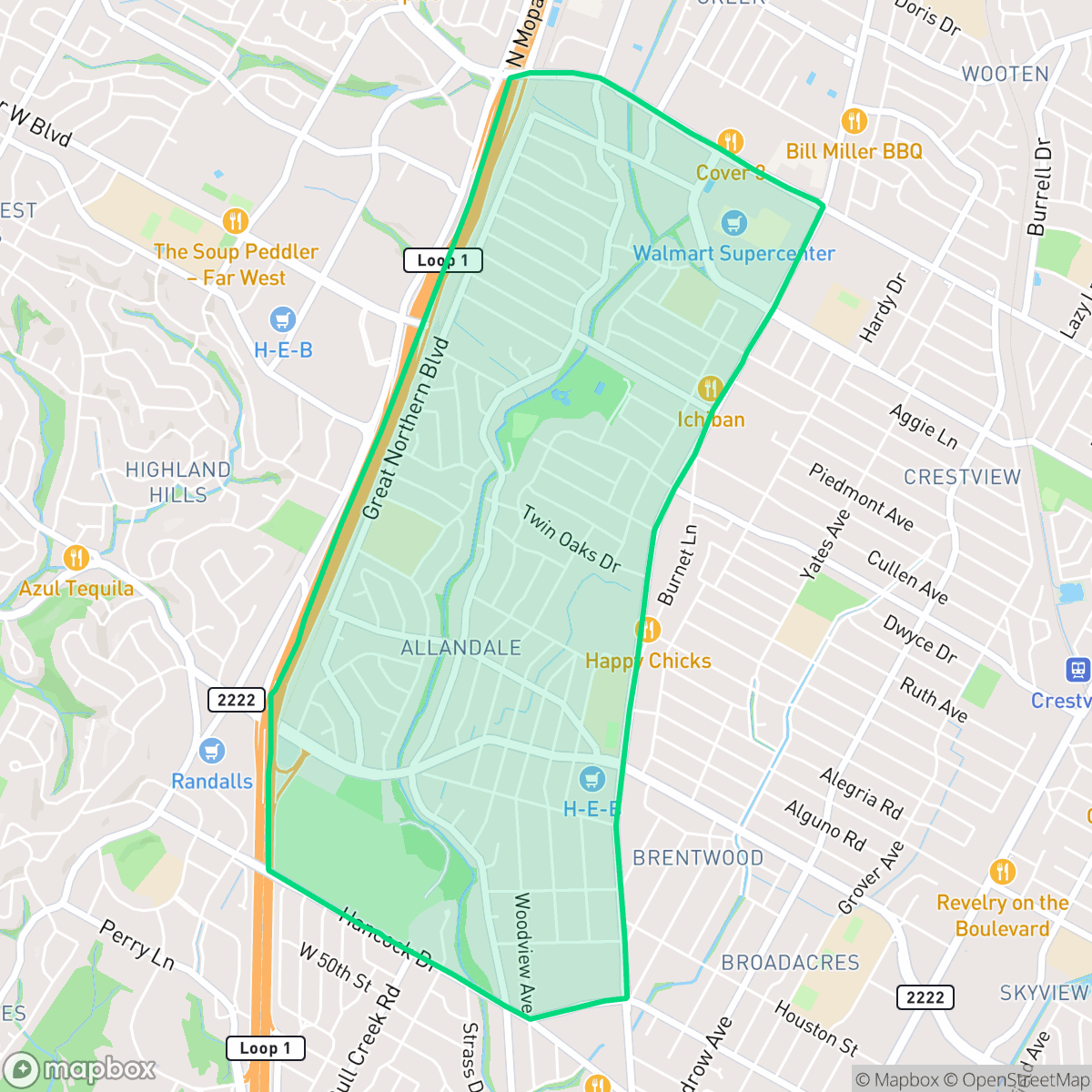
Located in north-central Austin, Allandale originated from an 1841 Republic of Texas land grant awarded to George W. Davis for his service in the Battle of San Jacinto; his family's historic cemetery remains in the neighborhood today. Modern development began in 1946 when W. Murray Graham platted the first tracts, which evolved into a scenic mid-century neighborhood defined by mature trees, Shoal Creek, and ranch-style homes. In 1954, Allandale hosted the "Air-Conditioned Village," a pioneering experiment by the National Association of Home Builders that tested central cooling systems in 22 homes, helping popularize residential air conditioning nationwide. Other local landmarks include Beverly S. Sheffield Northwest District Park—originally an 1850s limestone quarry that supplied stone for the Texas Capitol Building—and the mid-century modern Lamar Middle School.
The neighborhood serves as a well-established residential enclave that balances suburban quiet with proximity to local amenities. It features a mix of tree-lined streets and walkable corridors that host popular dining and wellness spots. Residents benefit from high-quality local education, with both Gullett Elementary and Lamar Middle School serving as anchors for the community. The visual appeal remains high, characterized by well-maintained lots and significant tree coverage that contributes to a serene atmosphere throughout the area.
Prospective residents should note that the area experiences elevated noise levels due to its proximity to major highways, with road traffic being the primary source of sound. While the neighborhood offers good walkability and dog-friendly paths, it also sits in a region with moderate flood risk. The community is well-suited for families and professionals who prioritize access to high-performing schools and established local services over a completely silent environment.
Neighborhood Scores Across 15 Qualities
Housing layouts offer a blend of single-family homes with generous yard buffers and more closely packed multi-family units. According to iHuus data, this level of spacing is largely comparable to the Austin average.
Sidewalks are well established along main roads and residential blocks, providing better connectivity than the Austin average. While dense tree canopy occasionally obscures paths, most internal streets remain accessible to pedestrians, though a major highway corridor can disrupt continuous walking routes.
Streetscapes often feature large single-family homes with private pools and complex architectural details. This level of visual variety and upscale amenity density is slightly above the Austin average, according to iHuus data.
Residential streets offer wide green verges and shaded areas for walking, though overall access to public parks is slightly below the Austin average. According to iHuus data, while some areas feature continuous greenery, other parts of the neighborhood rely more on private fenced yards for pet exercise.
Residential density here features a blend of apartment complexes and single-family homes with significant tree coverage. This landscape is less developed than the Austin average, offering more open space and woodland than the typical city environment.
A mix of quiet residential pockets and lively dining hubs creates an atmosphere that is more active than the Austin average. While many local favorites are reachable on foot, certain areas remain largely car-dependent due to the spread of businesses and green space.
Frequent noise from nearby major roads and transit corridors is common in this area. According to iHuus data, acoustic levels are slightly higher than the Austin average.
Air quality remains mostly clean with only rare instances of elevated readings. According to iHuus data, the air quality in Allandale is notably better than the Austin city average.
Industrial activity is virtually nonexistent here, as the area consists of residential, recreational, and light commercial uses. This lack of heavy industry or warehouses makes the neighborhood even more free of industrial hazards than the Austin average, according to iHuus data.
Health insurance access among Allandale residents is greater than the Austin average, according to iHuus data.
Voting patterns and census indicators reflect a deeply liberal political leaning that is even more pronounced than the Austin average, according to iHuus data.
Residents live alongside a balanced mix of young professionals, families, and seniors. According to iHuus data, this age distribution is slightly more varied than the average seen across Austin.
Flood risk in this area remains undetermined due to a lack of detailed federal studies. According to iHuus data, the level of safety from flooding is slightly lower than the Austin average.
Address-Level Insights for Allandale


iHuus Neighborhood Intelligence Insights
Get address-level neighborhood insights for Allandale
- Street-level scores — see how individual blocks compare, not just neighborhood averages
- Micro-zone boundaries — identify quiet pockets, flood boundaries, and walkable clusters before you visit
- 15 dimensions in full — walkability, noise, air quality, school quality, insurance coverage, population age profile, urban/rural index, and more
- Boundary risk alerts — know if your address sits near a block boundary where scores drop, the kind of detail no listing will ever mention
- School insights — individual school ratings and insights, not just district-level data
- Compare before you commit — side-by-side data across neighborhoods, down to block precision
No credit card required
Compare with Any Neighborhood
| Dimension | Allandale | Barton Hills |
|---|---|---|
| 🚶 Walkabilityavg 6.73 | ||
| 🔊 Acoustic Comfortavg 3.73 | ||
| 🤫 Privacy Indexavg 5.87 | ||
| 🎨 Visual Appealavg 6.95 | ||
| 🐕 Dog Friendlinessavg 6.92 | ||
| 🗺️ Urban-Rural Indexavg 7.09 | ||
| ✨ Neighborhood Vibeavg 4.91 | ||
| 🏥 Health Insurance Coverageavg 7.56 | ||
| 🌿 Air Qualityavg 5.17 | ||
| 🏭 Industrial Proximityavg 8.86 | ||
| 🌊 Flood Safetyavg 4.83 | ||
| 🗳️ Ideological Leanavg 9.13 | ||
| 👥 Population Age Profileavg 4.52 | ||
| 🔥 Fire Safety | ||
| 🏫 School Quality |
Allandale Rankings
School Districts Serving Allandale
School Insights for Allandale
Below average outcomes; significant attendance and academic challenges.
School Insights
See what's really behind every school rating near Allandale
- Individual school ratings — each school's own score with outcome context, not just a district average
- Enrollment & class size data — student-to-teacher ratio and how it compares to the state average
- Full demographics breakdown — ethnicity and gender composition for every school in the enrollment zone
- Every school in the district — all schools within the enrollment boundary ranked by rating, not just the closest one
- Grade levels & benchmarks — elementary through high school, with below/above state-average flags
No credit card required