Sears Park, Abilene
Updated · 5,937 residents
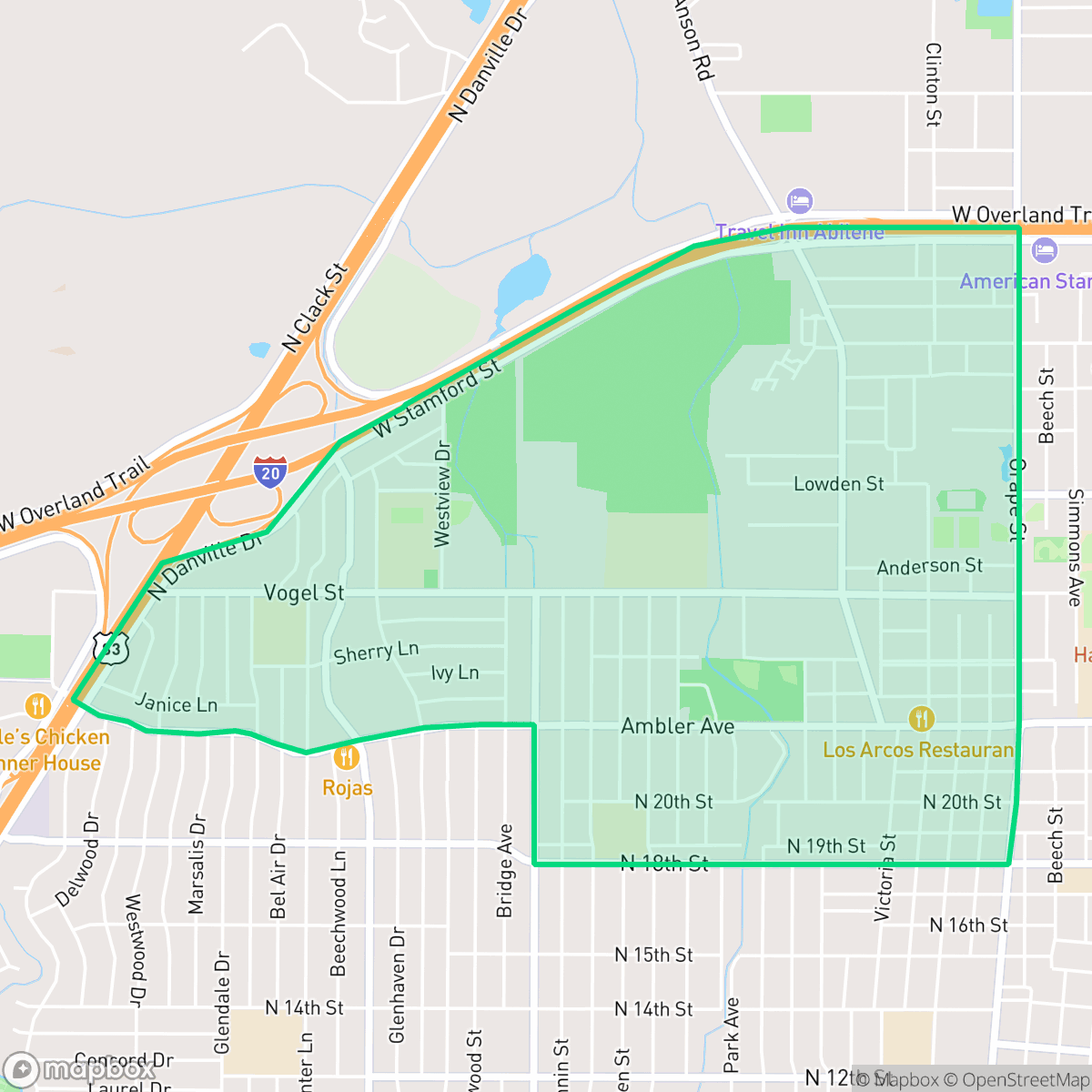
Sears Park is a quiet, low-density neighborhood in northwest Abilene characterized by its collection of midcentury ranch-style homes and abundant green space. While the area offers a peaceful residential atmosphere, residents experience limited walkability and occasional road traffic noise. According to iHuus data, the neighborhood provides a suburban setting with essential local services and nearby recreational facilities.
Key Highlights
About Sears Park
The Sears Park neighborhood in northwest Abilene, Texas, traces its origins to the vision of Arthur Sears, a 1920s rancher and banker who dreamed of establishing a park alongside a new residential development. Though delayed by the Great Depression, his widow donated the land in 1949 to create Arthur Sears Park. Developed primarily between 1940 and 1969, the neighborhood features midcentury ranch-style and minimal traditional homes. At its cultural heart is the Sears Park Recreation Center (adjacent to the Cesar Chavez Recreation Center), which opened in 1966. The center holds significant civil rights history; in October 1969, it served as the gathering hub for the historic Abilene Walkout, during which nearly 300 Chicano students staged an 11-day boycott to protest unequal treatment in local schools, marking one of the nation's longest student boycotts of the era.
The neighborhood functions as a quiet residential enclave defined by its midcentury architectural roots and proximity to major transit corridors. Its layout balances residential streets with open green spaces, creating a low-density environment that favors privacy over commercial density. While the area lacks a central business district, residents have access to scattered local services, including religious institutions and small eateries. The landscape is primarily suburban, characterized by a mix of residential lots and light industrial units located near highway access points. Prospective residents should consider that the neighborhood presents a mix of suburban tranquility and proximity to industrial activity. While the area is generally quiet, road traffic contributes to ambient noise levels, and the walkability score reflects a reliance on personal vehicles for daily errands. Educational options within the Abilene Independent School District vary in performance, and the area faces challenges regarding flood safety and access to comprehensive health insurance. This location is best suited for those seeking a stable, established community that prioritizes residential space over urban amenities.
Neighborhood Scores Across 15 Qualities
Residential spacing provides a moderate level of separation between neighbors. Houses are situated on a regular urban grid with consistent backyard fencing, offering a sense of privacy that is roughly in line with the Abilene average.
Low traffic volumes on the residential grid make for calm walking conditions, though the absence of consistent sidewalks is notable. This level of walkability is roughly in line with the city average, according to iHuus data.
Modest tract housing with uniform rooflines and small yards characterizes this area. According to iHuus data, the visual variety is slightly below the Abilene average.
Private fenced yards are common, but public green space and accessible verges are below the Abilene average. Walking dogs in the neighborhood relies primarily on residential lots rather than central public parks.
A mix of suburban residential grids and scattered open land characterizes the area. This landscape is slightly less open than the typical Abilene setting, according to iHuus data.
Low density and vast open spaces characterize this area, creating a tranquil atmosphere with limited commercial activity. Residents will find the neighborhood slightly less lively than the Abilene average, as most essential services and dining options require a vehicle to access.
Continuous sound from nearby busy streets creates a moderate level of ambient noise. This volume is slightly higher than the typical experience found elsewhere in Abilene.
Residential life here is free from warehouses or heavy industrial facilities, making the area notably cleaner than the Abilene average. According to iHuus data, the landscape consists of quiet streets and light commercial zones without visible industrial hazards.
Health insurance coverage among residents is slightly below the Abilene average. Data from iHuus indicates that access to coverage is moderate within this area.
Voting patterns and census indicators show a predominantly conservative political leaning that is more pronounced than the Abilene average, according to iHuus data.
Residents live alongside a varied demographic of young adults, families, and seniors. According to iHuus data, this age distribution is roughly in line with the city average.
Properties in this area are located within a recognized floodplain, which may necessitate specialized flood insurance. According to iHuus data, the flood risk in Sears Park is slightly higher than the Abilene city average.
Address-Level Insights for Sears Park


iHuus Neighborhood Intelligence Insights
Get address-level neighborhood insights for Sears Park
- Street-level scores — see how individual blocks compare, not just neighborhood averages
- Micro-zone boundaries — identify quiet pockets, flood boundaries, and walkable clusters before you visit
- 15 dimensions in full — walkability, noise, air quality, school quality, insurance coverage, population age profile, urban/rural index, and more
- Boundary risk alerts — know if your address sits near a block boundary where scores drop, the kind of detail no listing will ever mention
- School insights — individual school ratings and insights, not just district-level data
- Compare before you commit — side-by-side data across neighborhoods, down to block precision
No credit card required
Compare with Any Neighborhood
| Dimension | Sears Park | Abilene Heights |
|---|---|---|
| 🚶 Walkabilityavg 6.03 | ||
| 🔊 Acoustic Comfortavg 3.93 | ||
| 🤫 Privacy Indexavg 6.18 | ||
| 🎨 Visual Appealavg 5.66 | ||
| 🐕 Dog Friendlinessavg 5.58 | ||
| 🗺️ Urban-Rural Indexavg 7.25 | ||
| ✨ Neighborhood Vibeavg 4.1 | ||
| 🏥 Health Insurance Coverageavg 6.05 | ||
| 🌿 Air Quality | ||
| 🏭 Industrial Proximityavg 8.24 | ||
| 🌊 Flood Safetyavg 1.79 | ||
| 🗳️ Ideological Leanavg 0.7 | ||
| 👥 Population Age Profileavg 4.64 | ||
| 🔥 Fire Safety | ||
| 🏫 School Quality |
Sears Park Rankings
School Districts Serving Sears Park
School Insights for Sears Park
Below average outcomes; significant attendance and academic challenges.
School Insights
See what's really behind every school rating near Sears Park
- Individual school ratings — each school's own score with outcome context, not just a district average
- Enrollment & class size data — student-to-teacher ratio and how it compares to the state average
- Full demographics breakdown — ethnicity and gender composition for every school in the enrollment zone
- Every school in the district — all schools within the enrollment boundary ranked by rating, not just the closest one
- Grade levels & benchmarks — elementary through high school, with below/above state-average flags
No credit card required