River Oaks/Brookhollow, Abilene
Updated · 7,424 residents
River Oaks/Brookhollow is a quiet, established residential area in southwest Abilene known for its mid-century ranch-style homes and mature landscaping. While the neighborhood offers a semi-rural feel with open spaces, residents should be aware of elevated noise levels from nearby rail and freeway traffic, as well as the need for flood insurance due to local topography.
Key Highlights
About River Oaks/Brookhollow
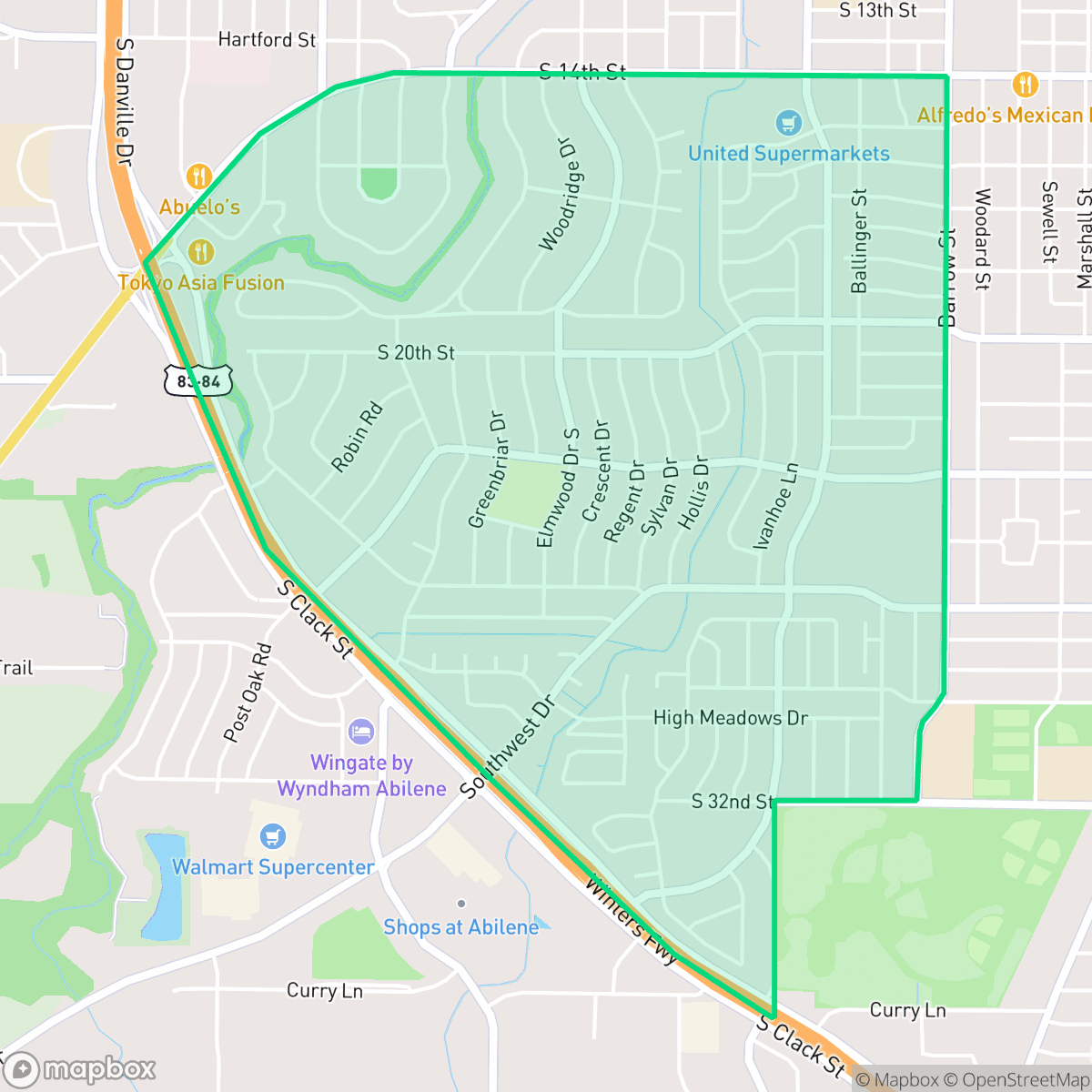
River Oaks and Brookhollow are established residential neighborhoods in southwest Abilene, primarily developed between the 1950s and 1960s. Characterized by their mid-century suburban design, these areas feature spacious ranch-style homes, brick construction, and large lots shaded by mature trees. The neighborhoods are recognized for their wider streets and a settled, family-oriented atmosphere that remains a popular choice for residents seeking a quiet, central location. While they share a similar era of growth, River Oaks is often noted for its larger lot sizes, whereas Brookhollow is frequently associated with a mix of established residential housing stock. Both neighborhoods are zoned for the Abilene Independent School District, with Austin Elementary serving as a focal point for the local community.
River Oaks/Brookhollow features a mix of detached homes and apartment clusters that create a varied residential density. While the streets are generally quiet and suitable for walking, the area is largely car-dependent for daily errands and commercial services. The community maintains a stable, conservative atmosphere with a diverse age demographic that spans from young families to long-term residents.
Prospective buyers should consider that the area sits within a designated floodplain, which typically requires additional insurance coverage. Furthermore, the proximity to major transit corridors results in frequent auditory disturbances from trains and heavy traffic. Despite these trade-offs, the area remains a popular choice for those seeking a settled, family-oriented environment with consistent access to health insurance and a sense of community stability according to iHuus data.
Neighborhood Scores Across 15 Qualities
Residential spacing is inconsistent across the area, with some detached homes offering significant distance from neighbors while apartment clusters sit more closely together. According to iHuus data, this level of density is roughly comparable to the Abilene city average.
Low traffic volumes on wide residential streets allow for safe walking, though sidewalk availability is inconsistent throughout the area. According to iHuus data, walkability in this neighborhood is roughly comparable to the Abilene average.
Standard tract housing and multi-family apartments define the landscape, featuring tidy but small yards and boxy rooflines. This area offers a slightly more varied visual environment than the Abilene city average.
Low-traffic cul-de-sacs and green verges provide decent space for walking dogs, though the area lacks dedicated public parkland. According to iHuus data, the availability of pet-friendly space is roughly comparable to the Abilene average.
Open land and scattered homes provide a more rustic atmosphere than the more urbanized parts of Abilene. While some areas feature dense suburban clusters, the landscape remains notably less developed than the city average.
A balanced mix of residential streets and accessible dining provides more activity than the typical Abilene neighborhood. While various local hubs and green spaces are present, most commercial services remain car-dependent.
Frequent noise from nearby railroad tracks and heavy freeway traffic makes this area louder than the Abilene average. According to iHuus data, residents may experience consistent auditory disturbances throughout the day.
Primarily residential with minimal industrial presence, this area offers a level of quiet similar to the Abilene average. While some light commercial activity and utility facilities exist, there is no significant industrial activity or heavy manufacturing nearby.
Health insurance coverage among residents is higher than the Abilene average, according to iHuus data. This indicates a relatively stable level of access to medical benefits within the area.
Voting patterns and census indicators show a predominantly conservative political leaning, though this tendency is slightly less pronounced than the average found across Abilene.
Residents live alongside a balanced mix of young adults, families, and older individuals. This demographic spread is consistent with the broader Abilene area.
Properties in this area are located within a designated floodplain, which typically necessitates flood insurance. According to iHuus data, the risk level here is slightly higher than the Abilene city average.
Address-Level Insights for River Oaks/Brookhollow


iHuus Neighborhood Intelligence Insights
Get address-level neighborhood insights for River Oaks/Brookhollow
- Street-level scores — see how individual blocks compare, not just neighborhood averages
- Micro-zone boundaries — identify quiet pockets, flood boundaries, and walkable clusters before you visit
- 15 dimensions in full — walkability, noise, air quality, school quality, insurance coverage, population age profile, urban/rural index, and more
- Boundary risk alerts — know if your address sits near a block boundary where scores drop, the kind of detail no listing will ever mention
- School insights — individual school ratings and insights, not just district-level data
- Compare before you commit — side-by-side data across neighborhoods, down to block precision
No credit card required
Compare with Any Neighborhood
| Dimension | River Oaks/Brookhollow | Abilene Heights |
|---|---|---|
| 🚶 Walkabilityavg 6.03 | ||
| 🔊 Acoustic Comfortavg 3.93 | ||
| 🤫 Privacy Indexavg 6.18 | ||
| 🎨 Visual Appealavg 5.66 | ||
| 🐕 Dog Friendlinessavg 5.58 | ||
| 🗺️ Urban-Rural Indexavg 7.25 | ||
| ✨ Neighborhood Vibeavg 4.1 | ||
| 🏥 Health Insurance Coverageavg 6.05 | ||
| 🌿 Air Quality | ||
| 🏭 Industrial Proximityavg 8.24 | ||
| 🌊 Flood Safetyavg 1.79 | ||
| 🗳️ Ideological Leanavg 0.7 | ||
| 👥 Population Age Profileavg 4.64 | ||
| 🔥 Fire Safety | ||
| 🏫 School Quality |
River Oaks/Brookhollow Rankings
School Districts Serving River Oaks/Brookhollow
School Insights for River Oaks/Brookhollow
Below average outcomes; significant attendance and academic challenges.
School Insights
See what's really behind every school rating near River Oaks/Brookhollow
- Individual school ratings — each school's own score with outcome context, not just a district average
- Enrollment & class size data — student-to-teacher ratio and how it compares to the state average
- Full demographics breakdown — ethnicity and gender composition for every school in the enrollment zone
- Every school in the district — all schools within the enrollment boundary ranked by rating, not just the closest one
- Grade levels & benchmarks — elementary through high school, with below/above state-average flags
No credit card required