River Oaks/Brookhollow, Abilene
Updated · 7,424 residents
River Oaks and Brookhollow offer a quiet, suburban environment defined by traditional ranch-style homes and tree-lined streets. While the area provides better walkability than the Abilene city average, residents should expect moderate noise levels primarily driven by local road traffic.
Key Highlights
About River Oaks/Brookhollow
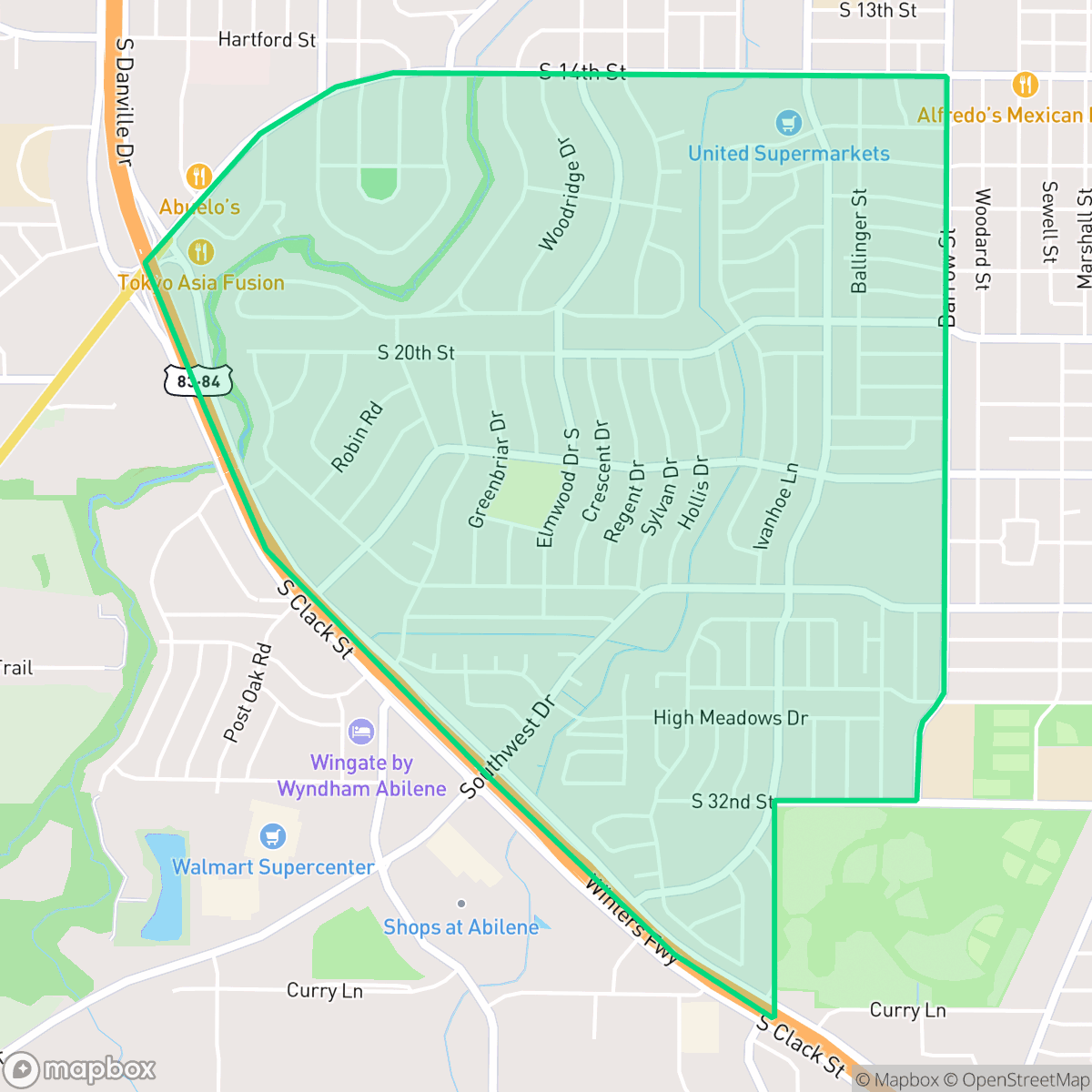
The River Oaks and Brookhollow subdivisions in southwest Abilene, Texas, developed primarily as premier mid-century residential communities. Platted and advertised in local publications like the Abilene Reporter-News starting in the late 1950s, the area quickly grew during the 1960s and 1970s. The neighborhood features quiet, tree-lined streets dominated by well-preserved, traditional ranch-style homes. Prominent local landmarks historically anchoring the area include the mid-century River Oaks Shopping Center—which once housed Grissom's and the M System Food Store—and the Brook Hollow Shopping Center, both designed in part by the notable local architectural firm David S. Castle Co. Today, the neighborhood maintains its established, family-friendly character, centered around Austin Elementary School.
The area functions as a stable, residential community in southwest Abilene, characterized by a mix of quiet suburban blocks and accessible green spaces. Local life centers around community hubs such as Redbud Park and various neighborhood churches, which provide a consistent rhythm to daily life. While the neighborhood lacks a dense commercial core, residents have access to diverse dining options and local services that contribute to a moderate level of walkability compared to the rest of the city. According to iHuus data, the area maintains a high degree of industrial safety, ensuring a purely residential and light commercial environment free from significant industrial hazards.
Prospective residents may find the neighborhood well-suited for families, particularly those drawn to the proximity of Austin Elementary School. While the area offers a peaceful aesthetic, the acoustic environment is influenced by road traffic, which results in moderate noise levels. The broader Abilene Independent School District provides a mix of high-tier vocational programs and academic challenges, making it a point of consideration for families. Overall, the neighborhood presents a balanced, low-density living experience for those seeking a traditional suburban lifestyle with steady access to essential services.
Neighborhood Scores Across 15 Qualities
Residential spacing varies throughout the area, featuring tightly clustered apartments alongside detached homes with significant separation between neighbors. This level of density is roughly comparable to the Abilene average, according to iHuus data.
Low traffic volumes on wide residential streets make for safe walking, though sidewalks are inconsistent throughout the area. This level of walkability is roughly in line with the Abilene city average, according to iHuus data.
Modest yards and traditional tract housing define the landscape, which offers slightly more visual variety than the Abilene average. According to iHuus data, the area features a mix of multi-family apartments and single-family homes with tidy, compact outdoor spaces.
Low-traffic cul-de-sacs and greenery between homes provide some space for pets, though the area lacks dedicated public park access. According to iHuus data, the availability of dog-friendly environments is roughly average for the Abilene area.
Open land and woodland areas provide a more rural character than the typical Abilene landscape. According to iHuus data, this area offers more scattered homes and fields than the city average.
A balanced mix of residential streets and local dining options creates a level of activity that is higher than the Abilene average. While some areas near major highways offer diverse dining, much of the neighborhood remains a quiet, car-dependent suburban setting.
Persistent sounds from nearby railroad tracks and heavy freeway traffic are common in this area. According to iHuus data, acoustic comfort levels are lower than the Abilene city average.
Residential life here is largely uninterrupted by heavy industry, as the area features primarily quiet streets and open green spaces. While some warehouses and a large greenhouse facility are present, the level of industrial proximity is slightly lower than the Abilene average according to iHuus data.
Health insurance access among residents is higher than the Abilene city average, according to iHuus data.
Voting patterns and census indicators reflect a conservative-leaning community. This political profile is slightly more conservative than the average for Abilene.
A diverse range of age groups resides here, reflecting a demographic spread that is consistent with the Abilene city average.
Properties within this area are located in a designated floodplain, which may necessitate flood insurance. According to iHuus data, the risk levels in this neighborhood are similar to the broader Abilene area.
Address-Level Insights for River Oaks/Brookhollow


iHuus Neighborhood Intelligence Insights
Get address-level neighborhood insights for River Oaks/Brookhollow
- Street-level scores — see how individual blocks compare, not just neighborhood averages
- Micro-zone boundaries — identify quiet pockets, flood boundaries, and walkable clusters before you visit
- 15 dimensions in full — walkability, noise, air quality, school quality, insurance coverage, population age profile, urban/rural index, and more
- Boundary risk alerts — know if your address sits near a block boundary where scores drop, the kind of detail no listing will ever mention
- School insights — individual school ratings and insights, not just district-level data
- Compare before you commit — side-by-side data across neighborhoods, down to block precision
No credit card required
Compare with Any Neighborhood
| Dimension | River Oaks/Brookhollow | Abilene Heights |
|---|---|---|
| 🚶 Walkabilityavg 6.03 | ||
| 🔊 Acoustic Comfortavg 3.93 | ||
| 🤫 Privacy Indexavg 6.18 | ||
| 🎨 Visual Appealavg 5.66 | ||
| 🐕 Dog Friendlinessavg 5.58 | ||
| 🗺️ Urban-Rural Indexavg 7.25 | ||
| ✨ Neighborhood Vibeavg 4.1 | ||
| 🏥 Health Insurance Coverageavg 6.05 | ||
| 🌿 Air Quality | ||
| 🏭 Industrial Proximityavg 8.24 | ||
| 🌊 Flood Safetyavg 1.79 | ||
| 🗳️ Ideological Leanavg 0.7 | ||
| 👥 Population Age Profileavg 4.64 | ||
| 🔥 Fire Safety | ||
| 🏫 School Quality |
River Oaks/Brookhollow Rankings
School Districts Serving River Oaks/Brookhollow
School Insights for River Oaks/Brookhollow
Below average outcomes; significant attendance and academic challenges.
School Insights
See what's really behind every school rating near River Oaks/Brookhollow
- Individual school ratings — each school's own score with outcome context, not just a district average
- Enrollment & class size data — student-to-teacher ratio and how it compares to the state average
- Full demographics breakdown — ethnicity and gender composition for every school in the enrollment zone
- Every school in the district — all schools within the enrollment boundary ranked by rating, not just the closest one
- Grade levels & benchmarks — elementary through high school, with below/above state-average flags
No credit card required