Overplace, Abilene
Updated · 4,271 residents
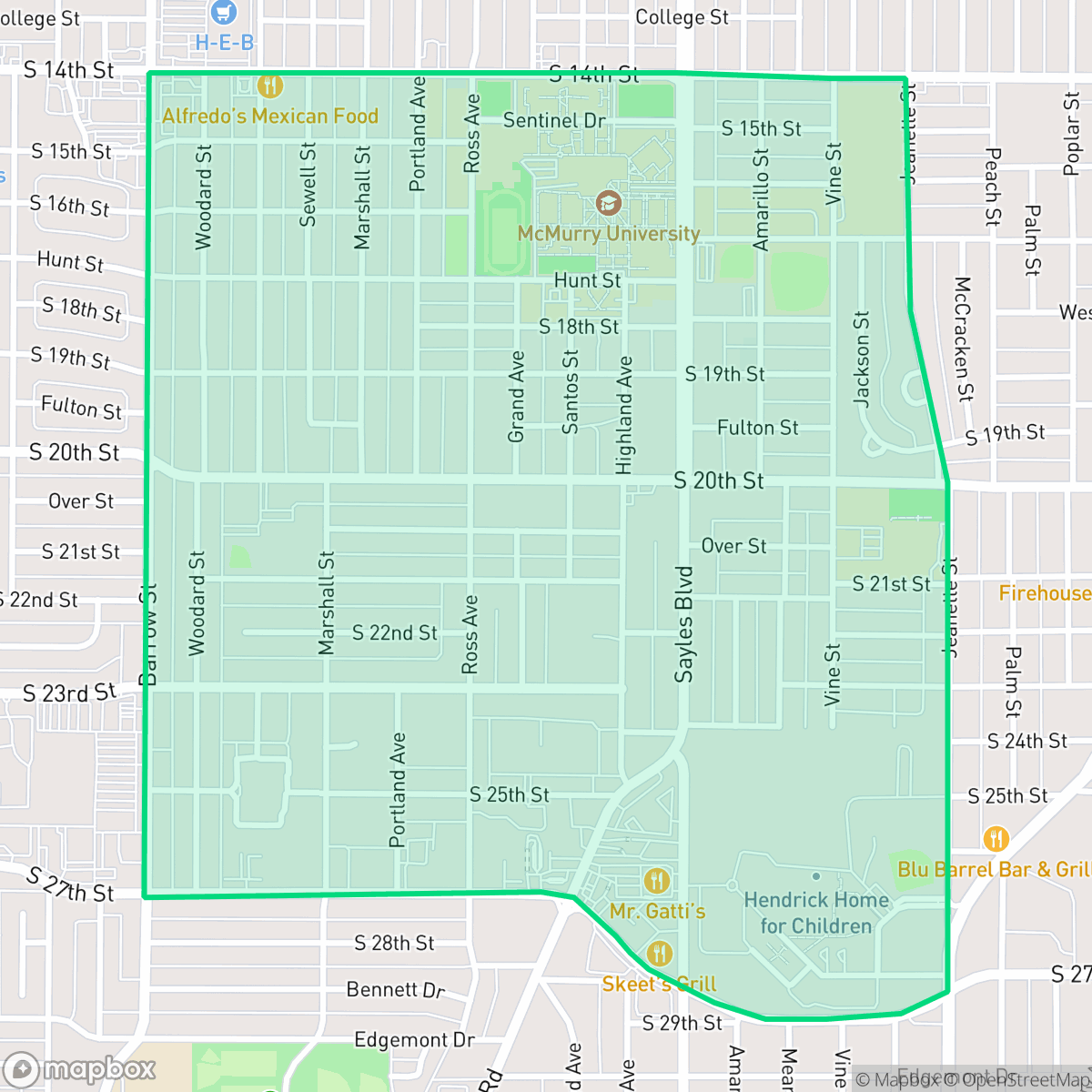
Overplace is a quiet, suburban enclave defined by its proximity to McMurry University and a mix of mid-century residential architecture. While it maintains a peaceful atmosphere, residents experience moderate noise levels from local road traffic and limited walkability to daily commercial amenities.
Key Highlights
About Overplace
Platted in the late 1920s as the "Over Place" addition, the Over Place neighborhood in Abilene, Texas, developed primarily between 1940 and 1969. This quiet, suburban pocket features well-established mid-century single-family homes and small apartment buildings. Closely integrated with the adjacent McMurry University, Over Place has evolved into a highly college-focused enclave with a significant student population. The neighborhood's distinct cultural character is anchored by the university's Amy Graves Ryan Little Theatre, which hosts local theatrical productions and serves as a key community gathering space within this otherwise peaceful residential area.
The neighborhood functions as a residential pocket with a steady rhythm of life, supported by local institutions such as the Aldersgate Abilene Methodist Church and Broadview Baptist Church. According to iHuus data, the area benefits from a complete lack of industrial activity, ensuring a purely residential and light commercial environment that prioritizes green space over heavy development. The aesthetic character remains consistent with its mid-century origins, offering a stable environment for those seeking a suburban lifestyle within the broader Abilene community.
Living in this area involves specific trade-offs, particularly regarding noise and infrastructure. Residents should anticipate an average noise level of 61 decibels, which is primarily attributed to road traffic rather than industrial or aviation sources. While the neighborhood provides a moderate level of walkability, most daily errands require a vehicle due to the sparse distribution of commercial services. Prospective residents should also be aware of local flood safety considerations and the ongoing academic transitions within the Abilene Independent School District, which serves the local student population.
Neighborhood Scores Across 15 Qualities
Residential spacing is mixed, providing some buffer between neighbors that is roughly in line with the Abilene average.
Sidewalks are available on one side of the street with safe crossings provided for pedestrians. This level of accessibility is slightly above the Abilene average according to iHuus data.
Typical tract housing features boxy rooflines and small, tidy yards. This aesthetic is consistent with the average visual character found across Abilene.
Limited access to large green verges and public parks makes pet walking less convenient than in many other parts of Abilene. According to iHuus data, the availability of dedicated outdoor spaces for dogs is slightly below the city average.
Open land and scattered homes provide a more rural atmosphere than much of Abilene. According to iHuus data, this area features more frequent fields and woodlands compared to the more developed city average.
Residential life and essential services move at a consistent, moderate pace that is slightly more active than the Abilene average. While the area features a reliable mix of churches, dining, and local eateries, most commercial destinations are spaced out among quiet, green streets.
Frequent sounds from nearby transportation corridors, such as railways or busy roads, characterize this area. According to iHuus data, acoustic comfort levels in Overplace are slightly below the Abilene average.
Industrial activity is virtually non-existent in this area, providing a landscape of residential streets and light commercial services that is notably cleaner of warehouses and hazards than the Abilene average. According to iHuus data, the neighborhood remains primarily residential with no detected heavy industrial facilities.
Health insurance enrollment in this area is lower than the Abilene average, according to iHuus data. Residents may find fewer neighbors with active coverage compared to the rest of the city.
Voting patterns and census indicators show a strong conservative lean, which is slightly more pronounced than the average seen across Abilene.
Residents live alongside a balanced mix of young adults, families, and older individuals. This age distribution is very similar to the broader Abilene area according to iHuus data.
Flood risk is significantly higher than the Abilene average, with terrain categorized as a high-hazard zone. Residents should prepare for potentially elevated or prohibitive flood insurance costs.
Address-Level Insights for Overplace


iHuus Neighborhood Intelligence Insights
Get address-level neighborhood insights for Overplace
- Street-level scores — see how individual blocks compare, not just neighborhood averages
- Micro-zone boundaries — identify quiet pockets, flood boundaries, and walkable clusters before you visit
- 15 dimensions in full — walkability, noise, air quality, school quality, insurance coverage, population age profile, urban/rural index, and more
- Boundary risk alerts — know if your address sits near a block boundary where scores drop, the kind of detail no listing will ever mention
- School insights — individual school ratings and insights, not just district-level data
- Compare before you commit — side-by-side data across neighborhoods, down to block precision
No credit card required
Compare with Any Neighborhood
| Dimension | Overplace | Abilene Heights |
|---|---|---|
| 🚶 Walkabilityavg 6.03 | ||
| 🔊 Acoustic Comfortavg 3.93 | ||
| 🤫 Privacy Indexavg 6.18 | ||
| 🎨 Visual Appealavg 5.66 | ||
| 🐕 Dog Friendlinessavg 5.58 | ||
| 🗺️ Urban-Rural Indexavg 7.25 | ||
| ✨ Neighborhood Vibeavg 4.1 | ||
| 🏥 Health Insurance Coverageavg 6.05 | ||
| 🌿 Air Quality | ||
| 🏭 Industrial Proximityavg 8.24 | ||
| 🌊 Flood Safetyavg 1.79 | ||
| 🗳️ Ideological Leanavg 0.7 | ||
| 👥 Population Age Profileavg 4.64 | ||
| 🔥 Fire Safety | ||
| 🏫 School Quality |
Overplace Rankings
School Districts Serving Overplace
School Insights for Overplace
Below average outcomes; significant attendance and academic challenges.
School Insights
See what's really behind every school rating near Overplace
- Individual school ratings — each school's own score with outcome context, not just a district average
- Enrollment & class size data — student-to-teacher ratio and how it compares to the state average
- Full demographics breakdown — ethnicity and gender composition for every school in the enrollment zone
- Every school in the district — all schools within the enrollment boundary ranked by rating, not just the closest one
- Grade levels & benchmarks — elementary through high school, with below/above state-average flags
No credit card required