Northwest Pompano, Pompano Beach
Updated · 6,984 residents
Northwest Pompano is a community defined by its deep-rooted cultural heritage and a functional, suburban landscape. While it offers a stable residential environment, the area is characterized by significant noise from nearby rail and freeway traffic, along with limited pedestrian infrastructure.
Key Highlights
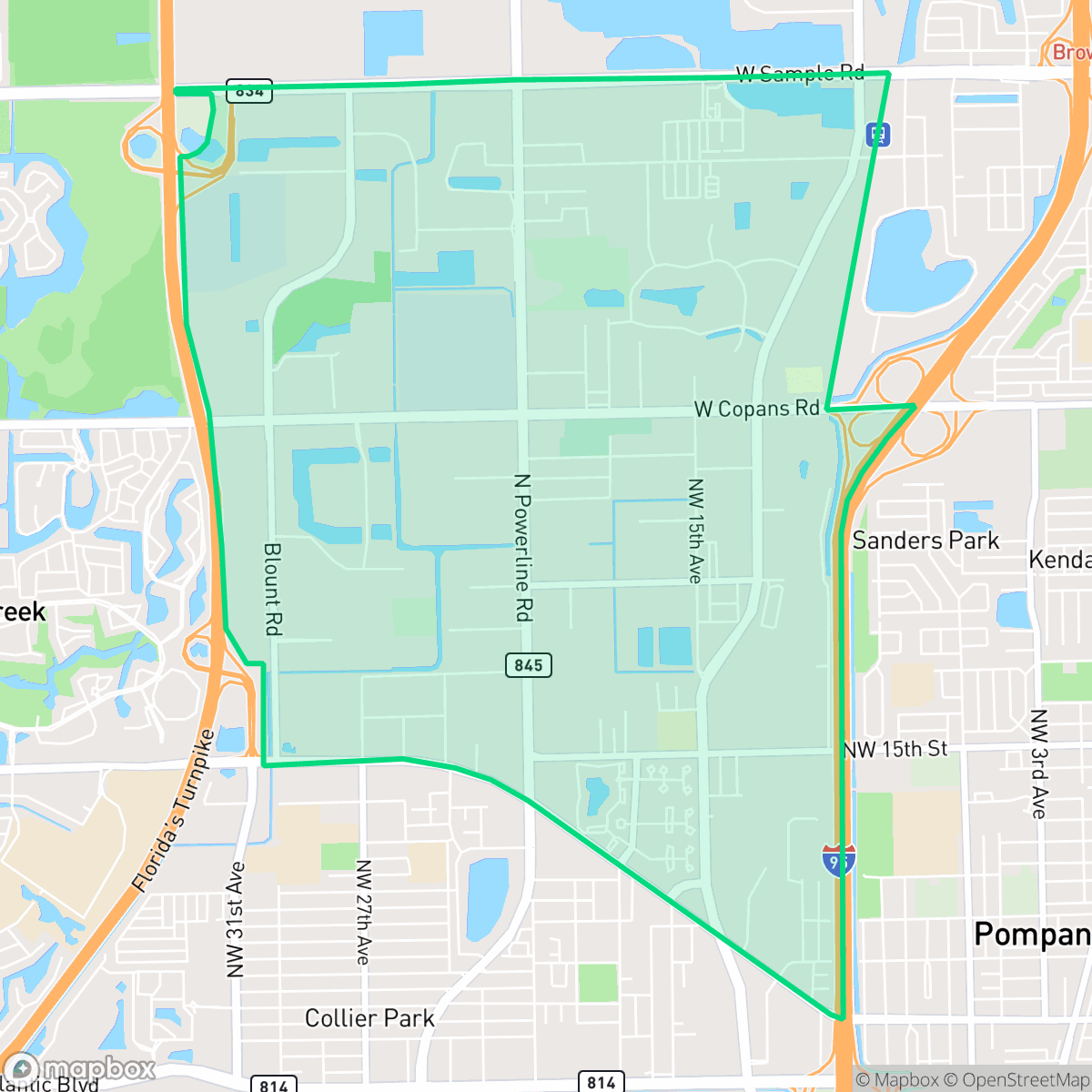
About Northwest Pompano
Northwest Pompano is historically significant as the heart of Pompano Beach’s African American community. Its roots trace back to the early 20th century when laborers, sharecroppers, and migrants from the Bahamas, Georgia, and the Carolinas settled in the area to work the surrounding vegetable farms. The neighborhood experienced rapid residential development in the 1950s, becoming a self-sustaining hub of homeownership and commerce. Key landmarks include the Blanche G. Ely House—the former home of a prominent civil rights activist and educator now serving as a cultural museum—along with the E. Pat Larkins Community Center and McNair Park. The area’s character is defined by its long-standing residential heritage, historic churches, and the commercial corridor along Martin Luther King Jr. Boulevard, which remains a focal point for the neighborhood’s social and cultural identity.
The neighborhood features a mix of single-family homes and apartment complexes, interspersed with industrial zones and warehouses. This blend creates a quiet, functional environment where daily life revolves around local parks and residential pockets. The landscape is primarily defined by standard tract housing, which offers a consistent, if modest, visual aesthetic throughout the area.
Prospective residents should be aware of the trade-offs regarding daily accessibility and environmental factors. According to iHuus data, the area experiences high noise levels due to proximity to major transportation corridors, and limited sidewalk infrastructure makes walking a challenge. Additionally, the neighborhood faces higher flood risks and lower health insurance coverage rates compared to the broader Pompano Beach region. This area is best suited for those who prioritize an established community feel over walkability and quietude.
Neighborhood Scores Across 15 Qualities
Residential spacing varies between widely separated homes and dense apartment clusters, resulting in a level of privacy that is slightly lower than the Pompano Beach average. According to iHuus data, some areas feature closely packed multi-family units with minimal buffers between neighbors.
High-traffic arterials and industrial warehouse zones create significant barriers to walking. According to iHuus data, the lack of sidewalk infrastructure makes this area much less walkable than the Pompano Beach average.
Standard tract housing and industrial architecture define the local landscape, resulting in a visual profile that is less varied than the Pompano Beach average. Most residential areas consist of mid-range apartments and small yards with basic roof geometries.
Walking dogs can be challenging due to sparse greenery and industrial zones dominated by pavement; this neighborhood offers fewer accessible parks and trails than the Pompano Beach average.
A diverse blend of single-family homes, apartment complexes, and industrial warehouses defines the landscape. This density is slightly lower than the Pompano Beach average, offering a balance between residential streets and large commercial or industrial zones.
Local activity is subdued and primarily revolves around suburban residential pockets, parks, and industrial warehouses. This area feels less energetic than the Pompano Beach average due to sparse commercial density and a reliance on vehicles for most errands.
Frequent disturbances from nearby railroad tracks and heavy freeway traffic characterize the area. According to iHuus data, acoustic comfort in this neighborhood is notably lower than the Pompano Beach average.
Air quality fluctuates between acceptable and unhealthy levels, presenting occasional concerns for sensitive groups. This level of air quality is slightly lower than the average found throughout Pompano Beach, according to iHuus data.
Frequent truck traffic and warehouse activity are notable in certain sectors, making industrial proximity higher than the Pompano Beach average. Residents may encounter intermittent noise from logistics hubs and large-scale loading docks near residential pockets.
Health insurance access is significantly lower in this area than the Pompano Beach average. According to iHuus data, a small minority of local residents are covered by health plans.
Political leanings in this area are more liberal than the Pompano Beach average. Residents will find a liberal majority with a moderate presence of opposing viewpoints according to iHuus data.
A varied range of age groups, including young adults and seniors, characterizes the area. According to iHuus data, this demographic distribution is more skewed toward specific age brackets than the typical Pompano Beach profile.
Flood risk in this area remains uncertain due to a lack of detailed FEMA studies, though the level of risk is slightly higher than the Pompano Beach average according to iHuus data.
Address-Level Insights for Northwest Pompano


iHuus Neighborhood Intelligence Insights
Get address-level neighborhood insights for Northwest Pompano
- Street-level scores — see how individual blocks compare, not just neighborhood averages
- Micro-zone boundaries — identify quiet pockets, flood boundaries, and walkable clusters before you visit
- 15 dimensions in full — walkability, noise, air quality, school quality, insurance coverage, population age profile, urban/rural index, and more
- Boundary risk alerts — know if your address sits near a block boundary where scores drop, the kind of detail no listing will ever mention
- School insights — individual school ratings and insights, not just district-level data
- Compare before you commit — side-by-side data across neighborhoods, down to block precision
No credit card required
Compare with Any Neighborhood
| Dimension | Northwest Pompano | Andrews Industrial District |
|---|---|---|
| 🚶 Walkabilityavg 6.05 | ||
| 🔊 Acoustic Comfortavg 3.33 | ||
| 🤫 Privacy Indexavg 5.28 | ||
| 🎨 Visual Appealavg 6.23 | ||
| 🐕 Dog Friendlinessavg 4.87 | ||
| 🗺️ Urban-Rural Indexavg 6.07 | ||
| ✨ Neighborhood Vibeavg 3.88 | ||
| 🏥 Health Insurance Coverageavg 4.55 | ||
| 🌿 Air Qualityavg 5.68 | ||
| 🏭 Industrial Proximityavg 5.66 | ||
| 🌊 Flood Safetyavg 4.23 | ||
| 🗳️ Ideological Leanavg 5.55 | ||
| 👥 Population Age Profileavg 4.99 | ||
| 🔥 Fire Safety | ||
| 🏫 School Quality |
Northwest Pompano Rankings
School Districts Serving Northwest Pompano
School Insights for Northwest Pompano
Below average outcomes; significant attendance and academic challenges.
School Insights
See what's really behind every school rating near Northwest Pompano
- Individual school ratings — each school's own score with outcome context, not just a district average
- Enrollment & class size data — student-to-teacher ratio and how it compares to the state average
- Full demographics breakdown — ethnicity and gender composition for every school in the enrollment zone
- Every school in the district — all schools within the enrollment boundary ranked by rating, not just the closest one
- Grade levels & benchmarks — elementary through high school, with below/above state-average flags
No credit card required