Woodstock, Jacksonville
Updated · 4,327 residents
Woodstock is a historic Westside neighborhood defined by its grid-pattern streets and a semi-rural atmosphere that feels less densely developed than much of Jacksonville. While it offers a quiet suburban environment with access to local parks, residents should anticipate noticeable traffic noise and an uneven walking experience due to inconsistent sidewalk infrastructure.
Key Highlights
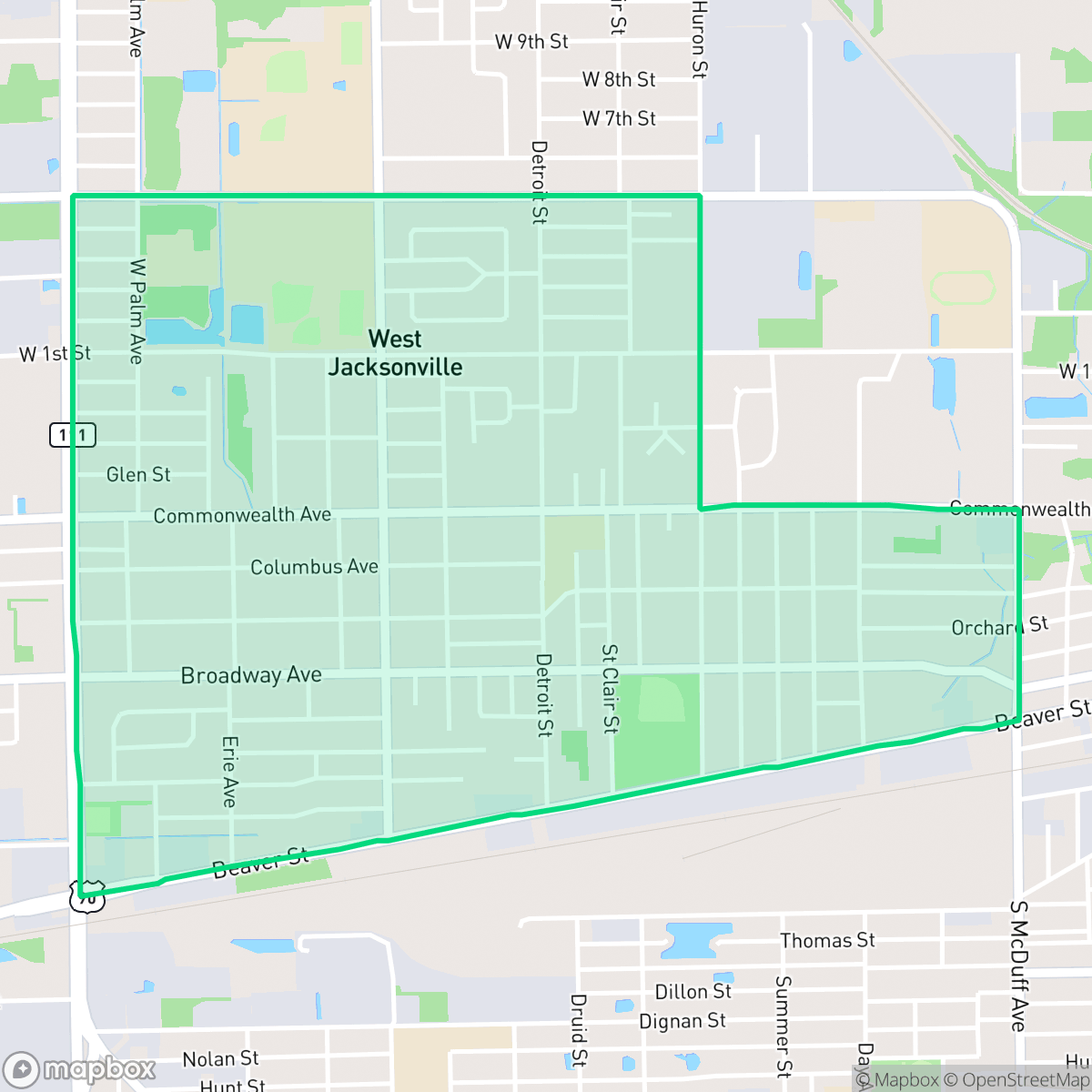
About Woodstock
Platted in 1917, Woodstock is a historic working-class neighborhood on Jacksonville’s Westside that emerged during the city’s rapid expansion between the Great Fire of 1901 and World War I. Characterized by a grid of streets named after Great Lakes waterways, the area was historically defined by its proximity to major rail yards and industrial facilities. A central landmark is the 15.8-acre Woodstock Park, deeded to the city in 1927. The neighborhood also encompasses the site of the former Paxon Air Field, where aviation pioneer Bessie Coleman died in 1926; the land later became home to Paxon High School in 1954. Annexed by Jacksonville in 1925, Woodstock retains a distinct identity shaped by its early 20th-century origins, mid-century residential growth, and a long-standing legacy of industrial and rail-based economic activity.
The neighborhood maintains a distinct character through its blend of standard single-family homes and pockets of open, undeveloped land. Residents benefit from a more varied age demographic than many other parts of the city, contributing to a diverse community feel. The area is characterized by moderate residential privacy, supported by heavy foliage and spacing between homes that exceeds the city average. While light commercial activity exists, the overall vibe remains quiet and suburban, punctuated by local dining options and accessible green spaces like Woodstock Park.
Living in this area involves several trade-offs, particularly regarding infrastructure and public services. The lack of consistent sidewalks makes navigating the neighborhood on foot unpredictable, and those sensitive to sound may find the proximity to major transit routes and industrial traffic in the southern sections noticeable. Prospective residents should also note that while air quality is generally better than the city average, the local school district is currently undergoing significant budget-related consolidations. The community is best suited for those seeking a more open, semi-rural landscape who are comfortable with a neighborhood in transition.
Neighborhood Scores Across 15 Qualities
Homes feature moderate spacing and heavy foliage that provides more separation than the Jacksonville average. According to iHuus data, house distances typically offer a balanced level of privacy between neighbors.
Residential streets are generally low traffic and easy to navigate, though the lack of consistent sidewalks makes walking less predictable than in other parts of Jacksonville. While some areas feature a sidewalk-lined grid, industrial traffic in the southern portion of Woodstock can impact the walking experience.
Standard single-family homes with small yards and boxy rooflines define the area. This visual character is consistent with the broader Jacksonville average, as observed through iHuus data.
Public athletic fields and tree-lined streets provide decent space for pets, though some residential areas lack wide grass verges. According to iHuus data, the neighborhood offers slightly better access to greenery and parks than the Jacksonville average.
Open land and woodland areas are more frequent here than in the rest of Jacksonville. Residents will find a landscape of scattered homes and fields that feels less densely developed than the city average.
Local activity levels are noticeably higher than the Jacksonville average, driven by a mix of suburban residential streets and various dining establishments. While many areas remain low-key after dark, certain pockets near transit hubs offer moderate walkability and access to local eateries.
Frequent sounds from nearby major transit routes and infrastructure are present. According to iHuus data, acoustic comfort levels in Woodstock are lower than the Jacksonville average.
Air quality in Woodstock is generally acceptable but may present occasional concerns for sensitive groups. According to iHuus data, the air quality levels here are notably better than the Jacksonville city average.
Light commercial and retail units are interspersed with residential areas, resulting in a higher concentration of utility-based traffic than the Jacksonville average. While heavy industry is absent from most parts of the neighborhood, some southern edges feature rail lines and significant truck activity.
Health insurance access among residents is roughly in line with the Jacksonville average. According to iHuus data, a significant portion of the population remains uninsured.
Voting patterns and census indicators show a predominantly liberal leaning, which is significantly more liberal than the Jacksonville average according to iHuus data.
A balanced mix of young adults, families, and older residents defines the community. According to iHuus data, this age distribution is notably more varied than the average seen across Jacksonville.
Flood risk levels in this area are currently uncertain because FEMA has not finalized a detailed study for the neighborhood. According to iHuus data, this lack of definitive information represents a slightly higher level of uncertainty than the average seen across Jacksonville.
Address-Level Insights for Woodstock


iHuus Neighborhood Intelligence Insights
Get address-level neighborhood insights for Woodstock
- Street-level scores — see how individual blocks compare, not just neighborhood averages
- Micro-zone boundaries — identify quiet pockets, flood boundaries, and walkable clusters before you visit
- 15 dimensions in full — walkability, noise, air quality, school quality, insurance coverage, population age profile, urban/rural index, and more
- Boundary risk alerts — know if your address sits near a block boundary where scores drop, the kind of detail no listing will ever mention
- School insights — individual school ratings and insights, not just district-level data
- Compare before you commit — side-by-side data across neighborhoods, down to block precision
No credit card required
Compare with Any Neighborhood
| Dimension | Woodstock | 29th and Chase |
|---|---|---|
| 🚶 Walkabilityavg 3.96 | ||
| 🔊 Acoustic Comfortavg 4.37 | ||
| 🤫 Privacy Indexavg 4.3 | ||
| 🎨 Visual Appealavg 4.24 | ||
| 🐕 Dog Friendlinessavg 4.28 | ||
| 🗺️ Urban-Rural Indexavg 5.22 | ||
| ✨ Neighborhood Vibeavg 1.5 | ||
| 🏥 Health Insurance Coverageavg 4.35 | ||
| 🌿 Air Qualityavg 3.84 | ||
| 🏭 Industrial Proximityavg 5.11 | ||
| 🌊 Flood Safetyavg 4.01 | ||
| 🗳️ Ideological Leanavg 2.75 | ||
| 👥 Population Age Profileavg 3.26 | ||
| 🔥 Fire Safety | ||
| 🏫 School Quality |
Woodstock Rankings
School Districts Serving Woodstock
School Insights for Woodstock
Below average outcomes; significant attendance and academic challenges.
School Insights
See what's really behind every school rating near Woodstock
- Individual school ratings — each school's own score with outcome context, not just a district average
- Enrollment & class size data — student-to-teacher ratio and how it compares to the state average
- Full demographics breakdown — ethnicity and gender composition for every school in the enrollment zone
- Every school in the district — all schools within the enrollment boundary ranked by rating, not just the closest one
- Grade levels & benchmarks — elementary through high school, with below/above state-average flags
No credit card required