Woodland Acres, Jacksonville
Updated · 7,575 residents
Woodland Acres is a hilly, semi-rural community in Jacksonville's Arlington area known for its diverse age demographic and pockets of active local commerce. While the neighborhood offers a quiet, green atmosphere with ample space for pets, residents should expect consistent background noise from nearby transit lines and major roadways.
Key Highlights
About Woodland Acres
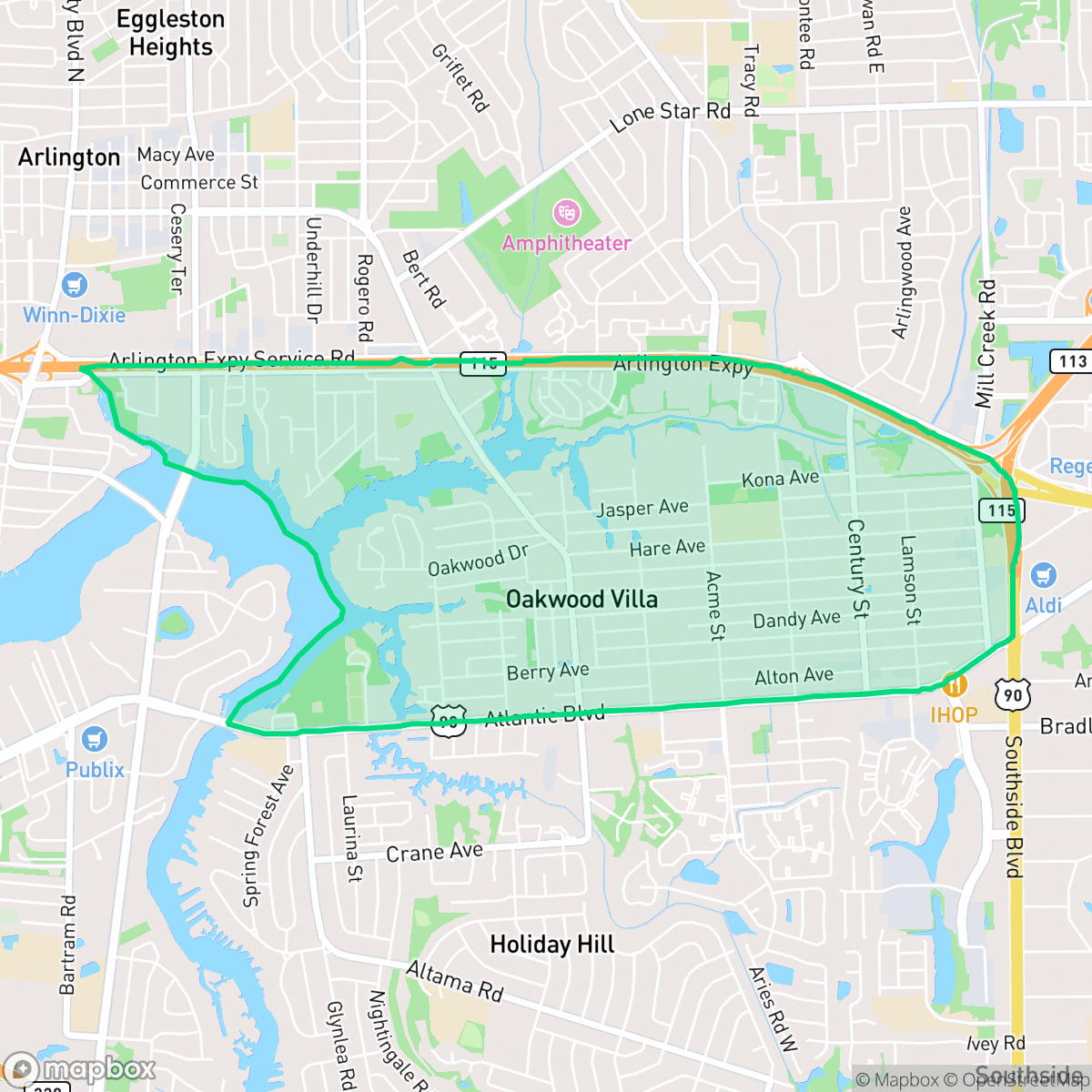
Woodland Acres, located in Jacksonville’s Arlington area, sits on land originally part of 19th-century Spanish land grants, including the Strawberry Plantation established by Francis Richard II. The neighborhood’s development began in 1910 when former city councilman Walter C. Warrington platted the area as Oakwood Villa Estates. While the community traces its roots to the early 20th century, it saw significant residential expansion between 1940 and 1960. The neighborhood is defined by its hilly topography and proximity to Silversmith and Strawberry creeks, with Arlington Road following the path of a historic 19th-century dam. Notable local landmarks include Warrington Park, donated by the Warrington family in 1955, and the nearby Kona Skatepark. Historically, the area gained a unique reputation in the 1960s as 'Sin City' due to a controversial, adults-only apartment complex that once operated within its borders.
The area maintains a distinct semi-rural character defined by its rolling topography, mature tree canopy, and generous residential buffers. Unlike many dense suburbs, it features a varied landscape that ranges from single-family homes to apartment clusters, providing a sense of privacy that often exceeds the city average. Despite its quiet residential side streets, the neighborhood hosts surprisingly lively hubs of retail and dining, serving as a social center for a diverse population of young adults, families, and seniors. According to iHuus data, this combination of natural buffers and localized commerce creates a unique living environment that feels distinct from the typical Jacksonville suburban layout. Prospective residents should consider the trade-offs of living in this part of the city, particularly regarding acoustic comfort and infrastructure. The proximity to major transit routes results in elevated noise levels throughout the day, and while residential streets are pleasant for walking, the lack of continuous sidewalks on main roads can limit pedestrian mobility. The area also requires awareness of flood risks during heavy rain events. Families will find themselves within the Duval County school system, which offers access to specialized magnet programs alongside the challenges of ongoing district-wide consolidation and budget management.
Neighborhood Scores Across 15 Qualities
Residential spacing varies significantly throughout the area, ranging from dense apartment clusters to single-family homes with moderate buffers. According to iHuus data, this neighborhood offers more separation between structures than the typical Jacksonville area.
Residential side streets are safe and pleasant for walking, though the lack of continuous sidewalks along major arterials makes traversing the neighborhood difficult. According to iHuus data, this area offers higher pedestrian connectivity than much of Jacksonville.
Typical suburban tract housing and mid-range apartment complexes characterize this area. The visual landscape features modest yards and shared amenities that are notably more varied than the Jacksonville average.
Abundant wooded buffers and residential lawns offer more space for pets than the Jacksonville average, though a central highway can act as a barrier to easy movement. According to iHuus data, while formal park access varies, the neighborhood features significant tree cover and grass verges suitable for walking dogs.
Open land and significant tree canopy provide a more rural character than the typical Jacksonville landscape. According to iHuus data, this area features frequent woodlands and scattered homes amidst larger natural buffers.
Active pockets of retail, dining, and civic institutions provide much more engagement than the typical Jacksonville suburb. While many streets remain quiet and residential, certain areas function as local hotspots for commerce and social activity according to iHuus data.
Frequent traffic and transit sounds from nearby major roads and rail lines make this area significantly louder than the Jacksonville average. According to iHuus data, residents can expect consistent acoustic disturbances throughout the day.
Air quality in Woodland Acres is generally acceptable, though it experiences occasional periods of concern for sensitive groups. According to iHuus data, the air quality levels here are notably better than the Jacksonville city average.
Largely residential with only light commercial activity and utility buffers, this area lacks heavy industrial hazards. According to iHuus data, the neighborhood features significantly fewer industrial facilities than the Jacksonville average.
Health insurance coverage levels in Woodland Acres are notably higher than the Jacksonville average. According to iHuus data, a significant portion of the local population maintains medical coverage.
Political leanings in this area are evenly split between conservative and liberal perspectives. This creates a more diverse ideological landscape than the city average, according to iHuus data.
Residents will find a more varied demographic spread of young adults, families, and seniors compared to the typical age distribution found across Jacksonville. This balanced profile indicates a community with several different generations living in close proximity.
Flood risk in this area is higher than the Jacksonville average, though detailed FEMA studies for the neighborhood are currently unavailable. Residents should remain cautious of potential water accumulation during heavy rain events according to iHuus data.
Address-Level Insights for Woodland Acres


iHuus Neighborhood Intelligence Insights
Get address-level neighborhood insights for Woodland Acres
- Street-level scores — see how individual blocks compare, not just neighborhood averages
- Micro-zone boundaries — identify quiet pockets, flood boundaries, and walkable clusters before you visit
- 15 dimensions in full — walkability, noise, air quality, school quality, insurance coverage, population age profile, urban/rural index, and more
- Boundary risk alerts — know if your address sits near a block boundary where scores drop, the kind of detail no listing will ever mention
- School insights — individual school ratings and insights, not just district-level data
- Compare before you commit — side-by-side data across neighborhoods, down to block precision
No credit card required
Compare with Any Neighborhood
| Dimension | Woodland Acres | 29th and Chase |
|---|---|---|
| 🚶 Walkabilityavg 3.96 | ||
| 🔊 Acoustic Comfortavg 4.37 | ||
| 🤫 Privacy Indexavg 4.3 | ||
| 🎨 Visual Appealavg 4.24 | ||
| 🐕 Dog Friendlinessavg 4.28 | ||
| 🗺️ Urban-Rural Indexavg 5.22 | ||
| ✨ Neighborhood Vibeavg 1.5 | ||
| 🏥 Health Insurance Coverageavg 4.35 | ||
| 🌿 Air Qualityavg 3.84 | ||
| 🏭 Industrial Proximityavg 5.11 | ||
| 🌊 Flood Safetyavg 4.01 | ||
| 🗳️ Ideological Leanavg 2.75 | ||
| 👥 Population Age Profileavg 3.26 | ||
| 🔥 Fire Safety | ||
| 🏫 School Quality |
Woodland Acres Rankings
School Districts Serving Woodland Acres
School Insights for Woodland Acres
Below average outcomes; significant attendance and academic challenges.
School Insights
See what's really behind every school rating near Woodland Acres
- Individual school ratings — each school's own score with outcome context, not just a district average
- Enrollment & class size data — student-to-teacher ratio and how it compares to the state average
- Full demographics breakdown — ethnicity and gender composition for every school in the enrollment zone
- Every school in the district — all schools within the enrollment boundary ranked by rating, not just the closest one
- Grade levels & benchmarks — elementary through high school, with below/above state-average flags
No credit card required