Whitehouse, Jacksonville
Updated · 5,939 residents
Whitehouse offers a quiet, rural atmosphere on Jacksonville's Westside, characterized by spacious residential lots and a strong sense of privacy. Residents enjoy clean air and a balanced demographic, though the area remains largely removed from the city's commercial and social hubs.
Key Highlights
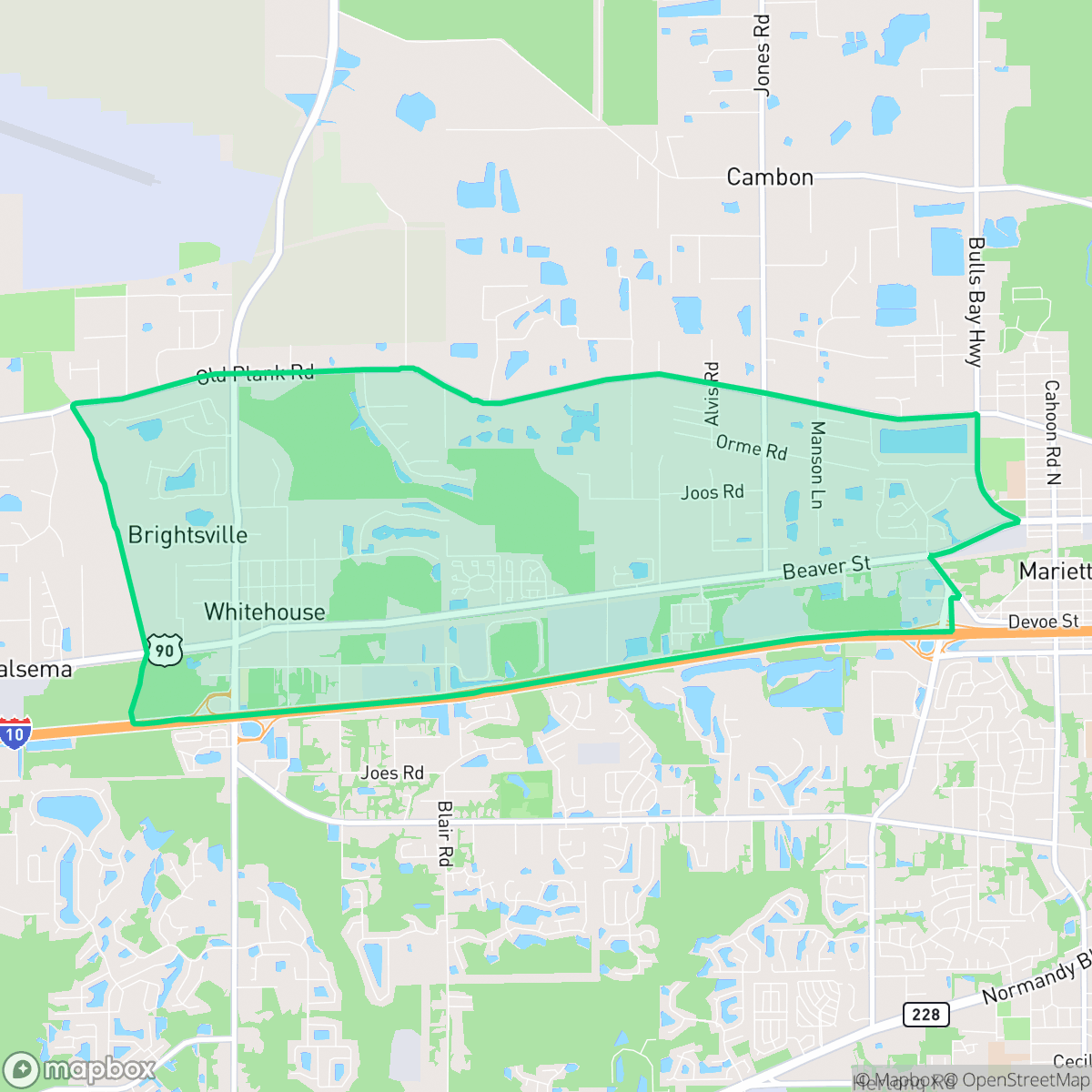
About Whitehouse
Whitehouse, located on Jacksonville's Westside, originated as a rural crossroads community that developed alongside local railroad lines. The neighborhood derives its name from a local legend involving a railroad conductor who frequently stopped his train near a prominent white frame house situated beside the tracks. The community's early development was anchored by the establishment of Whitehouse Elementary School (School Number 51) in 1926, which originally served students from grades one through eight. Historically characterized by its rural setting and proximity to rail infrastructure, Whitehouse has evolved into a residential area that retains a distinct identity separate from the dense urban core of Jacksonville.
The area is defined by its expansive natural landscapes and wooded surroundings, providing a rural character that stands in contrast to the dense urban core of Jacksonville. With large residential lots that offer significant separation between neighbors, the neighborhood appeals to those seeking a low-key, private living environment. Air quality is consistently high, and the presence of connected green spaces provides ample room for outdoor activities and pet owners to enjoy the local scenery.
While the environment is peaceful, prospective residents should consider specific trade-offs regarding infrastructure and location. The area experiences frequent traffic noise from nearby transit corridors and carries a moderate risk of flooding during heavy rain. While streets are generally quiet and suitable for walking, the lack of sidewalks and the subdued, residential nature of the neighborhood mean that daily errands often require travel to more commercialized parts of the city. It is well-suited for those who prioritize space and tranquility over immediate access to urban amenities.
Neighborhood Scores Across 15 Qualities
Large residential lots with significant separation between homes provide a level of privacy that is considerably higher than the Jacksonville average. According to iHuus data, this spacing reduces immediate proximity to neighbors.
Low traffic volumes and peaceful streets make for pleasant strolls; however, the lack of sidewalks distinguishes this area from more pedestrian-oriented urban centers. According to iHuus data, walkability here is notably higher than the Jacksonville average.
Standard tract housing with tidy yards defines the local landscape. This level of visual interest sits well above the Jacksonville average according to iHuus data.
Connected green spaces and wide paths provide ample opportunities for walking pets safely away from traffic. According to iHuus data, this level of accessibility to outdoor areas is significantly higher than the Jacksonville average.
Expansive natural landscapes and wooded areas define this area, offering a much more rural character than the Jacksonville average according to iHuus data.
Very little commercial activity or social energy exists within this residential area. According to iHuus data, the neighborhood is slightly below the city average for lively destinations and features a primarily subdued, low-key atmosphere.
Proximity to major roadways and transit corridors results in higher levels of disturbance than the Jacksonville average. Residents may experience frequent sound from nearby vehicle and rail traffic according to iHuus data.
Air quality remains mostly clean with rare instances of elevated readings; this level of air purity is significantly higher than the Jacksonville average according to iHuus data.
Primarily residential in nature, this area features very little heavy industry compared to the Jacksonville average. While most of the neighborhood consists of quiet streets and local services, some areas near storage facilities experience increased freight traffic and loading activity.
Health insurance accessibility is significantly higher than the Jacksonville average, according to iHuus data. Most residents in this area have access to comprehensive medical coverage.
Voting patterns and census indicators reflect a strongly conservative leaning, which is notably higher than the Jacksonville average according to iHuus data.
Residents live alongside a varied demographic of young adults, families, and seniors. According to iHuus data, this population spread is significantly more balanced than the citywide average.
Flood risk in this area is higher than the Jacksonville average, though a detailed federal study for this specific location is currently unavailable. Residents should remain aware of potential vulnerabilities during heavy rain events according to iHuus data.
Address-Level Insights for Whitehouse


iHuus Neighborhood Intelligence Insights
Get address-level neighborhood insights for Whitehouse
- Street-level scores — see how individual blocks compare, not just neighborhood averages
- Micro-zone boundaries — identify quiet pockets, flood boundaries, and walkable clusters before you visit
- 15 dimensions in full — walkability, noise, air quality, school quality, insurance coverage, population age profile, urban/rural index, and more
- Boundary risk alerts — know if your address sits near a block boundary where scores drop, the kind of detail no listing will ever mention
- School insights — individual school ratings and insights, not just district-level data
- Compare before you commit — side-by-side data across neighborhoods, down to block precision
No credit card required
Compare with Any Neighborhood
| Dimension | Whitehouse | 29th and Chase |
|---|---|---|
| 🚶 Walkabilityavg 3.96 | ||
| 🔊 Acoustic Comfortavg 4.37 | ||
| 🤫 Privacy Indexavg 4.3 | ||
| 🎨 Visual Appealavg 4.24 | ||
| 🐕 Dog Friendlinessavg 4.28 | ||
| 🗺️ Urban-Rural Indexavg 5.22 | ||
| ✨ Neighborhood Vibeavg 1.5 | ||
| 🏥 Health Insurance Coverageavg 4.35 | ||
| 🌿 Air Qualityavg 3.84 | ||
| 🏭 Industrial Proximityavg 5.11 | ||
| 🌊 Flood Safetyavg 4.01 | ||
| 🗳️ Ideological Leanavg 2.75 | ||
| 👥 Population Age Profileavg 3.26 | ||
| 🔥 Fire Safety | ||
| 🏫 School Quality |
Whitehouse Rankings
School Districts Serving Whitehouse
School Insights for Whitehouse
Below average outcomes; significant attendance and academic challenges.
School Insights
See what's really behind every school rating near Whitehouse
- Individual school ratings — each school's own score with outcome context, not just a district average
- Enrollment & class size data — student-to-teacher ratio and how it compares to the state average
- Full demographics breakdown — ethnicity and gender composition for every school in the enrollment zone
- Every school in the district — all schools within the enrollment boundary ranked by rating, not just the closest one
- Grade levels & benchmarks — elementary through high school, with below/above state-average flags
No credit card required