Wesconnett, Jacksonville
Updated · 5,035 residents
Wesconnett is a quiet, semi-rural community defined by its heavy tree canopy and a varied residential landscape. While the area offers a peaceful atmosphere with more privacy than typical urban settings, residents should be aware of limited sidewalk access and moderate flood risk.
Key Highlights
About Wesconnett
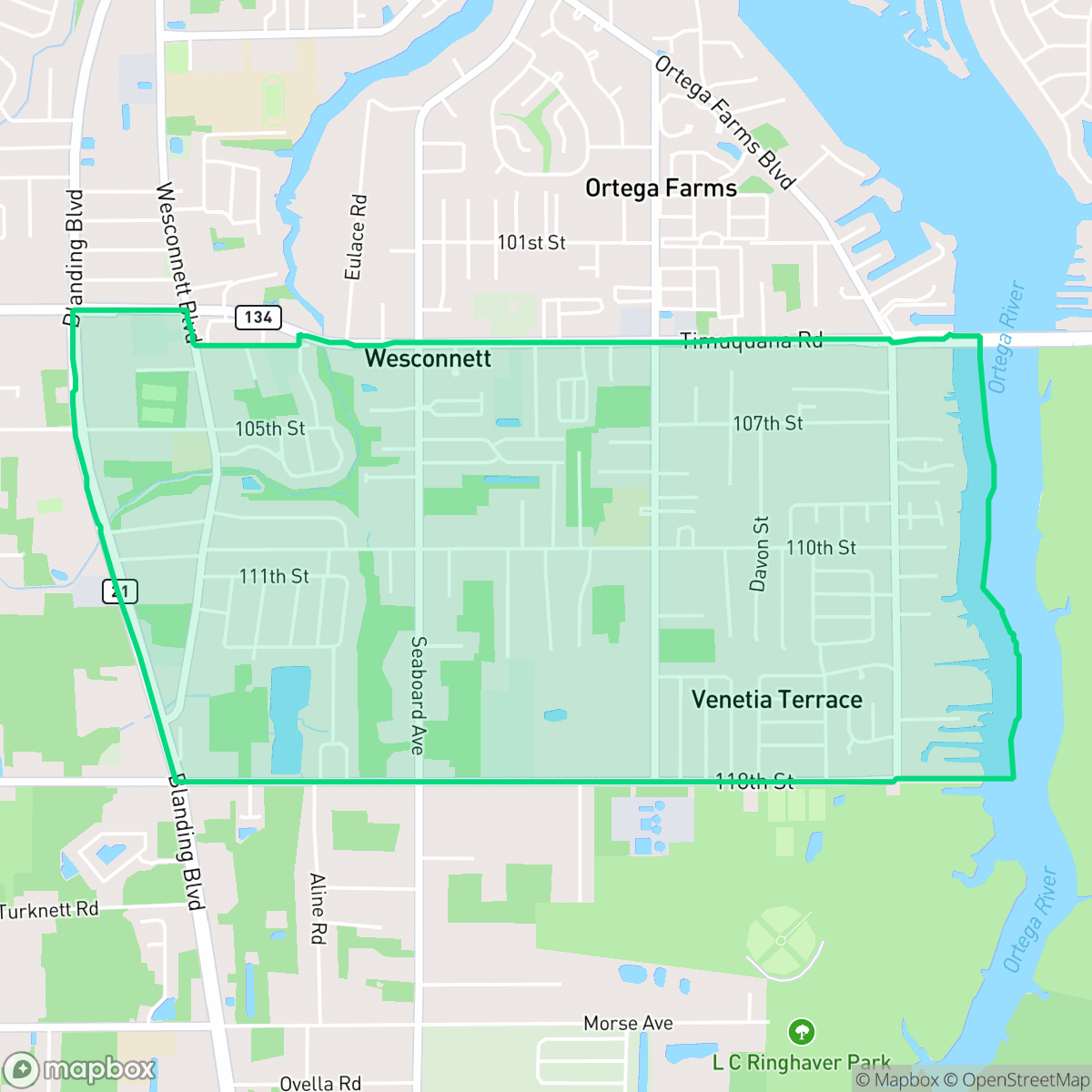
Originally known as the Fishing Pen Creek Settlement, the Wesconnett neighborhood in Jacksonville, Florida, derives its name from a 1914 community naming contest honoring three pioneer families: the Wests, the Turknetts, and the Silcoxes. Historically defined by family farms and dairy operations, the area maintained a rural character until the mid-20th century, when suburban expansion and the nearby development of the Naval Air Station transformed the landscape. The Turknett Cemetery remains a significant local landmark, serving as the last physical vestige of the community's early agricultural heritage. The historic heart of the neighborhood was centered near the intersection of Wesconnett Boulevard, Old Timquana Road, and 103rd Street, where the transition from rural homesteads to the residential subdivisions that define its modern identity began.
The neighborhood maintains a distinct semi-rural character, characterized by open land and a significant tree canopy that provides a buffer between homes. The housing stock is diverse, ranging from mobile home clusters to more isolated wooded lots, which creates a higher level of residential privacy than is found in many other parts of Jacksonville. Because the area remains largely residential with minimal commercial activity, the environment is notably quiet and subdued, making it a suitable choice for those who prefer a low-density living experience over a bustling urban center.
Living in this area involves specific trade-offs, particularly regarding infrastructure and environmental factors. Pedestrians often navigate road shoulders due to a lack of formal sidewalks, though low traffic volumes make walking feasible in many sections. Residents should also be prepared for moderate flood risk, as official federal studies for the area are still pending. Regarding education, the neighborhood falls under the Duval County School District, where families may experience a wide range of outcomes depending on school zoning and access to specialized magnet programs as the district undergoes a significant consolidation process.
Neighborhood Scores Across 15 Qualities
Housing density varies significantly across the area, ranging from concentrated mobile home clusters to more isolated wooded lots. This level of privacy is higher than the Jacksonville average, offering more buffer between neighbors in certain sections according to iHuus data.
Pedestrians must often use road shoulders due to a lack of formal sidewalks on many residential streets. While the low traffic volume makes walking feasible, the area remains more walkable than the Jacksonville average because some arterial roads feature established paths.
Modest tract housing and mobile home parks define the landscape, though the area features a more varied visual character than much of Jacksonville. Landscapes consist primarily of functional yards and standard apartment complexes without significant luxury amenities.
Green verges and a significant tree canopy provide adequate space for strolls, though public park access is limited compared to the Jacksonville average. According to iHuus data, much of the neighborhood's greenery consists of private wooded lots rather than dedicated recreational parks.
Open land and heavy tree canopy characterize this area, offering a more semi-rural feel than the typical Jacksonville urban landscape. Low-density residential pockets and wooded lots are frequent throughout the neighborhood according to iHuus data.
Primarily defined by a calm, suburban atmosphere, this area features low-density housing and a heavy tree canopy with very little commercial activity. While the neighborhood offers more local presence than the city average, it remains a subdued environment with few points of interest or nightlife.
Local traffic from nearby busy streets creates a consistent background noise, though levels are slightly more noticeable than the Jacksonville average.
Air quality levels in Wesconnett fluctuate between acceptable and unhealthy, which is notably better than the average for Jacksonville. Sensitive groups should remain aware of occasional days with higher pollutant concentrations according to iHuus data.
A blend of residential streets and light commercial uses defines this area, which contains more industrial activity than the Jacksonville average. While most blocks are quiet, certain sectors include utility infrastructure, storage facilities, and heavy freight traffic.
Health insurance coverage among residents is higher than the Jacksonville average. According to iHuus data, a significant portion of the population maintains coverage, though access remains moderate compared to broader city trends.
Political leanings in this area are relatively balanced between conservative and liberal perspectives, which represents a more even split than the city average according to iHuus data.
Residents will find a more varied mix of young adults, families, and seniors compared to the broader Jacksonville area. According to iHuus data, the population lacks the heavy concentration of a single age demographic seen elsewhere in the city.
Flood risk levels in this area are notably higher than the Jacksonville average. According to iHuus data, the precise level of danger remains undetermined as official federal flood studies for this specific location have not yet been completed.
Address-Level Insights for Wesconnett


iHuus Neighborhood Intelligence Insights
Get address-level neighborhood insights for Wesconnett
- Street-level scores — see how individual blocks compare, not just neighborhood averages
- Micro-zone boundaries — identify quiet pockets, flood boundaries, and walkable clusters before you visit
- 15 dimensions in full — walkability, noise, air quality, school quality, insurance coverage, population age profile, urban/rural index, and more
- Boundary risk alerts — know if your address sits near a block boundary where scores drop, the kind of detail no listing will ever mention
- School insights — individual school ratings and insights, not just district-level data
- Compare before you commit — side-by-side data across neighborhoods, down to block precision
No credit card required
Compare with Any Neighborhood
| Dimension | Wesconnett | 29th and Chase |
|---|---|---|
| 🚶 Walkabilityavg 3.96 | ||
| 🔊 Acoustic Comfortavg 4.37 | ||
| 🤫 Privacy Indexavg 4.3 | ||
| 🎨 Visual Appealavg 4.24 | ||
| 🐕 Dog Friendlinessavg 4.28 | ||
| 🗺️ Urban-Rural Indexavg 5.22 | ||
| ✨ Neighborhood Vibeavg 1.5 | ||
| 🏥 Health Insurance Coverageavg 4.35 | ||
| 🌿 Air Qualityavg 3.84 | ||
| 🏭 Industrial Proximityavg 5.11 | ||
| 🌊 Flood Safetyavg 4.01 | ||
| 🗳️ Ideological Leanavg 2.75 | ||
| 👥 Population Age Profileavg 3.26 | ||
| 🔥 Fire Safety | ||
| 🏫 School Quality |
Wesconnett Rankings
School Districts Serving Wesconnett
School Insights for Wesconnett
Below average outcomes; significant attendance and academic challenges.
School Insights
See what's really behind every school rating near Wesconnett
- Individual school ratings — each school's own score with outcome context, not just a district average
- Enrollment & class size data — student-to-teacher ratio and how it compares to the state average
- Full demographics breakdown — ethnicity and gender composition for every school in the enrollment zone
- Every school in the district — all schools within the enrollment boundary ranked by rating, not just the closest one
- Grade levels & benchmarks — elementary through high school, with below/above state-average flags
No credit card required