University Park, Jacksonville
Updated · 3,106 residents
University Park is a quiet, spacious residential enclave in Jacksonville defined by its mature tree canopy, upscale waterfront properties, and pedestrian-friendly streets. The neighborhood offers a semi-rural atmosphere with a balanced demographic profile, providing a peaceful environment for residents who prioritize outdoor activity and privacy over proximity to commercial hubs.
Key Highlights
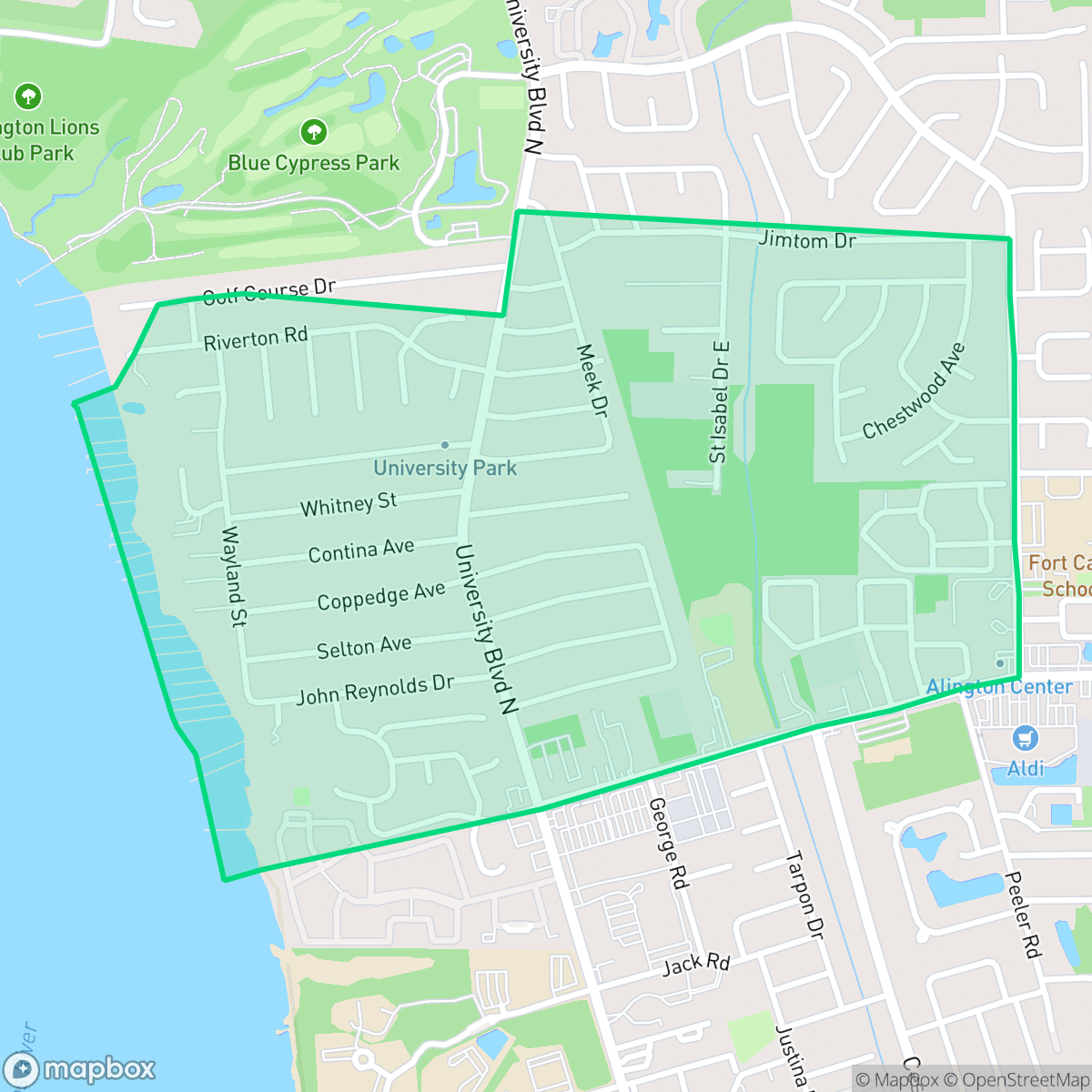
About University Park
University Park serves as a tranquil, primarily residential community characterized by its expansive lots, manicured landscapes, and significant greenbelts. The area maintains a distinctively spacious suburban feel, enhanced by mature trees that offer both visual appeal and a sense of privacy for homeowners. With its prevalence of sidewalks and low-traffic residential loops, the neighborhood is well-suited for those who enjoy walking, and it remains a popular choice for dog owners due to the abundance of open space and forested buffers.
While the area offers a high quality of life, it is primarily a quiet residential zone with very limited commercial amenities or local business activity. Prospective residents should be aware of the moderate risk of drainage issues during heavy rain and the proximity of an EPA Superfund site that may warrant consideration regarding groundwater. Educational needs are served by the Duval County School District, where families often navigate the balance between neighborhood schools and the district's competitive magnet programs. According to iHuus data, the area provides a stable, ideologically diverse environment that is notably cleaner and more pedestrian-friendly than the broader Jacksonville city average.
Neighborhood Scores Across 15 Qualities
Residential spacing varies between dense apartment complexes and single-family homes, though many properties benefit from mature trees that provide more visual buffer than the Jacksonville average. According to iHuus data, wooded rear yards and standard lot sizes offer a moderate level of separation between neighbors.
Sidewalks are prevalent along main roads and residential streets, making the area significantly more walkable than the Jacksonville average. Low-traffic loops and cul-de-sacs offer safe walking environments, though dense tree canopy can occasionally obscure pavement in certain sections.
Manicured landscapes, large lots, and premium waterfront properties with private docks create a highly attractive visual environment. This area features significantly more upscale amenities and spacious estates than the Jacksonville average.
Abundant forested buffers, sports fields, and low-traffic streets offer much more space for pets than the Jacksonville average. Many residential areas feature large wooded sections and wide grassy buffers that are well-suited for outdoor activity.
Frequent open land and significant tree cover create a semi-rural atmosphere that is notably more open than the Jacksonville average. Residential areas feature a mix of single-family homes and preserved greenbelts, according to iHuus data.
Primarily composed of established single-family homes and greenbelts, this area offers a calm atmosphere with more local activity than the Jacksonville average. While the neighborhood is walkable, residents will find very few commercial amenities or points of interest within the immediate vicinity.
Steady sounds from nearby busy streets are common throughout the area. According to iHuus data, acoustic comfort in University Park is slightly higher than the Jacksonville average.
Air quality levels are generally acceptable but may occasionally reach levels that cause concern for sensitive groups. According to iHuus data, the air quality in University Park remains notably better than the Jacksonville city average.
Primarily residential and institutional land use defines this area, providing a much cleaner environment than the Jacksonville average. While light commercial services and an electrical substation are present, residents should note the proximity of a nearby EPA Superfund site which may impact groundwater concerns according to iHuus data.
Health insurance access among residents is notably higher than the Jacksonville average, according to iHuus data.
Political leanings within this area are split relatively evenly between conservative and liberal perspectives. This creates a more ideologically balanced landscape than the broader Jacksonville average, according to iHuus data.
Residents live alongside a wide variety of age demographics, including young adults and families. This population spread is notably more balanced than the city average, according to iHuus data.
Flood risk in this area is higher than the Jacksonville average, though a lack of detailed FEMA studies means the exact level of uncertainty remains undetermined. According to iHuus data, residents should account for potential moderate drainage considerations during heavy rain events.
Address-Level Insights for University Park


iHuus Neighborhood Intelligence Insights
Get address-level neighborhood insights for University Park
- Street-level scores — see how individual blocks compare, not just neighborhood averages
- Micro-zone boundaries — identify quiet pockets, flood boundaries, and walkable clusters before you visit
- 15 dimensions in full — walkability, noise, air quality, school quality, insurance coverage, population age profile, urban/rural index, and more
- Boundary risk alerts — know if your address sits near a block boundary where scores drop, the kind of detail no listing will ever mention
- School insights — individual school ratings and insights, not just district-level data
- Compare before you commit — side-by-side data across neighborhoods, down to block precision
No credit card required
Compare with Any Neighborhood
| Dimension | University Park | 29th and Chase |
|---|---|---|
| 🚶 Walkabilityavg 3.96 | ||
| 🔊 Acoustic Comfortavg 4.37 | ||
| 🤫 Privacy Indexavg 4.3 | ||
| 🎨 Visual Appealavg 4.24 | ||
| 🐕 Dog Friendlinessavg 4.28 | ||
| 🗺️ Urban-Rural Indexavg 5.22 | ||
| ✨ Neighborhood Vibeavg 1.5 | ||
| 🏥 Health Insurance Coverageavg 4.35 | ||
| 🌿 Air Qualityavg 3.84 | ||
| 🏭 Industrial Proximityavg 5.11 | ||
| 🌊 Flood Safetyavg 4.01 | ||
| 🗳️ Ideological Leanavg 2.75 | ||
| 👥 Population Age Profileavg 3.26 | ||
| 🔥 Fire Safety | ||
| 🏫 School Quality |
University Park Rankings
School Districts Serving University Park
School Insights for University Park
Below average outcomes; significant attendance and academic challenges.
School Insights
See what's really behind every school rating near University Park
- Individual school ratings — each school's own score with outcome context, not just a district average
- Enrollment & class size data — student-to-teacher ratio and how it compares to the state average
- Full demographics breakdown — ethnicity and gender composition for every school in the enrollment zone
- Every school in the district — all schools within the enrollment boundary ranked by rating, not just the closest one
- Grade levels & benchmarks — elementary through high school, with below/above state-average flags
No credit card required