Tiger Hole-Secret Woods, Jacksonville
Updated · 3,912 residents
Tiger Hole-Secret Woods is a tranquil, semi-rural community in Jacksonville defined by its mature tree canopy and upscale residential aesthetic. The area provides a peaceful living environment with well-defined sidewalk networks and significant privacy buffers between properties.
Key Highlights
About Tiger Hole-Secret Woods
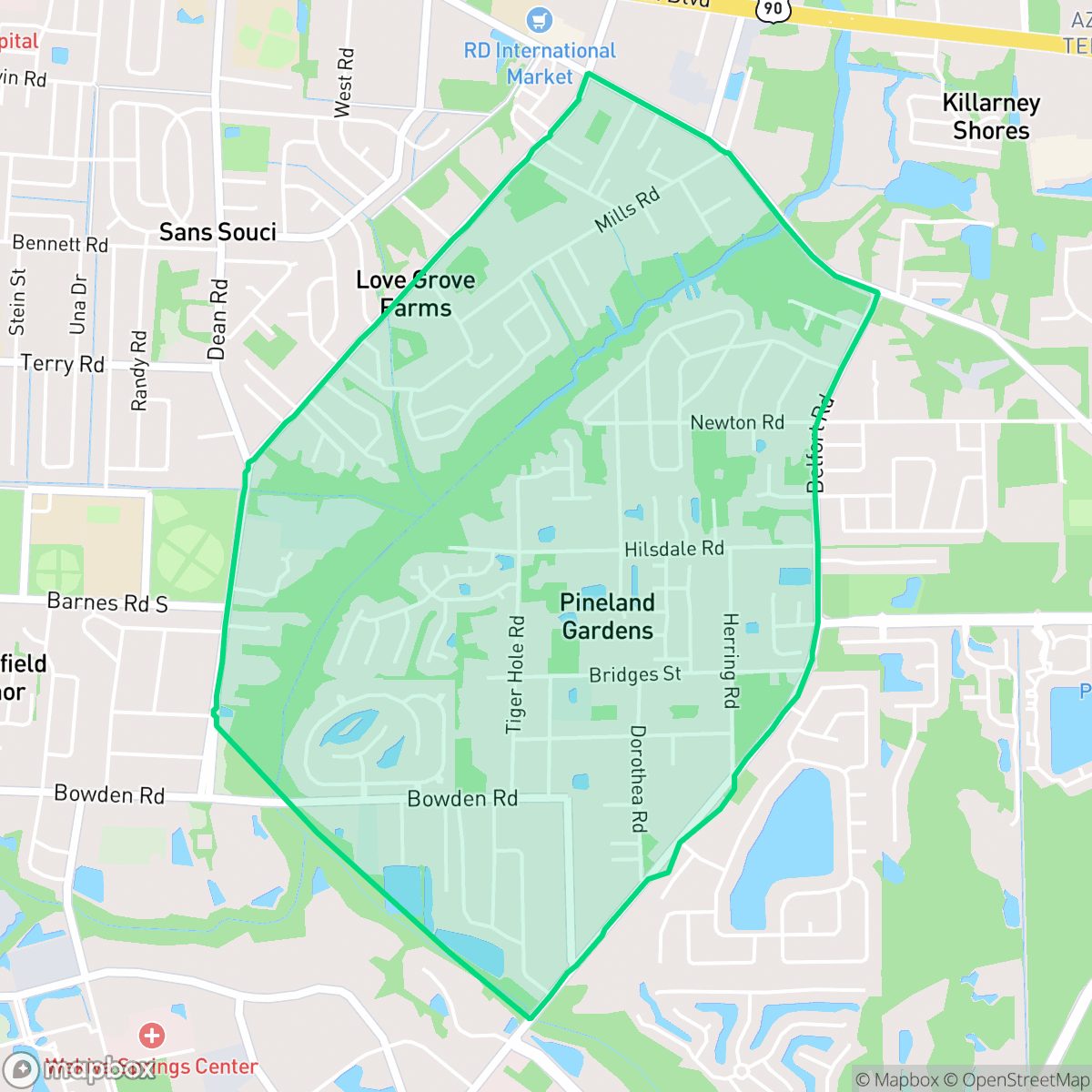
The Tiger Hole-Secret Woods neighborhood in Jacksonville is a suburban residential area in the Southside region. Its development was largely defined by the Secret Woods subdivision, which began construction in 1984 under developer Howard White. Prior to this, the land was primarily rural, consisting of swampy, marshy terrain that was often used for farming or left undeveloped. To prepare the site for housing, developers utilized soil excavated from retention ponds to fill the wetlands. Historically, the area was known for its relative isolation, characterized by its quiet, rural nature before the surrounding region underwent significant commercial expansion. Today, the neighborhood is noted for its established single-family homes and its convenient proximity to major Jacksonville shopping centers and commuter routes, marking a transition from its origins as a secluded, marshy tract to a central suburban community.
The neighborhood maintains a semi-rural character that feels distinct from the typical dense suburban landscape of Jacksonville. With minimal industrial activity and a high level of visual appeal, residents enjoy a quiet atmosphere supported by large lots and forested buffers. According to iHuus data, the area attracts a diverse mix of age groups, ranging from young families to older individuals, all of whom benefit from the neighborhood's commitment to preserving its natural green spaces.
Prospective residents should consider the trade-offs of living in a location that balances seclusion with proximity to major transit routes. While the neighborhood offers a calm retreat, a consistent hum from nearby traffic is present. Educational options fall under the Duval County School District, which offers access to specialized magnet programs alongside a broader landscape of shifting school consolidations. The area provides moderate flood safety, and its well-connected paths make it a notably pet-friendly environment for those who enjoy walking through wooded surroundings.
Neighborhood Scores Across 15 Qualities
Residential spacing offers a mix of clustered homes and forested buffers that provide more separation than the Jacksonville average. According to iHuus data, properties feature detached housing with modest yards and varying levels of distance between neighbors.
Sidewalk networks are well-defined in certain residential clusters and along main arterials, making this area significantly more walkable than the Jacksonville average. While some residential streets lack consistent sidewalks, low-traffic cul-de-sacs provide safe routes for pedestrians according to iHuus data.
Large homes and frequent private amenities, such as backyard pools, contribute to a visual environment significantly more polished than the Jacksonville average. According to iHuus data, the area features expansive driveways and well-maintained residential lots.
Extensive wooded areas and wide, grassy verges provide a much more pet-friendly environment than the Jacksonville average. Residents benefit from connected green spaces and paths that are well-separated from traffic.
Frequent open land and significant tree canopy provide a more secluded, wooded atmosphere than the typical Jacksonville suburban landscape. Residents can expect a mix of scattered homes and forest patches that feel notably less dense than the city average.
This area offers a calm, low-key atmosphere with significantly more activity than the city average. While commercial options are sparse, the neighborhood features a peaceful suburban character defined by heavy tree canopies and limited street life.
Local traffic from nearby busy streets creates a consistent hum. This level of acoustic activity is slightly higher than the average for Jacksonville.
Air quality fluctuates between acceptable and unhealthy levels, though it remains notably better than the Jacksonville average according to iHuus data. Sensitive groups may experience occasional concern during certain periods.
Residential and light commercial uses dominate the landscape, offering a much lower presence of heavy industry than the Jacksonville average. Residents can expect primarily quiet streets and open green spaces with only occasional light commercial activity or service-related traffic.
Health insurance coverage among residents is higher than the Jacksonville average. This indicates a relatively better level of medical security compared to much of the city, according to iHuus data.
Conservative political leanings are characteristic of this area, aligning closely with the broader Jacksonville average according to iHuus data.
Residents live alongside a balanced mix of young adults, families, and older individuals. According to iHuus data, this age distribution is more varied than the average seen across Jacksonville.
Residual flood risks exist within the area as it falls within a 500-year floodplain. This level of safety is notably higher than the Jacksonville city average, according to iHuus data.
Address-Level Insights for Tiger Hole-Secret Woods


iHuus Neighborhood Intelligence Insights
Get address-level neighborhood insights for Tiger Hole-Secret Woods
- Street-level scores — see how individual blocks compare, not just neighborhood averages
- Micro-zone boundaries — identify quiet pockets, flood boundaries, and walkable clusters before you visit
- 15 dimensions in full — walkability, noise, air quality, school quality, insurance coverage, population age profile, urban/rural index, and more
- Boundary risk alerts — know if your address sits near a block boundary where scores drop, the kind of detail no listing will ever mention
- School insights — individual school ratings and insights, not just district-level data
- Compare before you commit — side-by-side data across neighborhoods, down to block precision
No credit card required
Compare with Any Neighborhood
| Dimension | Tiger Hole-Secret Woods | 29th and Chase |
|---|---|---|
| 🚶 Walkabilityavg 3.96 | ||
| 🔊 Acoustic Comfortavg 4.37 | ||
| 🤫 Privacy Indexavg 4.3 | ||
| 🎨 Visual Appealavg 4.24 | ||
| 🐕 Dog Friendlinessavg 4.28 | ||
| 🗺️ Urban-Rural Indexavg 5.22 | ||
| ✨ Neighborhood Vibeavg 1.5 | ||
| 🏥 Health Insurance Coverageavg 4.35 | ||
| 🌿 Air Qualityavg 3.84 | ||
| 🏭 Industrial Proximityavg 5.11 | ||
| 🌊 Flood Safetyavg 4.01 | ||
| 🗳️ Ideological Leanavg 2.75 | ||
| 👥 Population Age Profileavg 3.26 | ||
| 🔥 Fire Safety | ||
| 🏫 School Quality |
Tiger Hole-Secret Woods Rankings
School Districts Serving Tiger Hole-Secret Woods
School Insights for Tiger Hole-Secret Woods
Below average outcomes; significant attendance and academic challenges.
School Insights
See what's really behind every school rating near Tiger Hole-Secret Woods
- Individual school ratings — each school's own score with outcome context, not just a district average
- Enrollment & class size data — student-to-teacher ratio and how it compares to the state average
- Full demographics breakdown — ethnicity and gender composition for every school in the enrollment zone
- Every school in the district — all schools within the enrollment boundary ranked by rating, not just the closest one
- Grade levels & benchmarks — elementary through high school, with below/above state-average flags
No credit card required