St. Nicholas, Jacksonville
Updated · 2,176 residents
St. Nicholas is a scenic Jacksonville community defined by its upscale waterfront estates, mature oak trees, and a semi-rural atmosphere that feels distinct from the surrounding urban density. While the area offers a peaceful environment for dog owners and those seeking visual appeal, residents should anticipate higher noise levels due to proximity to major transit corridors and railroad lines.
Key Highlights
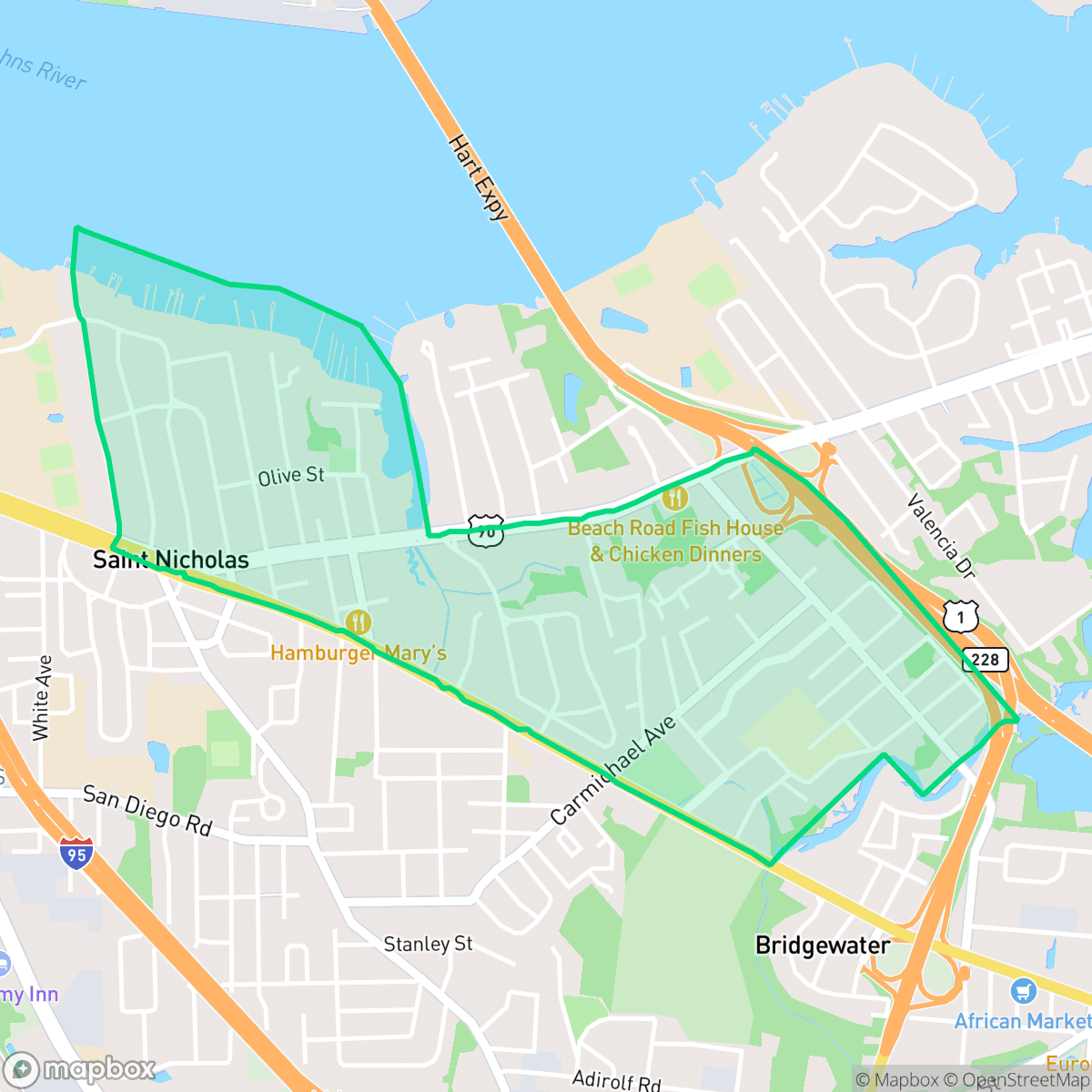
About St. Nicholas
St. Nicholas is one of Jacksonville’s oldest communities, originating from 18th-century Spanish land grants and the 1793 construction of Fort San Nicolas on the south bank of the St. Johns River. The area, named for the Spanish designation 'San Nicolas,' served as a strategic defensive point and a transit corridor along the historic King’s Road. While initially sparsely populated by plantation owners, the neighborhood evolved into a residential enclave during the early 20th century. Key landmarks include the historic St. Nicholas Cemetery, dating back to 1849, and the relocated St. Nicholas Train Station, which once served the Florida East Coast Railway. Today, the neighborhood is defined by its preserved mid-century residential character, mature oak-lined streets, and active community efforts to maintain its unique heritage and riverfront identity.
The neighborhood offers a unique blend of quiet, tree-lined residential streets and upscale riverfront properties, creating a visually polished environment. Residents enjoy a semi-rural feel with significant vegetation providing visual privacy between homes, despite being situated within reach of local university hubs and diverse dining options. The population is notably multi-generational, attracting a mix of families, young adults, and retirees who value the area's established character and scenic waterfront views.
Prospective residents should be aware of the trade-offs associated with this location, particularly regarding acoustic comfort. Frequent noise from nearby railroad lines and the Hart Expressway is a common reality for many households. While the neighborhood provides better walkability than many parts of Jacksonville, pedestrian infrastructure remains inconsistent outside of main thoroughfares. Families should also consider the broader Duval County school landscape, which features a complex mix of specialized magnet programs and ongoing district-wide consolidation efforts. Overall, the area is well-suited for those who prioritize aesthetic beauty and a central location over complete silence.
Neighborhood Scores Across 15 Qualities
Residential spacing varies between dense townhomes and large riverfront estates, offering more visual buffering than the Jacksonville average. According to iHuus data, significant backyard vegetation provides a sense of separation between many neighbors.
Pedestrian access is significantly better than the Jacksonville average, though sidewalks are mostly restricted to main roads and intermittent in residential areas. Low speed streets and wide paved shoulders make walking through many parts of the neighborhood viable for residents.
Large estates, private pools, and riverfront docks create a highly scenic environment that is significantly more visually polished than the Jacksonville average. According to iHuus data, the presence of waterfront amenities and expansive properties defines the area's aesthetic.
Abundant tree canopy and low-traffic residential streets provide shaded, safe walking areas. According to iHuus data, these connected green spaces and nearby river access make the area significantly more dog-friendly than the Jacksonville average.
Open land and wooded areas are more common here than across much of Jacksonville. Residents will find a mix of low-density housing and scattered greenery, according to iHuus data.
Activity levels are notably higher than the Jacksonville average due to a diverse mix of university hubs, civic institutions, and various dining options. While some residential pockets remain quiet and suburban, other areas near the Hart Expressway provide a surprisingly lively atmosphere for residents.
Frequent auditory disruptions occur due to the neighborhood's proximity to active railroad lines and busy freeway corridors. According to iHuus data, acoustic comfort in St. Nicholas is significantly lower than the Jacksonville average.
Air quality in this area fluctuates between acceptable and unhealthy levels, posing occasional concerns for sensitive groups. According to iHuus data, these conditions are notably better than the average found across Jacksonville.
Residential life remains largely undisturbed by heavy industry, as the area contains only light commercial services and local utilities. This lack of industrial activity is significantly lower than the Jacksonville average, according to iHuus data.
Health insurance enrollment among residents is notably higher than the Jacksonville average, according to iHuus data.
Political viewpoints are evenly distributed within the area, presenting a more balanced ideological landscape than much of Jacksonville. According to iHuus data, residents encounter a mix of conservative and liberal perspectives.
Residents of all life stages are present here, providing a more diverse age distribution than the Jacksonville average. This mix of young adults, families, and seniors creates a multi-generational community atmosphere.
Flood safety levels are higher than the Jacksonville average, though official assessments for this specific area remain incomplete. Residents should remain aware of potential vulnerabilities since detailed federal flood studies have not been finalized for these streets.
Address-Level Insights for St. Nicholas


iHuus Neighborhood Intelligence Insights
Get address-level neighborhood insights for St. Nicholas
- Street-level scores — see how individual blocks compare, not just neighborhood averages
- Micro-zone boundaries — identify quiet pockets, flood boundaries, and walkable clusters before you visit
- 15 dimensions in full — walkability, noise, air quality, school quality, insurance coverage, population age profile, urban/rural index, and more
- Boundary risk alerts — know if your address sits near a block boundary where scores drop, the kind of detail no listing will ever mention
- School insights — individual school ratings and insights, not just district-level data
- Compare before you commit — side-by-side data across neighborhoods, down to block precision
No credit card required
Compare with Any Neighborhood
| Dimension | St. Nicholas | 29th and Chase |
|---|---|---|
| 🚶 Walkabilityavg 3.96 | ||
| 🔊 Acoustic Comfortavg 4.37 | ||
| 🤫 Privacy Indexavg 4.3 | ||
| 🎨 Visual Appealavg 4.24 | ||
| 🐕 Dog Friendlinessavg 4.28 | ||
| 🗺️ Urban-Rural Indexavg 5.22 | ||
| ✨ Neighborhood Vibeavg 1.5 | ||
| 🏥 Health Insurance Coverageavg 4.35 | ||
| 🌿 Air Qualityavg 3.84 | ||
| 🏭 Industrial Proximityavg 5.11 | ||
| 🌊 Flood Safetyavg 4.01 | ||
| 🗳️ Ideological Leanavg 2.75 | ||
| 👥 Population Age Profileavg 3.26 | ||
| 🔥 Fire Safety | ||
| 🏫 School Quality |
St. Nicholas Rankings
School Districts Serving St. Nicholas
School Insights for St. Nicholas
Below average outcomes; significant attendance and academic challenges.
School Insights
See what's really behind every school rating near St. Nicholas
- Individual school ratings — each school's own score with outcome context, not just a district average
- Enrollment & class size data — student-to-teacher ratio and how it compares to the state average
- Full demographics breakdown — ethnicity and gender composition for every school in the enrollment zone
- Every school in the district — all schools within the enrollment boundary ranked by rating, not just the closest one
- Grade levels & benchmarks — elementary through high school, with below/above state-average flags
No credit card required