St. Johns Bluff, Jacksonville
Updated · 1,014 residents
St. Johns Bluff is a quiet, scenic enclave defined by its elevated forested landscape and large, private waterfront estates. The area offers a tranquil, rural atmosphere with minimal commercial activity, making it a peaceful retreat from the surrounding city.
Key Highlights
About St. Johns Bluff
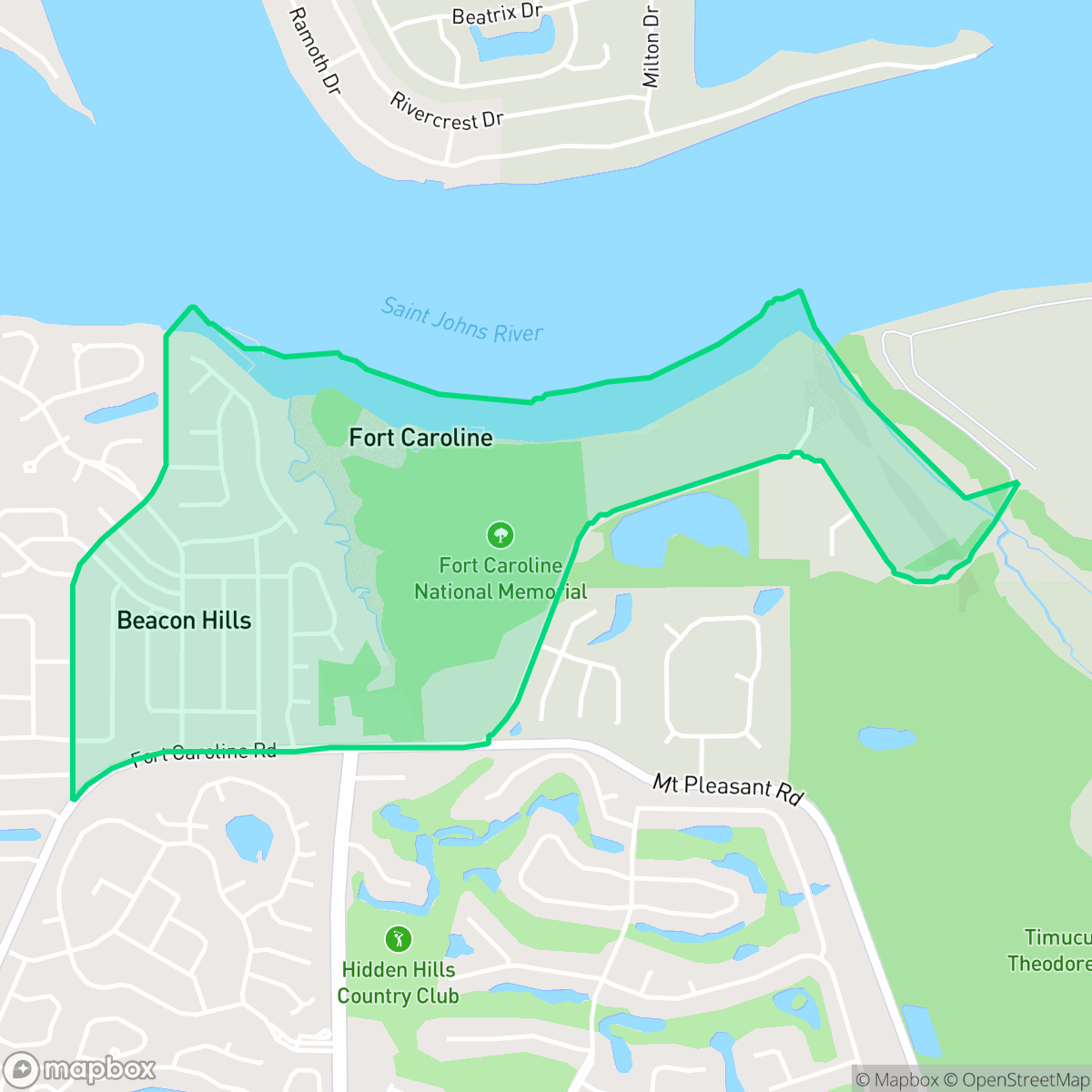
St. Johns Bluff, the highest point in Duval County, is a site of immense historical significance dating back to the 16th-century arrival of French Huguenots, who established nearby Fort Caroline in 1564. The area’s strategic elevation overlooking the St. Johns River made it a focal point for defense throughout history, including the 1782 development of St. Johns Town to house Loyalist refugees and the 1862 Civil War Battle of St. Johns Bluff, where Confederate forces constructed earthworks to control river navigation. In 1898, the bluff was further utilized for artillery installations during the Spanish-American War. Today, while much of the surrounding area has transitioned into a residential neighborhood, the bluff remains a landmark of colonial exploration and military history, with much of the original landscape preserved under the stewardship of the National Park Service.
The neighborhood is characterized by its low housing density and significant tree canopy, which fosters a secluded environment. Residents enjoy spacious lots and a high degree of visual appeal, particularly along the local canals where large homes are common. With minimal industrial presence and a notably quiet acoustic profile, the area provides a tranquil setting that feels removed from the typical bustle of Jacksonville. According to iHuus data, the community benefits from a strong sense of privacy, supported by mature trees that buffer residential properties.
While the area is conducive to walking on quiet residential streets, it lacks traditional sidewalk infrastructure and immediate access to commercial destinations. Families and retirees often find the environment appealing due to high rates of health insurance coverage and a balanced demographic mix. Prospective residents should note that while the neighborhood is safer regarding flood risks than much of the city, they will be served by the broader Duval County School District, which currently manages a complex transition involving school consolidations and budget adjustments.
Neighborhood Scores Across 15 Qualities
Residential plots feature moderate spacing and mature trees that provide more visual buffering between neighbors than the Jacksonville average. According to iHuus data, these natural buffers help maintain a sense of separation despite the neighborhood's mixed density.
Low traffic volumes and a lush tree canopy make these streets safer for pedestrians than the Jacksonville average, even though sidewalks are largely absent. Residents can enjoy walking through residential cul-de-sacs without significant vehicle interference.
Large homes with private pools and spacious driveways characterize the area, particularly along the canals. This level of visual appeal is significantly higher than the Jacksonville average according to iHuus data.
Low traffic volumes and grassy verges provide a favorable environment for walking dogs, offering significantly better conditions than the Jacksonville average. While dedicated public parks are limited, the tree-covered residential streets offer quiet routes for pet owners.
Low housing density and a significant tree canopy provide a much more rural atmosphere than the Jacksonville average. According to iHuus data, this area is characterized by forested landscapes and sparse development.
Minimal commercial activity and a lack of local destinations create a highly tranquil, residential atmosphere. This area offers slightly less street life than the Jacksonville average, characterized by low-density housing and very few points of interest.
Acoustic levels are significantly lower than the Jacksonville average, with only occasional sounds from distant traffic or trains. Residents can expect a tranquil environment according to iHuus data.
Air quality levels fluctuate between acceptable and unhealthy, posing occasional concerns for sensitive groups. According to iHuus data, the air quality in this area is notably better than the Jacksonville average.
Industrial activity is very low in this area, consisting primarily of residential streets and natural wetlands. According to iHuus data, the neighborhood lacks the heavy manufacturing and freight traffic found more commonly across Jacksonville.
Health insurance enrollment among residents is exceptionally high, significantly outpacing the Jacksonville average according to iHuus data.
Voting patterns and census indicators reflect a more conservative political leaning than the Jacksonville average, according to iHuus data.
Residents live alongside a wide variety of age demographics, ranging from young professionals to seniors. This demographic mix is notably more balanced than the much younger average seen across Jacksonville.
Residual flood risks exist due to the area being within a 500-year floodplain, though safety levels remain significantly higher than the Jacksonville average according to iHuus data.
Address-Level Insights for St. Johns Bluff


iHuus Neighborhood Intelligence Insights
Get address-level neighborhood insights for St. Johns Bluff
- Street-level scores — see how individual blocks compare, not just neighborhood averages
- Micro-zone boundaries — identify quiet pockets, flood boundaries, and walkable clusters before you visit
- 15 dimensions in full — walkability, noise, air quality, school quality, insurance coverage, population age profile, urban/rural index, and more
- Boundary risk alerts — know if your address sits near a block boundary where scores drop, the kind of detail no listing will ever mention
- School insights — individual school ratings and insights, not just district-level data
- Compare before you commit — side-by-side data across neighborhoods, down to block precision
No credit card required
Compare with Any Neighborhood
| Dimension | St. Johns Bluff | 29th and Chase |
|---|---|---|
| 🚶 Walkabilityavg 3.96 | ||
| 🔊 Acoustic Comfortavg 4.37 | ||
| 🤫 Privacy Indexavg 4.3 | ||
| 🎨 Visual Appealavg 4.24 | ||
| 🐕 Dog Friendlinessavg 4.28 | ||
| 🗺️ Urban-Rural Indexavg 5.22 | ||
| ✨ Neighborhood Vibeavg 1.5 | ||
| 🏥 Health Insurance Coverageavg 4.35 | ||
| 🌿 Air Qualityavg 3.84 | ||
| 🏭 Industrial Proximityavg 5.11 | ||
| 🌊 Flood Safetyavg 4.01 | ||
| 🗳️ Ideological Leanavg 2.75 | ||
| 👥 Population Age Profileavg 3.26 | ||
| 🔥 Fire Safety | ||
| 🏫 School Quality |
St. Johns Bluff Rankings
School Districts Serving St. Johns Bluff
School Insights for St. Johns Bluff
Below average outcomes; significant attendance and academic challenges.
School Insights
See what's really behind every school rating near St. Johns Bluff
- Individual school ratings — each school's own score with outcome context, not just a district average
- Enrollment & class size data — student-to-teacher ratio and how it compares to the state average
- Full demographics breakdown — ethnicity and gender composition for every school in the enrollment zone
- Every school in the district — all schools within the enrollment boundary ranked by rating, not just the closest one
- Grade levels & benchmarks — elementary through high school, with below/above state-average flags
No credit card required