Spring Park, Jacksonville
Updated · 4,908 residents
Spring Park is a distinctive Jacksonville community defined by its semi-rural character and mature tree canopy, offering a blend of suburban living and historical significance. While the area provides residents with high health insurance accessibility and a diverse demographic mix, it is characterized by noticeable noise levels from nearby transit corridors and a fragmented sidewalk network.
Key Highlights
About Spring Park
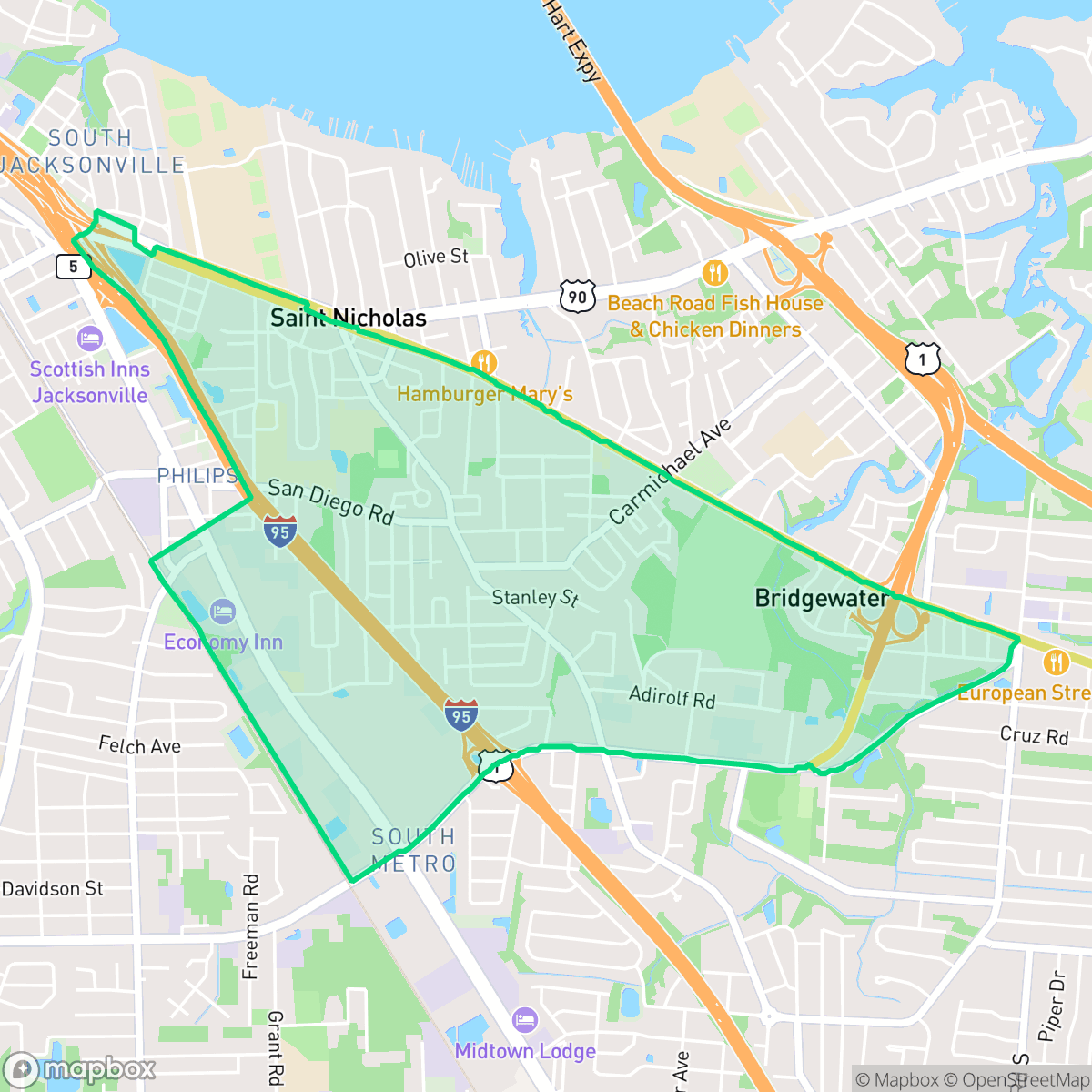
Spring Park, located between Emerson Street, Philips Highway, and Beach Boulevard, evolved from historically rural African American communities—most notably the 19th-century Philips settlement—into a suburban residential area during Jacksonville's mid-20th-century expansion. The neighborhood’s street grid and layout remain vivid reminders of its rural origins, later transformed by post-World War II infrastructure projects like the completion of Beach Boulevard in 1949. By the late 1950s, Spring Park became a hub for Southside development, hosting early suburban landmarks like the Southgate Shopping Center and the Koger Center, the nation's first suburban office park. The community is also home to the historic Douglas Anderson School of the Arts, which began as a public school for African American students in 1922 and remains a significant cultural institution in the area today.
The area maintains a semi-rural feel with frequent open spaces and significant vegetation that creates visual buffers between properties. It serves as a central hub for diverse residents, ranging from young professionals to retirees, and is bolstered by high rates of health insurance coverage. The landscape features a mix of standard suburban developments and more upscale riverfront estates, contributing to a varied visual identity that stands out within the broader Jacksonville region. Prospective residents should consider the trade-offs associated with the location near major transit arteries. While the proximity to key roads provides convenience, it also results in higher noise levels from vehicle and rail traffic. The pedestrian experience is similarly mixed, as quiet residential streets offer pleasant walking conditions, yet the lack of a continuous sidewalk network can limit mobility for those who prefer to travel on foot. Additionally, while the area is generally well-maintained, residents should be mindful of flood risks during periods of heavy rainfall.
Neighborhood Scores Across 15 Qualities
Residential spacing provides more separation between neighbors than the Jacksonville average. Trees and vegetation often create visual buffers between homes, though density increases near apartment clusters.
Low-traffic residential streets allow for safe walking, though the lack of a continuous sidewalk network makes pedestrian travel more difficult than in many other parts of Jacksonville. While main arterials provide some infrastructure, many interior streets rely on wide paved shoulders rather than dedicated sidewalks.
Riverfront estates and private pools contribute to a visual landscape that is significantly more polished than the Jacksonville average. Residents will notice many large homes with waterfront docks alongside standard suburban developments and some commercial warehouses.
Abundant tree canopy, wide residential verges, and nearby community parks provide more outdoor walking opportunities for pets than the Jacksonville average. According to iHuus data, while some areas feature private fenced yards, others offer direct access to shaded paths and riverfront greenery.
Frequent open land and scattered homes amidst woodlands provide a more semi-rural feel than the typical Jacksonville landscape. According to iHuus data, this area features more significant tree canopy and low-density pockets compared to the city average.
A diverse array of dining, hospitality, and educational institutions provides much more activity than the typical Jacksonville neighborhood. While primarily suburban in character, certain pockets near major transit corridors offer a surprisingly lively atmosphere with easy access to local restaurants and wellness services.
Frequent disturbance from nearby transit corridors and railroad proximity creates a much noisier environment than the Jacksonville average. According to iHuus data, residents can expect significant acoustic interference from heavy vehicle and rail traffic.
Air quality in Spring Park is notably better than the Jacksonville average, though residents may still encounter days that are unhealthy for sensitive groups. According to iHuus data, conditions typically fluctuate between acceptable and concerning levels.
Industrial activity is notably lower than the Jacksonville average, consisting primarily of light commercial services and occasional warehouses. Residents may experience minor truck traffic and low-level operational noise near certain transit corridors, but heavy industrial hazards are absent.
Health insurance accessibility is significantly higher than the Jacksonville average, according to iHuus data. Most residents in this area have access to comprehensive medical coverage.
Political leanings in Spring Park are split nearly evenly between conservative and liberal perspectives, representing a more diverse ideological landscape than the city average according to iHuus data.
Residents will find a more varied demographic spread than in much of Jacksonville, as the area contains a notable balance of young adults, families, and seniors according to iHuus data.
Flood risk in this area is higher than the Jacksonville average, though a lack of detailed federal studies means specific vulnerability levels remain undetermined. Residents should exercise caution during heavy rain events based on iHuus data.
Address-Level Insights for Spring Park


iHuus Neighborhood Intelligence Insights
Get address-level neighborhood insights for Spring Park
- Street-level scores — see how individual blocks compare, not just neighborhood averages
- Micro-zone boundaries — identify quiet pockets, flood boundaries, and walkable clusters before you visit
- 15 dimensions in full — walkability, noise, air quality, school quality, insurance coverage, population age profile, urban/rural index, and more
- Boundary risk alerts — know if your address sits near a block boundary where scores drop, the kind of detail no listing will ever mention
- School insights — individual school ratings and insights, not just district-level data
- Compare before you commit — side-by-side data across neighborhoods, down to block precision
No credit card required
Compare with Any Neighborhood
| Dimension | Spring Park | 29th and Chase |
|---|---|---|
| 🚶 Walkabilityavg 3.96 | ||
| 🔊 Acoustic Comfortavg 4.37 | ||
| 🤫 Privacy Indexavg 4.3 | ||
| 🎨 Visual Appealavg 4.24 | ||
| 🐕 Dog Friendlinessavg 4.28 | ||
| 🗺️ Urban-Rural Indexavg 5.22 | ||
| ✨ Neighborhood Vibeavg 1.5 | ||
| 🏥 Health Insurance Coverageavg 4.35 | ||
| 🌿 Air Qualityavg 3.84 | ||
| 🏭 Industrial Proximityavg 5.11 | ||
| 🌊 Flood Safetyavg 4.01 | ||
| 🗳️ Ideological Leanavg 2.75 | ||
| 👥 Population Age Profileavg 3.26 | ||
| 🔥 Fire Safety | ||
| 🏫 School Quality |
Spring Park Rankings
School Districts Serving Spring Park
School Insights for Spring Park
Below average outcomes; significant attendance and academic challenges.
School Insights
See what's really behind every school rating near Spring Park
- Individual school ratings — each school's own score with outcome context, not just a district average
- Enrollment & class size data — student-to-teacher ratio and how it compares to the state average
- Full demographics breakdown — ethnicity and gender composition for every school in the enrollment zone
- Every school in the district — all schools within the enrollment boundary ranked by rating, not just the closest one
- Grade levels & benchmarks — elementary through high school, with below/above state-average flags
No credit card required