Southpoint, Jacksonville
Updated · 3,402 residents
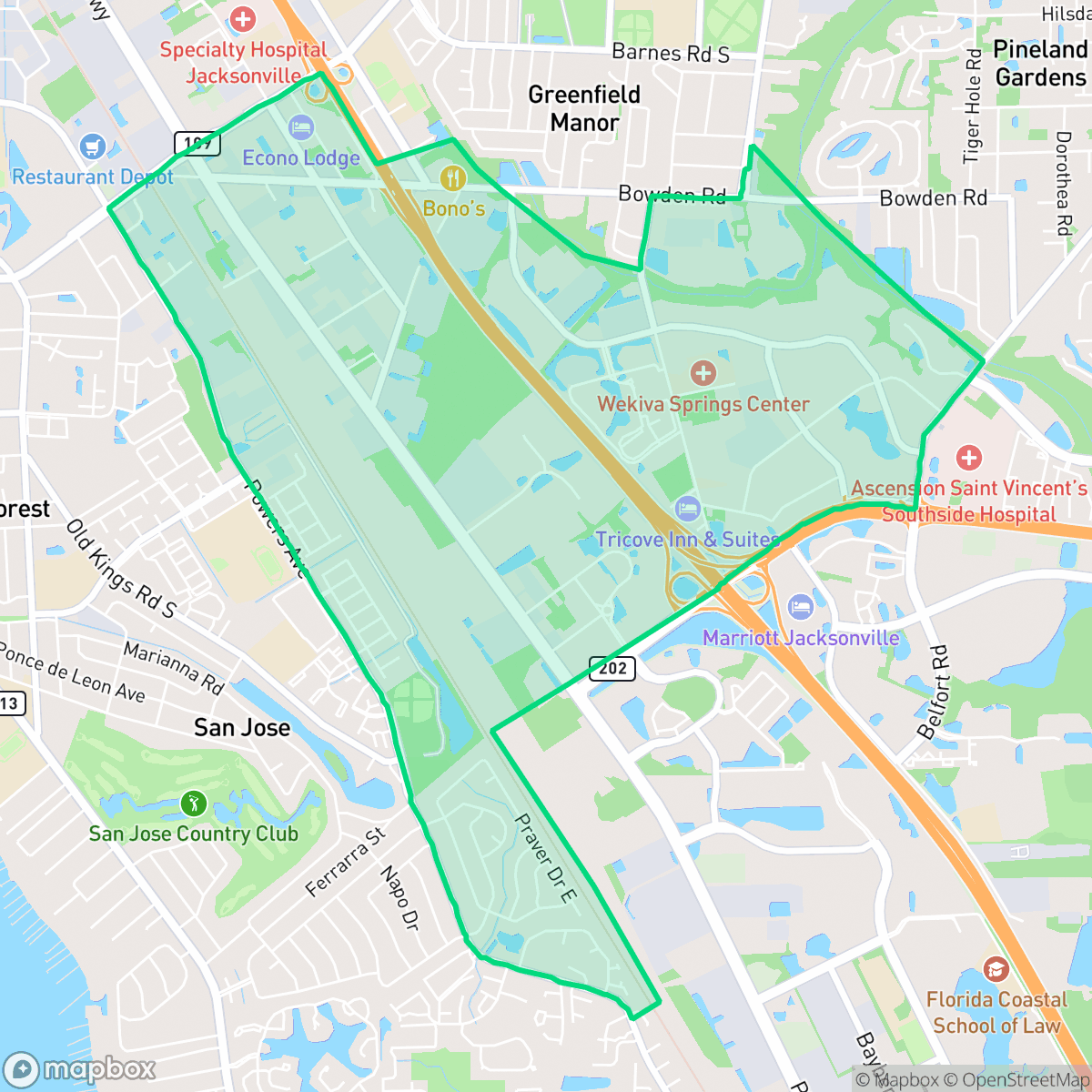
Southpoint serves as a bustling professional and medical hub in Jacksonville, characterized by its mix of corporate office parks and diverse residential pockets. While the area offers higher walkability and more green space than many local neighborhoods, residents should anticipate a lively environment with frequent noise from nearby transit and freight corridors.
Key Highlights
About Southpoint
Southpoint, located in Jacksonville’s Southside, transformed from rural Skinner family dairy and farm land into a major commercial hub during the late 1970s and early 1980s. The area's development was catalyzed by the 1979 completion of J. Turner Butler Boulevard, which improved access to the region east of Interstate 95. In 1980, Gate Petroleum partnered with the Bryant Skinner Company to establish the 250-acre Southpoint office park, defining the neighborhood’s character as a corporate and professional center. The district further solidified its role in the 1980s with the 1984 construction of St. Lukes Hospital, now known as St. Vincent’s Medical Center Southside. Today, the area remains a prominent business and medical corridor, distinguished by its concentration of professional office centers and proximity to major regional thoroughfares.
The neighborhood functions as a central suburban destination where professional life and residential living intersect. Its landscape is defined by a variety of housing styles, ranging from established tract homes to more spacious, upscale properties with private amenities. According to iHuus data, the area maintains a balanced demographic profile, attracting a mix of young professionals, families, and retirees. The presence of significant healthcare facilities and commercial centers ensures that essential services and dining options are readily accessible, contributing to a vibrant, active atmosphere.
Prospective residents should weigh the benefits of the location against its specific environmental profile. While the neighborhood provides better air quality and more recreational green space for pet owners than the city average, the proximity to major roadways and an active rail yard results in higher noise levels. Additionally, those considering the area should be mindful of the moderate flood risk and the ongoing transitions within the local school district. It is best suited for individuals who prioritize central access to major thoroughfares and a dynamic, suburban lifestyle over complete acoustic seclusion.
Neighborhood Scores Across 15 Qualities
Residential spacing fluctuates between dense apartment clusters and single-family homes with moderate yard buffers. According to iHuus data, this neighborhood offers more separation between neighbors than the Jacksonville average.
Quiet residential streets and certain newer developments provide safe walking conditions, though many main thoroughfares lack continuous sidewalk infrastructure. This level of pedestrian connectivity is higher than the average seen across Jacksonville.
Visual landscapes range from standard tract housing and dense apartments to more affluent pockets featuring large homes, golf course proximity, and private pools. According to iHuus data, the area offers a higher level of aesthetic variety than much of Jacksonville.
Abundant green verges, wooded areas, and proximity to large public parks provide more opportunities for dog walking than the Jacksonville average. Many residential streets feature substantial grass margins and backyard space suitable for pets.
Residential layouts offer a blend of single-family homes and apartment complexes alongside manicured green spaces. This environment is more densely suburban than the Jacksonville average, according to iHuus data.
This area offers a much more vibrant energy than the city average, characterized by a steady rhythm of dining, healthcare, and civic institutions. While some residential pockets remain quiet, many parts of Southpoint function as lively suburban destinations with significant local activity.
Frequent traffic and transit-related sounds characterize this area, making it significantly noisier than the Jacksonville average. According to iHuus data, proximity to major roadways and rail lines contributes to a lack of acoustic comfort.
Air quality levels in Southpoint fluctuate between acceptable and unhealthy periods, presenting occasional concerns for sensitive groups. According to iHuus data, the air quality in this neighborhood is notably better than the Jacksonville average.
Residential areas are interspersed with light commercial uses like retail and dining, though an active rail yard and logistics hub on the eastern edge introduce notable noise and freight traffic. According to iHuus data, this level of industrial proximity is slightly higher than the Jacksonville average.
Health insurance access for residents in Southpoint is notably higher than the Jacksonville average, according to iHuus data.
Political leanings in Southpoint are split nearly evenly between conservative and liberal perspectives, representing a more moderate landscape than the broader Jacksonville area according to iHuus data.
Residents live alongside a more varied mix of young adults, families, and seniors than is typically found across Jacksonville. According to iHuus data, the area lacks a single dominant age group, resulting in a balanced demographic spread.
Flood risk in this area sits above the Jacksonville average, though a lack of detailed FEMA studies makes the specific level of danger difficult to determine. Residents should remain cautious as local flood patterns are not fully documented according to iHuus data.
Address-Level Insights for Southpoint


iHuus Neighborhood Intelligence Insights
Get address-level neighborhood insights for Southpoint
- Street-level scores — see how individual blocks compare, not just neighborhood averages
- Micro-zone boundaries — identify quiet pockets, flood boundaries, and walkable clusters before you visit
- 15 dimensions in full — walkability, noise, air quality, school quality, insurance coverage, population age profile, urban/rural index, and more
- Boundary risk alerts — know if your address sits near a block boundary where scores drop, the kind of detail no listing will ever mention
- School insights — individual school ratings and insights, not just district-level data
- Compare before you commit — side-by-side data across neighborhoods, down to block precision
No credit card required
Compare with Any Neighborhood
| Dimension | Southpoint | 29th and Chase |
|---|---|---|
| 🚶 Walkabilityavg 3.96 | ||
| 🔊 Acoustic Comfortavg 4.37 | ||
| 🤫 Privacy Indexavg 4.3 | ||
| 🎨 Visual Appealavg 4.24 | ||
| 🐕 Dog Friendlinessavg 4.28 | ||
| 🗺️ Urban-Rural Indexavg 5.22 | ||
| ✨ Neighborhood Vibeavg 1.5 | ||
| 🏥 Health Insurance Coverageavg 4.35 | ||
| 🌿 Air Qualityavg 3.84 | ||
| 🏭 Industrial Proximityavg 5.11 | ||
| 🌊 Flood Safetyavg 4.01 | ||
| 🗳️ Ideological Leanavg 2.75 | ||
| 👥 Population Age Profileavg 3.26 | ||
| 🔥 Fire Safety | ||
| 🏫 School Quality |
Southpoint Rankings
School Districts Serving Southpoint
School Insights for Southpoint
Below average outcomes; significant attendance and academic challenges.
School Insights
See what's really behind every school rating near Southpoint
- Individual school ratings — each school's own score with outcome context, not just a district average
- Enrollment & class size data — student-to-teacher ratio and how it compares to the state average
- Full demographics breakdown — ethnicity and gender composition for every school in the enrollment zone
- Every school in the district — all schools within the enrollment boundary ranked by rating, not just the closest one
- Grade levels & benchmarks — elementary through high school, with below/above state-average flags
No credit card required