South Riverside, Jacksonville
Updated · 2,598 residents
South Riverside offers a semi-rural atmosphere with a diverse demographic mix and an active local culinary scene. While the neighborhood provides more privacy and better air quality than much of Jacksonville, residents should expect frequent noise from nearby rail and highway infrastructure.
Key Highlights
About South Riverside
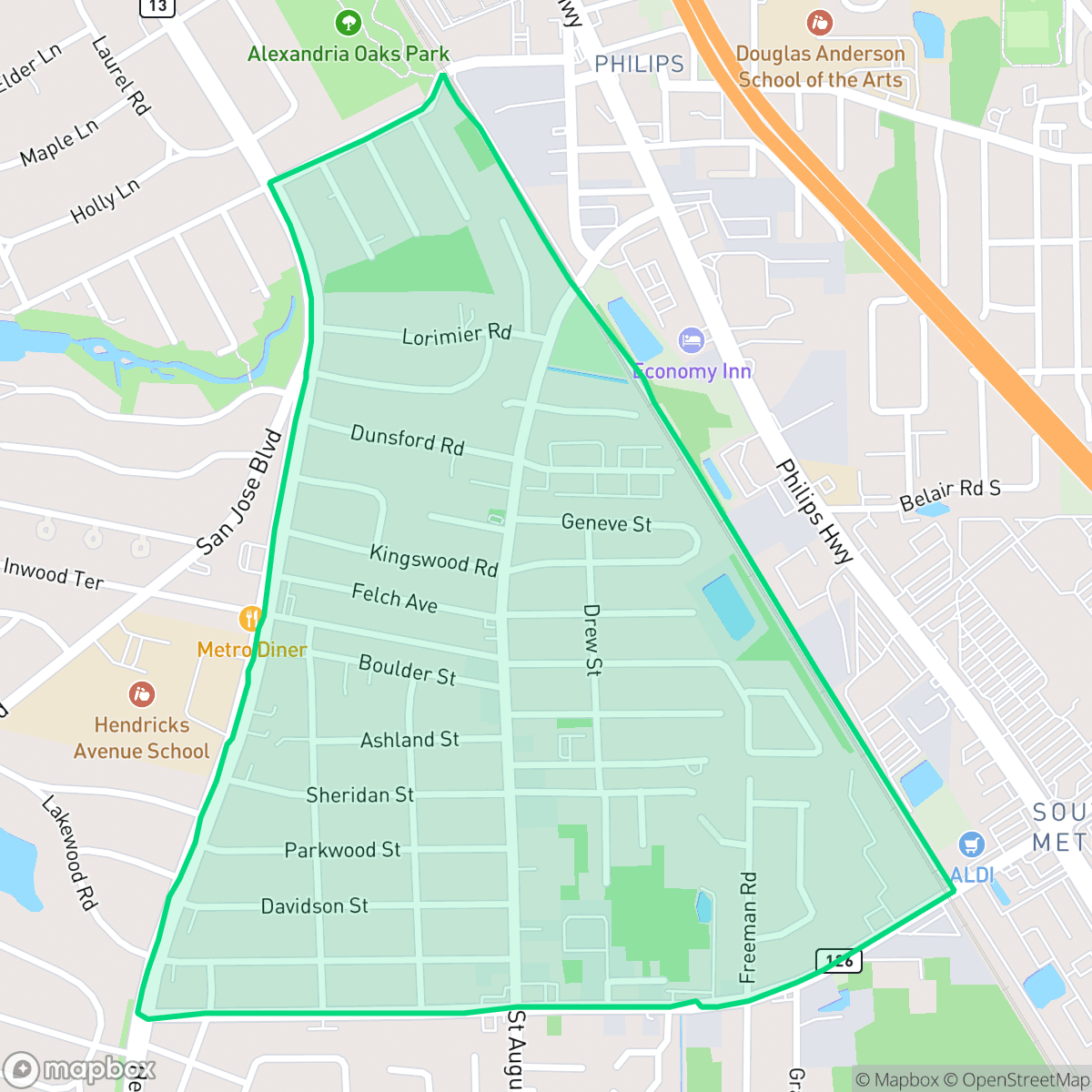
South Riverside is a Jacksonville neighborhood situated on land once part of the 19th-century Red Bank Plantation. Historically linked to the rural Philips community, which developed around a railway station and the Philips Methodist Church in the late 1800s, the area was later platted as a residential subdivision following the 1921 completion of the Acosta Bridge. Today, the neighborhood retains remnants of its past, including the historic Philips Craig Swamp Cemetery—a 140-year-old site containing graves dating back to 1867—and Angelina Danese Park, which commemorates the Italian immigrant family that established a homestead there in 1929. South Riverside is characterized by a diverse architectural mix, blending early 20th-century residential styles with the remnants of the rural settlement that existed prior to the suburban expansion of Jacksonville.
The area functions as a distinct residential pocket that balances suburban comfort with scattered light industrial zones. The landscape is marked by a diverse architectural range, featuring standard tract housing alongside mid-range apartment complexes. Residents benefit from a higher level of health insurance coverage compared to the broader city, and the neighborhood maintains a politically moderate environment. The presence of local cafes and restaurants creates a lively atmosphere that serves as a central hub for the community.
Prospective residents should weigh the benefits of increased privacy and open space against the logistical challenges of the area. While internal residential streets are generally quiet, the neighborhood faces significant pedestrian barriers due to a lack of continuous sidewalks and proximity to major transportation corridors. The local school district presents a complex landscape, where access to specialized magnet programs often contrasts with the ongoing consolidation of neighborhood schools. This area is well-suited for those who value a spread-out, semi-rural feel and proximity to local dining, provided they are comfortable with the ambient noise associated with its central transit location.
Neighborhood Scores Across 15 Qualities
Residential spacing provides more separation between neighbors than the Jacksonville average. Building distances and tree buffers vary from dense apartment layouts to standard suburban lots with moderate setbacks.
Low traffic volumes on residential streets allow for easy walking, though a lack of continuous sidewalks and major highway crossings create significant pedestrian barriers. According to iHuus data, the neighborhood offers better walkability than the Jacksonville average despite these infrastructure gaps.
Residential views consist primarily of standard tract housing and mid-range apartment complexes with relatively small yards. This level of visual variety is notably higher than the Jacksonville city average according to iHuus data.
Residential blocks feature abundant tree canopy and private fenced yards, though public park access is limited. According to iHuus data, the neighborhood offers slightly more greenery and grassy verges than the Jacksonville average.
Low-density residential pockets and open land characterize this area, which feels more spread out than the typical Jacksonville urban landscape. According to iHuus data, the neighborhood features a blend of scattered homes and light industrial zones that provide more openness than the city average.
A diverse mix of cafes, restaurants, and cultural venues provides a much higher level of activity than the Jacksonville average. Residents can access various dining options and transit hubs within a neighborhood that blends suburban pockets with lively, walkable commercial blocks.
Frequent noise from nearby railroad tracks and major freeways makes the area louder than most of Jacksonville. According to iHuus data, acoustic comfort in this neighborhood is lower than the city average.
Air quality levels in South Riverside are notably better than the Jacksonville average, though residents may still encounter occasional periods of poor air that could affect sensitive groups.
Industrial activity is notably lower than the Jacksonville average, consisting primarily of light commercial services and small warehouses. While most areas are residential, some pockets near rail lines or logistics yards may experience occasional truck traffic and operational noise.
Health insurance access among residents is significantly higher than the Jacksonville average, according to iHuus data.
Political perspectives in South Riverside are evenly split between conservative and liberal leanings, representing a more moderate landscape than the broader Jacksonville area according to iHuus data.
A varied mix of young professionals, families, and seniors resides here. According to iHuus data, this demographic distribution is significantly more balanced than the citywide average.
Residual flood risks exist within this area due to its location in a floodplain, though safety levels remain notably higher than the Jacksonville average according to iHuus data.
Address-Level Insights for South Riverside


iHuus Neighborhood Intelligence Insights
Get address-level neighborhood insights for South Riverside
- Street-level scores — see how individual blocks compare, not just neighborhood averages
- Micro-zone boundaries — identify quiet pockets, flood boundaries, and walkable clusters before you visit
- 15 dimensions in full — walkability, noise, air quality, school quality, insurance coverage, population age profile, urban/rural index, and more
- Boundary risk alerts — know if your address sits near a block boundary where scores drop, the kind of detail no listing will ever mention
- School insights — individual school ratings and insights, not just district-level data
- Compare before you commit — side-by-side data across neighborhoods, down to block precision
No credit card required
Compare with Any Neighborhood
| Dimension | South Riverside | 29th and Chase |
|---|---|---|
| 🚶 Walkabilityavg 3.96 | ||
| 🔊 Acoustic Comfortavg 4.37 | ||
| 🤫 Privacy Indexavg 4.3 | ||
| 🎨 Visual Appealavg 4.24 | ||
| 🐕 Dog Friendlinessavg 4.28 | ||
| 🗺️ Urban-Rural Indexavg 5.22 | ||
| ✨ Neighborhood Vibeavg 1.5 | ||
| 🏥 Health Insurance Coverageavg 4.35 | ||
| 🌿 Air Qualityavg 3.84 | ||
| 🏭 Industrial Proximityavg 5.11 | ||
| 🌊 Flood Safetyavg 4.01 | ||
| 🗳️ Ideological Leanavg 2.75 | ||
| 👥 Population Age Profileavg 3.26 | ||
| 🔥 Fire Safety | ||
| 🏫 School Quality |
South Riverside Rankings
School Districts Serving South Riverside
School Insights for South Riverside
Below average outcomes; significant attendance and academic challenges.
School Insights
See what's really behind every school rating near South Riverside
- Individual school ratings — each school's own score with outcome context, not just a district average
- Enrollment & class size data — student-to-teacher ratio and how it compares to the state average
- Full demographics breakdown — ethnicity and gender composition for every school in the enrollment zone
- Every school in the district — all schools within the enrollment boundary ranked by rating, not just the closest one
- Grade levels & benchmarks — elementary through high school, with below/above state-average flags
No credit card required