Secret Cove, Jacksonville
Updated · 5,486 residents
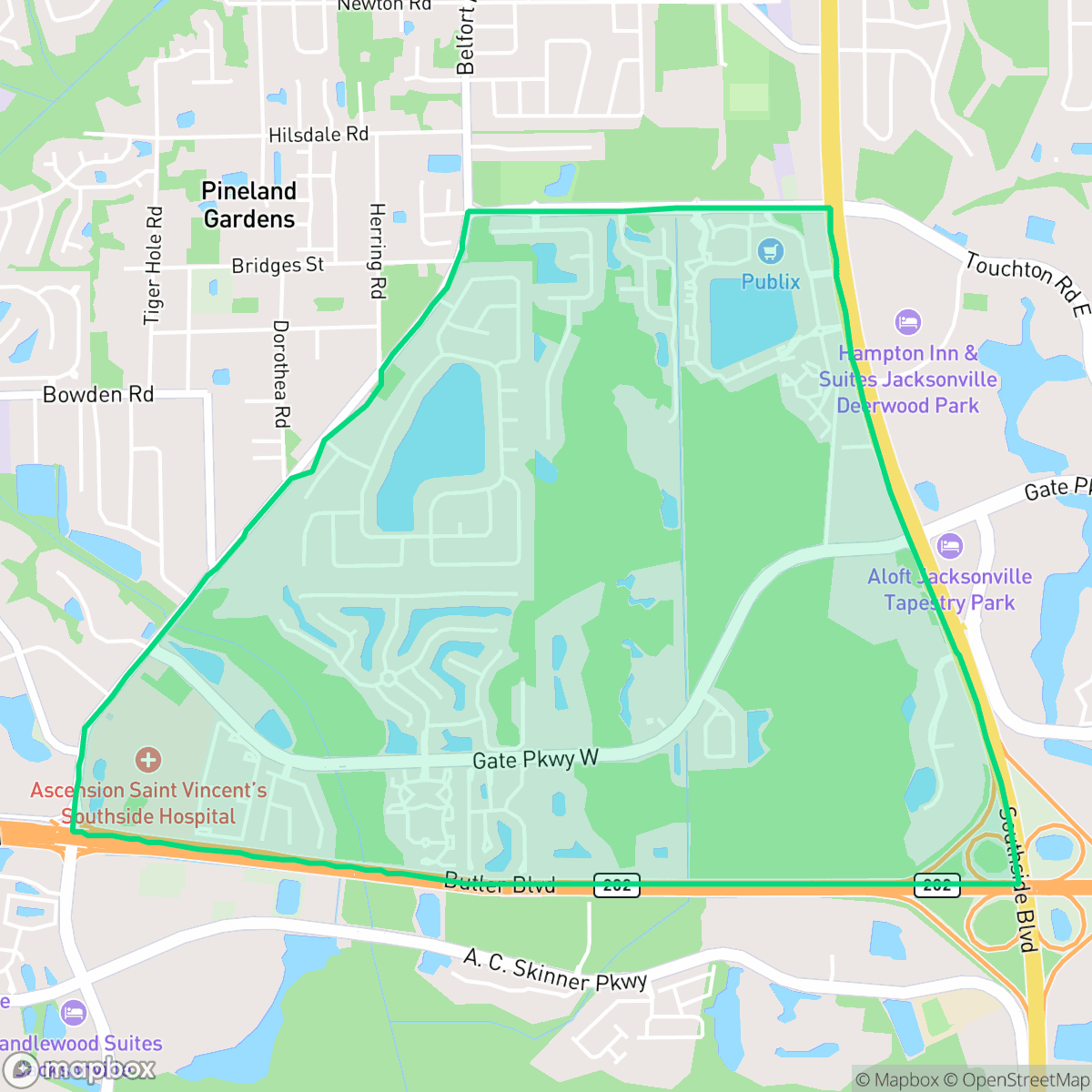
Secret Cove is a residential community in Jacksonville defined by its central 23-acre lake and an upscale suburban aesthetic. The neighborhood offers a semi-rural feel with abundant green space for pet owners, though residents should expect higher noise levels due to its proximity to major transit corridors.
Key Highlights
About Secret Cove
Secret Cove, a residential community in Jacksonville’s Southside, was developed in 1974 by Howard White of North Florida Builders. The neighborhood’s defining feature is a 23-acre lake, which originated as a 'borrow pit' created between 1963 and 1970 when earth was excavated from the Tiger Hole Swamp to provide fill dirt for the construction of nearby I-95. Prior to its transformation into a planned residential area, the site was rural, characterized by swampy terrain, farming, and active strip mining. The community was intentionally designed around this lake to preserve the natural setting, marking a significant transition from the area's history as an undeveloped, isolated tract. Today, the neighborhood remains distinct for its central water feature and the long-standing involvement of the Secret Cove Civic Association, which has helped maintain the community's character since its inception.
The neighborhood maintains a distinct identity through its combination of manicured landscaping and varied residential density, which provides more privacy than many other parts of the city. With a minimal industrial presence, the area feels primarily residential and quiet, offering a semi-rural atmosphere characterized by scattered homes nestled among woodland and field patches. It is particularly well-suited for pet owners, as the extensive greenery and wide, traffic-safe paths provide ample space for outdoor activity. According to iHuus data, the area also benefits from high levels of health insurance coverage among its diverse demographic of residents.
Living in this area involves certain trade-offs, most notably the frequent acoustic disturbances caused by nearby major transit routes. While the neighborhood is more walkable than the city average, residents are divided by a major arterial road that impacts overall connectivity. Families in the community are served by the Duval County School District, where educational outcomes vary significantly depending on access to specialized magnet programs versus neighborhood schools. This location is best suited for those who prioritize a visually appealing, pet-friendly environment and are comfortable with the noise levels associated with its convenient transit access.
Neighborhood Scores Across 15 Qualities
Residential spacing varies between dense clusters and larger lots, providing more separation than the Jacksonville average. Wooded buffers and mixed densities offer a level of seclusion that is noticeably higher than much of the city.
Sidewalks are consistently available along residential loops and internal pathways, though a major arterial road divides the area. According to iHuus data, this connectivity is notably higher than the Jacksonville average.
Large homes featuring private pools and expansive driveways characterize the area. This level of visual quality and manicured landscaping sits well above the Jacksonville average, according to iHuus data.
Abundant wooded edges and green buffers provide ample walking space for pets. Extensive greenery and wide, traffic-safe paths make this area significantly more dog friendly than the Jacksonville average, according to iHuus data.
Frequent open land and preserved forests create a more semi-rural feel than much of Jacksonville. According to iHuus data, the landscape features scattered homes situated among woodland and field patches.
This area offers a calm, residential atmosphere with much more activity than the typical Jacksonville neighborhood. While commercial options are sparse, many parts of the community feature highly walkable streets centered around parks, universities, and nature preserves.
Frequent acoustic disturbances from nearby major transit corridors characterize this area. According to iHuus data, noise levels are notably higher than the Jacksonville average.
Air quality in Secret Cove is generally acceptable, though sensitive individuals may notice occasional periods of poor air. According to iHuus data, the air quality levels here are notably better than the Jacksonville city average.
Industrial activity is nearly non-existent in this area, offering a much cleaner environment than the Jacksonville average. Residents can expect a primarily residential atmosphere characterized by light commercial services and occasional traffic from nearby arterial roads rather than heavy manufacturing or industrial hazards.
Health insurance accessibility is significantly higher in this area than the Jacksonville average, according to iHuus data. Most residents in Secret Cove maintain active health coverage.
Political views in Secret Cove are evenly distributed between conservative and liberal leanings. This creates a more balanced ideological landscape than the city average, according to iHuus data.
Residents live alongside a wide variety of age demographics, ranging from young adults to seniors. This demographic spread is significantly more diverse than the average seen across Jacksonville, according to iHuus data.
Residual flood risk exists due to proximity to the 500-year floodplain, though safety levels remain notably higher than the Jacksonville average according to iHuus data.
Address-Level Insights for Secret Cove


iHuus Neighborhood Intelligence Insights
Get address-level neighborhood insights for Secret Cove
- Street-level scores — see how individual blocks compare, not just neighborhood averages
- Micro-zone boundaries — identify quiet pockets, flood boundaries, and walkable clusters before you visit
- 15 dimensions in full — walkability, noise, air quality, school quality, insurance coverage, population age profile, urban/rural index, and more
- Boundary risk alerts — know if your address sits near a block boundary where scores drop, the kind of detail no listing will ever mention
- School insights — individual school ratings and insights, not just district-level data
- Compare before you commit — side-by-side data across neighborhoods, down to block precision
No credit card required
Compare with Any Neighborhood
| Dimension | Secret Cove | 29th and Chase |
|---|---|---|
| 🚶 Walkabilityavg 3.96 | ||
| 🔊 Acoustic Comfortavg 4.37 | ||
| 🤫 Privacy Indexavg 4.3 | ||
| 🎨 Visual Appealavg 4.24 | ||
| 🐕 Dog Friendlinessavg 4.28 | ||
| 🗺️ Urban-Rural Indexavg 5.22 | ||
| ✨ Neighborhood Vibeavg 1.5 | ||
| 🏥 Health Insurance Coverageavg 4.35 | ||
| 🌿 Air Qualityavg 3.84 | ||
| 🏭 Industrial Proximityavg 5.11 | ||
| 🌊 Flood Safetyavg 4.01 | ||
| 🗳️ Ideological Leanavg 2.75 | ||
| 👥 Population Age Profileavg 3.26 | ||
| 🔥 Fire Safety | ||
| 🏫 School Quality |
Secret Cove Rankings
School Districts Serving Secret Cove
School Insights for Secret Cove
Below average outcomes; significant attendance and academic challenges.
School Insights
See what's really behind every school rating near Secret Cove
- Individual school ratings — each school's own score with outcome context, not just a district average
- Enrollment & class size data — student-to-teacher ratio and how it compares to the state average
- Full demographics breakdown — ethnicity and gender composition for every school in the enrollment zone
- Every school in the district — all schools within the enrollment boundary ranked by rating, not just the closest one
- Grade levels & benchmarks — elementary through high school, with below/above state-average flags
No credit card required