Sandalwood, Jacksonville
Updated · 18,243 residents
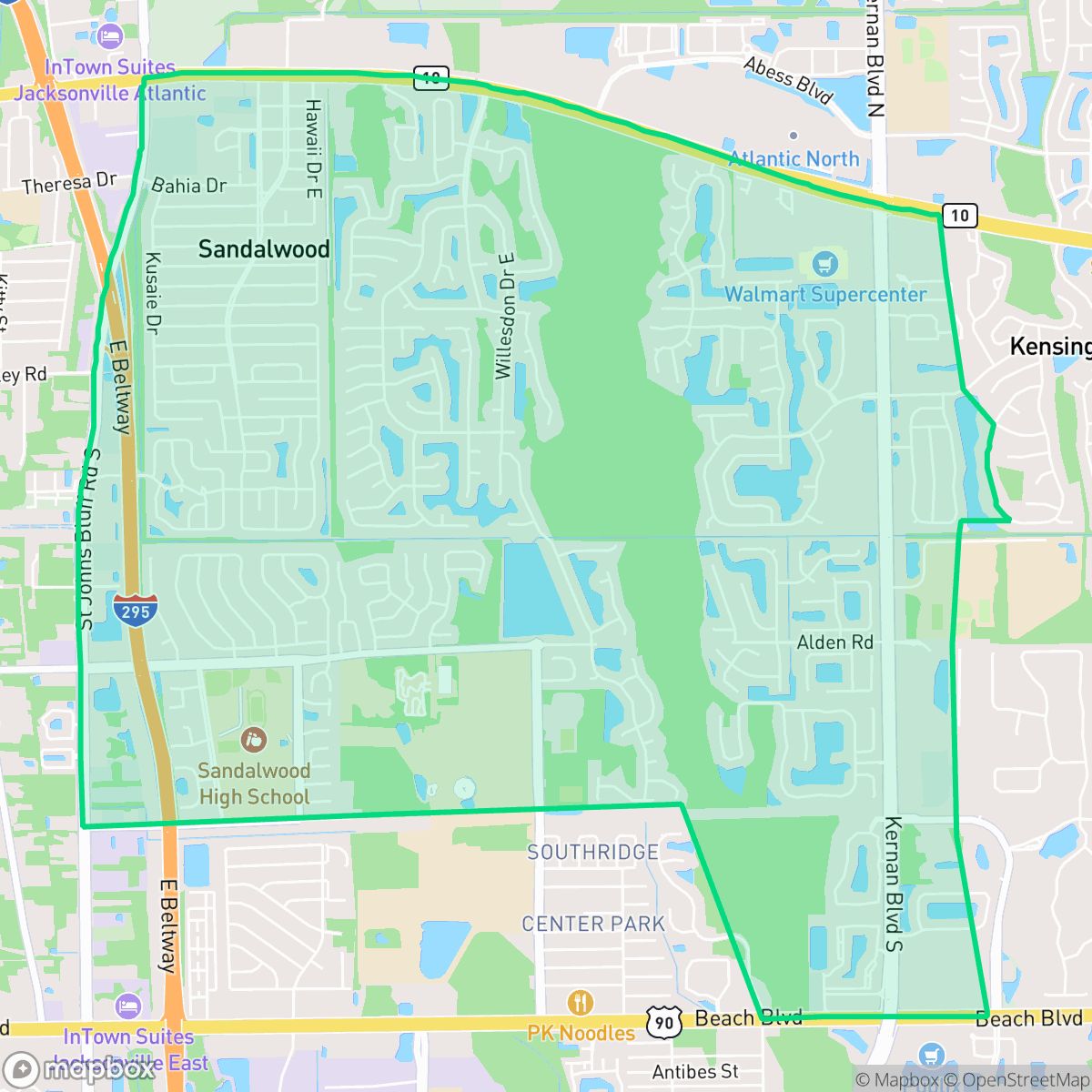
Sandalwood is a distinct Jacksonville community known for its mid-century Pacific Island-themed streets and established residential character. The area offers a semi-rural atmosphere with significant tree cover and a polished suburban aesthetic, balanced by quiet, family-oriented living.
Key Highlights
About Sandalwood
Sandalwood, a residential neighborhood in Jacksonville, Florida, began development in the spring of 1960 by the firm Pearce-Uible. Marketed as being 'halfway between business and pleasure,' it was strategically positioned between downtown Jacksonville and the beaches. The neighborhood is uniquely characterized by its Pacific Island-themed street names—such as Mindanao, Hawaii, and Kusai drives—and its original mid-century home models, which included styles like the 'Aloha,' 'Bikini,' and 'Polynesian.' The initial 500-home development primarily attracted U.S. Navy families stationed at Mayport and employees of the CSX railroad. The area expanded significantly in the late 1970s through construction by Sofranko Homes, and it remains anchored by Sandalwood High School, which opened in 1971.
The neighborhood provides a quiet, residential environment that feels removed from the bustle of the city. Residents benefit from a semi-rural aesthetic characterized by preserved wetlands, wooded buffers, and well-maintained lawns. Its layout, featuring wide green verges and pedestrian-friendly cul-de-sacs, makes it a popular choice for those who prioritize outdoor activity and a sense of space.
While the area is largely peaceful and free from industrial activity, it experiences consistent traffic noise from nearby arterial roads. The community attracts a diverse age range, from young families to retirees, who value the stability of the local housing stock. Prospective residents should note that while the neighborhood is highly walkable for recreation, navigating major thoroughfares on foot can be challenging due to high traffic volumes.
Neighborhood Scores Across 15 Qualities
Residential spacing provides more privacy than the Jacksonville average, featuring a mix of standard suburban lots and wooded buffers. According to iHuus data, while some homes are closely spaced in tract developments, others benefit from significant natural boundaries and larger distances between neighbors.
Sidewalks are present on most residential streets and low-traffic cul-de-sacs, making the area much more pedestrian-friendly than the Jacksonville average. While internal loops allow for safe movement, crossing major arterial roads remains a challenge due to high traffic volumes.
Manicured lawns, large homes, and frequent private pools characterize much of the area. According to iHuus data, this neighborhood offers a significantly more polished visual landscape than the Jacksonville average.
Wide green verges and retention pond paths provide much more space for walking pets than the Jacksonville average. According to iHuus data, many areas feature continuous grassy buffers between sidewalks and roads that are ideal for outdoor exercise.
Open land and wooded areas are much more prevalent here than in the typical Jacksonville urban landscape. Residents can expect a mix of suburban residential clusters interspersed with significant tree canopies and preserved wetlands.
Local activity is primarily centered around quiet, suburban residential pockets with very little commercial density. While some areas offer moderate walkability near small clusters of dining or wellness services, the overall energy is notably more subdued than the city average.
Local traffic from nearby busy streets creates a consistent hum of sound. This level of acoustic activity is slightly higher than the average found across Jacksonville.
Air quality in Sandalwood fluctuates between acceptable and unhealthy levels, though it remains significantly better than the Jacksonville average according to iHuus data. Sensitive groups should monitor local conditions during days when pollution levels rise.
Largely residential and quiet, this area lacks heavy industrial activity and remains significantly cleaner of large-scale manufacturing than the Jacksonville average. While some pockets near major highways feature light commercial warehouses and increased transit traffic, most of the neighborhood is free from industrial hazards.
Health insurance access among residents is significantly higher than the Jacksonville average, according to iHuus data.
Conservative viewpoints represent a majority within the community, though a modest opposing presence exists. According to iHuus data, this political leaning is slightly more conservative than the Jacksonville average.
Residents will find a more balanced distribution of age groups than the typical Jacksonville profile, featuring a mix of young adults, families, and seniors. According to iHuus data, this demographic variety creates a multi-generational community atmosphere.
Residual flood risk exists within the area, though safety levels are notably higher than the Jacksonville average according to iHuus data.
Address-Level Insights for Sandalwood


iHuus Neighborhood Intelligence Insights
Get address-level neighborhood insights for Sandalwood
- Street-level scores — see how individual blocks compare, not just neighborhood averages
- Micro-zone boundaries — identify quiet pockets, flood boundaries, and walkable clusters before you visit
- 15 dimensions in full — walkability, noise, air quality, school quality, insurance coverage, population age profile, urban/rural index, and more
- Boundary risk alerts — know if your address sits near a block boundary where scores drop, the kind of detail no listing will ever mention
- School insights — individual school ratings and insights, not just district-level data
- Compare before you commit — side-by-side data across neighborhoods, down to block precision
No credit card required
Compare with Any Neighborhood
| Dimension | Sandalwood | 29th and Chase |
|---|---|---|
| 🚶 Walkabilityavg 3.96 | ||
| 🔊 Acoustic Comfortavg 4.37 | ||
| 🤫 Privacy Indexavg 4.3 | ||
| 🎨 Visual Appealavg 4.24 | ||
| 🐕 Dog Friendlinessavg 4.28 | ||
| 🗺️ Urban-Rural Indexavg 5.22 | ||
| ✨ Neighborhood Vibeavg 1.5 | ||
| 🏥 Health Insurance Coverageavg 4.35 | ||
| 🌿 Air Qualityavg 3.84 | ||
| 🏭 Industrial Proximityavg 5.11 | ||
| 🌊 Flood Safetyavg 4.01 | ||
| 🗳️ Ideological Leanavg 2.75 | ||
| 👥 Population Age Profileavg 3.26 | ||
| 🔥 Fire Safety | ||
| 🏫 School Quality |
Sandalwood Rankings
School Districts Serving Sandalwood
School Insights for Sandalwood
Below average outcomes; significant attendance and academic challenges.
School Insights
See what's really behind every school rating near Sandalwood
- Individual school ratings — each school's own score with outcome context, not just a district average
- Enrollment & class size data — student-to-teacher ratio and how it compares to the state average
- Full demographics breakdown — ethnicity and gender composition for every school in the enrollment zone
- Every school in the district — all schools within the enrollment boundary ranked by rating, not just the closest one
- Grade levels & benchmarks — elementary through high school, with below/above state-average flags
No credit card required