San Mateo, Jacksonville
Updated · 2,617 residents
San Mateo is a quiet, mid-century residential enclave in Jacksonville defined by its ranch-style homes and semi-rural, tree-lined atmosphere. While it offers a peaceful, suburban environment, residents should be aware of the limited walkability and the presence of nearby industrial activity.
Key Highlights
About San Mateo
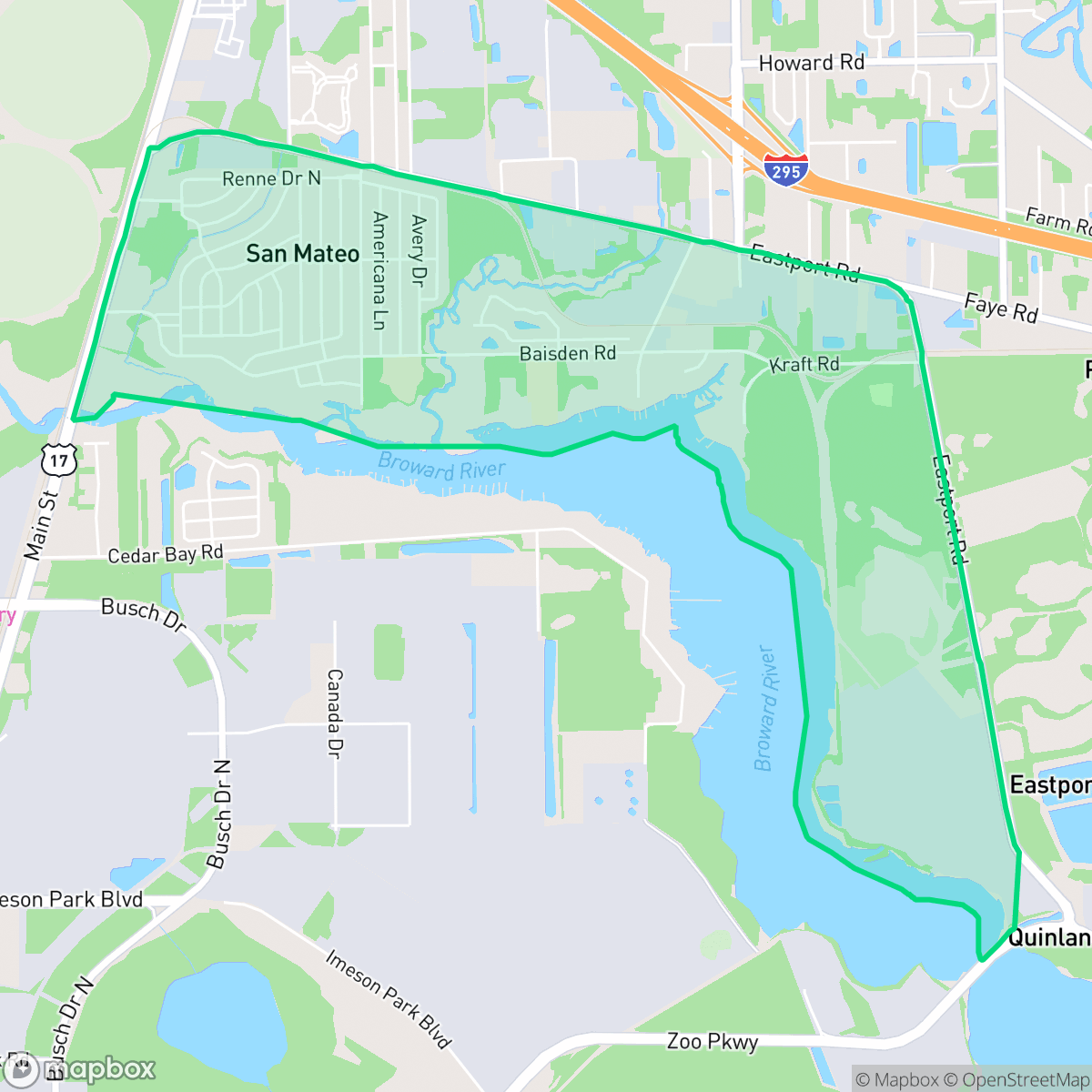
San Mateo is a post-World War II residential neighborhood in Jacksonville, Florida, located along the Broward River. Development began in 1955, primarily driven by Meyers and Lazeau Builders, who marketed the area as a destination for affordable, modern suburban living. The neighborhood is characterized by mid-century modern ranch-style architecture, featuring distinctive elements such as Florida rooms, decorative block walls, and fireplaces. Originally situated outside Jacksonville's city limits, San Mateo became part of the city following the 1968 consolidation with Duval County. The name San Mateo, meaning St. Matthew in Spanish, shares its etymological roots with a 16th-century Spanish fort established nearby, though the modern neighborhood itself is defined by its mid-century suburban character and mature, tree-lined landscape.
The area maintains a distinct, low-key character, blending residential pockets with nearby industrial corridors. It provides a semi-rural feel, with single-family homes often featuring private pools and spacious lots that contrast with the denser urban core of Jacksonville. The demographic profile is notably diverse, attracting a mix of young families and long-term residents who appreciate the established, suburban landscape.
Living here involves certain trade-offs, particularly regarding daily convenience and environmental factors. The area experiences noticeable traffic noise and has limited pedestrian infrastructure, making vehicle reliance essential for errands. Additionally, residents may encounter occasional industrial odors and air quality challenges due to the proximity of freight logistics hubs. This neighborhood is well-suited for those who prioritize a quiet, private home life over walkability and proximity to commercial amenities.
Neighborhood Scores Across 15 Qualities
Residential spacing remains consistent with the Jacksonville average, featuring a suburban grid where houses are positioned relatively close to one another. According to iHuus data, this layout offers a moderate buffer between neighbors without significant isolation.
Walking throughout the area can be difficult due to missing sidewalks and traffic patterns; this makes pedestrian movement less comfortable than the Jacksonville average. While some residential streets feature a low-traffic grid, according to iHuus data, many pathways remain obscured or absent.
Standard tract housing with modest yards and frequent private pools defines the landscape. This area offers a slightly more varied visual profile than much of Jacksonville.
Minimal public park access and narrow street verges make outdoor exercise difficult for dogs. Most available green space consists of private fenced yards, which is below the Jacksonville average according to iHuus data.
Open land and scattered woodlands provide a more spacious, semi-rural atmosphere than the typical Jacksonville urban landscape. According to iHuus data, many areas feature single-family homes interspersed with nearby fields and commercial warehouses.
Very little commercial activity or street life exists here, making the area significantly more tranquil than the Jacksonville average. Residents will find a primarily residential landscape with sparse local amenities and a reliance on vehicles for most errands.
Steady traffic sounds from nearby thoroughfares are a regular presence, resulting in acoustic comfort levels that fall below the Jacksonville average according to iHuus data.
Frequent unhealthy air quality levels pose a significant risk to sensitive groups. According to iHuus data, the atmosphere in San Mateo is slightly worse than the Jacksonville average.
Frequent heavy freight traffic, loading dock activity, and large-scale logistics warehouses characterize the area, making industrial proximity much higher than the Jacksonville average. Residents may encounter increased truck noise and utility odors near certain commercial corridors according to iHuus data.
Health insurance access among residents is slightly higher than the Jacksonville average, according to iHuus data. This level of coverage represents a moderate amount of-insured individuals within the community.
Voting patterns and census indicators reflect a predominantly conservative political landscape, which is notably more conservative than the Jacksonville average according to iHuus data.
Residents live alongside a more varied mix of young adults, families, and seniors than is typically found in the broader Jacksonville area. According to iHuus data, this creates a balanced demographic spread across the neighborhood.
Flood safety in this area presents a moderate level of uncertainty because official federal studies are currently incomplete; however, the risk level remains higher than the Jacksonville city average according to iHuus data.
Address-Level Insights for San Mateo


iHuus Neighborhood Intelligence Insights
Get address-level neighborhood insights for San Mateo
- Street-level scores — see how individual blocks compare, not just neighborhood averages
- Micro-zone boundaries — identify quiet pockets, flood boundaries, and walkable clusters before you visit
- 15 dimensions in full — walkability, noise, air quality, school quality, insurance coverage, population age profile, urban/rural index, and more
- Boundary risk alerts — know if your address sits near a block boundary where scores drop, the kind of detail no listing will ever mention
- School insights — individual school ratings and insights, not just district-level data
- Compare before you commit — side-by-side data across neighborhoods, down to block precision
No credit card required
Compare with Any Neighborhood
| Dimension | San Mateo | 29th and Chase |
|---|---|---|
| 🚶 Walkabilityavg 3.96 | ||
| 🔊 Acoustic Comfortavg 4.37 | ||
| 🤫 Privacy Indexavg 4.3 | ||
| 🎨 Visual Appealavg 4.24 | ||
| 🐕 Dog Friendlinessavg 4.28 | ||
| 🗺️ Urban-Rural Indexavg 5.22 | ||
| ✨ Neighborhood Vibeavg 1.5 | ||
| 🏥 Health Insurance Coverageavg 4.35 | ||
| 🌿 Air Qualityavg 3.84 | ||
| 🏭 Industrial Proximityavg 5.11 | ||
| 🌊 Flood Safetyavg 4.01 | ||
| 🗳️ Ideological Leanavg 2.75 | ||
| 👥 Population Age Profileavg 3.26 | ||
| 🔥 Fire Safety | ||
| 🏫 School Quality |
San Mateo Rankings
School Districts Serving San Mateo
School Insights for San Mateo
Below average outcomes; significant attendance and academic challenges.
School Insights
See what's really behind every school rating near San Mateo
- Individual school ratings — each school's own score with outcome context, not just a district average
- Enrollment & class size data — student-to-teacher ratio and how it compares to the state average
- Full demographics breakdown — ethnicity and gender composition for every school in the enrollment zone
- Every school in the district — all schools within the enrollment boundary ranked by rating, not just the closest one
- Grade levels & benchmarks — elementary through high school, with below/above state-average flags
No credit card required