San Marco, Jacksonville
Updated · 2,870 residents
San Marco is a highly walkable neighborhood defined by its scenic, upscale residential streets and a vibrant, active commercial core. Residents benefit from a diverse age demographic and a semi-rural atmosphere characterized by significant greenery, though the area experiences noticeable noise from nearby transit corridors.
Key Highlights
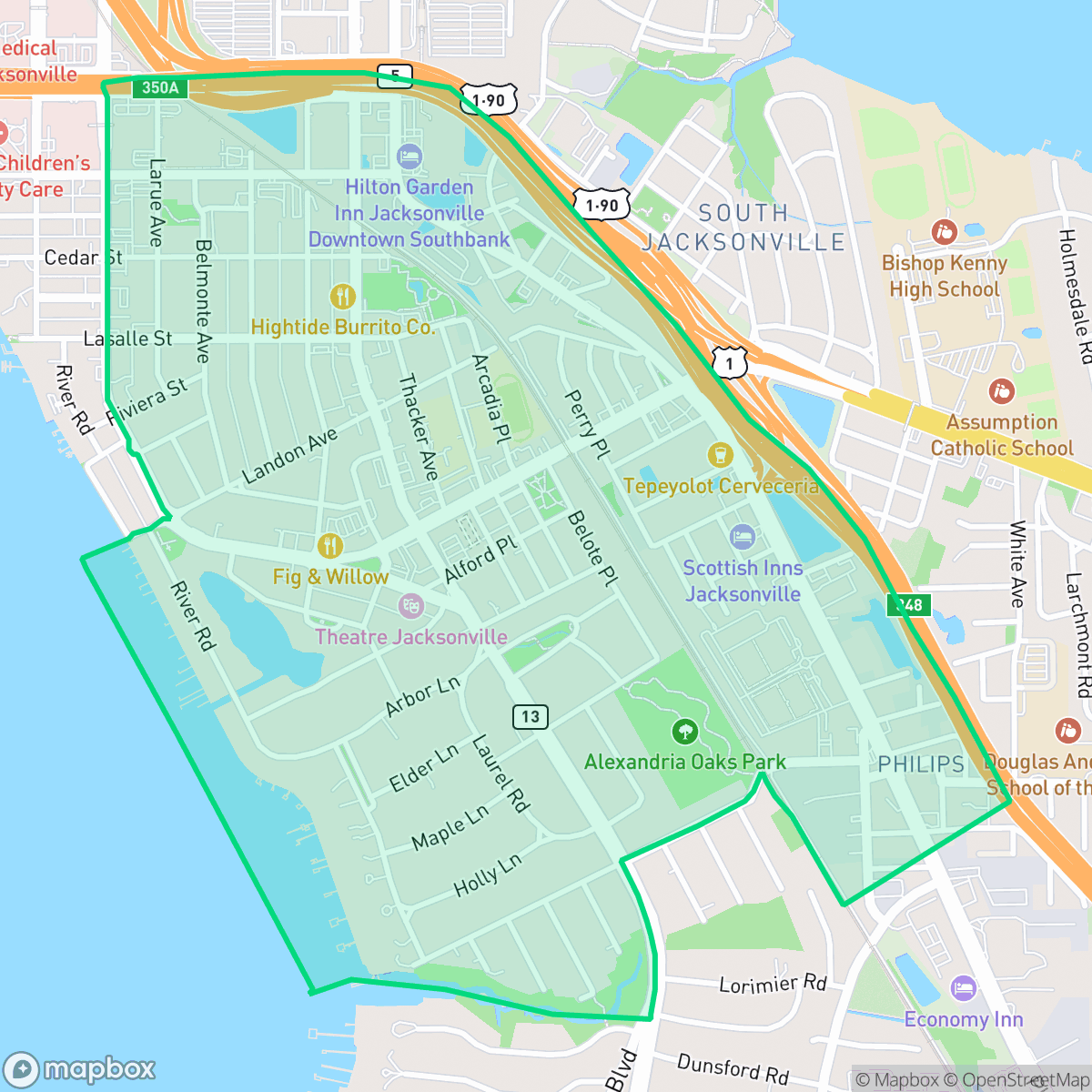
About San Marco
San Marco, originally incorporated as the town of South Jacksonville in 1907, evolved into a premier residential district following the 1921 completion of the St. Johns River (Acosta) Bridge. In 1925, developer Telfair Stockton transformed the site of the former Gamble and Stockton Brick Company into the San Marco subdivision, famously converting a clay pit into the neighborhood's signature Lake Marco. Designed with Mediterranean Revival influences, the area features the iconic San Marco Square, which was modeled after Venice’s Piazza San Marco. Though San Marco was annexed by Jacksonville in 1932, it retained a distinct identity defined by its winding streets, historic park system, and architectural landmarks like the 1927 St. Marks Building. Today, the neighborhood remains a vibrant hub, celebrated for its unique blend of 1920s planning and preserved historic residential stock.
The area offers a distinct blend of luxury riverside estates and standard single-family homes, providing a more visually polished environment than much of the city. Its layout encourages an active lifestyle, with a continuous sidewalk network that supports high levels of pedestrian activity and access to local breweries, cafes, and parks. The neighborhood maintains a semi-rural feel through its preserved woodland areas and open land, creating a quiet, green buffer that contrasts with its central location. Residents enjoy high levels of health insurance coverage and a politically diverse community, contributing to a stable and well-supported local environment.
Prospective residents should consider the trade-offs of living in this historic district, including the potential for noticeable traffic noise from nearby rail lines and major thoroughfares. While the neighborhood features a moderate level of privacy due to generous building setbacks, it also carries a moderate flood risk that remains under evaluation. Families considering the area will navigate the Duval County School District, which provides access to competitive magnet programs alongside a broader system currently undergoing significant administrative transitions. This neighborhood is well-suited for those who value walkability, historic character, and a community that balances suburban quiet with active commercial amenities.
Neighborhood Scores Across 15 Qualities
Building spacing and setbacks provide more separation between neighbors than is typical for Jacksonville. This mix of multi-family units and detached homes offers a moderate level of buffer according to iHuus data.
Pedestrian access is significantly better than the Jacksonville average due to a continuous sidewalk network and safe crossings. While many residential streets feature a dense tree canopy, most commercial and residential areas offer reliable infrastructure for walking.
Large riverside estates with private docks and swimming pools contribute to a landscape that is significantly more visually polished than the Jacksonville average. According to iHuus data, the area features a mix of prominent luxury properties alongside standard single-family residential tracts.
Riverside access and wide green verges between sidewalks and roads offer better dog-walking opportunities than the Jacksonville average. Many residential pockets feature private fenced yards, though some areas lack direct public park access.
Open land and woodland areas are more common here than in the rest of Jacksonville. This creates a landscape characterized by scattered homes and significant greenery compared to the city average.
Diverse dining and local entertainment hubs provide significantly more activity than the Jacksonville average. While some pockets remain quiet and nature-oriented, many areas offer a high level of energy with walkable access to breweries, cafes, and parks.
Frequent sounds from nearby transit corridors and rail lines make this area noisier than the Jacksonville average. Residents may experience intermittent disruptions due to proximity to major thoroughfares, according to iHuus data.
Air quality in San Marco fluctuates between acceptable and unhealthy levels, presenting occasional concerns for sensitive groups. According to iHuus data, the air quality here is notably better than the Jacksonville city average.
Industrial activity remains minimal throughout most of the area, offering a much cleaner environment than the Jacksonville average. While some northern sections feature warehouses and rail lines that introduce occasional truck traffic, the neighborhood is primarily composed of residential and light commercial spaces.
Health insurance access among residents is significantly higher than the Jacksonville average, according to iHuus data. This level of coverage indicates a more robustly insured population compared to most parts of the city.
Political leanings in this area are split nearly evenly between conservative and liberal perspectives, representing a much more balanced ideological mix than the city average according to iHuus data.
A balanced mix of young professionals, families, and seniors characterizes the area. This demographic variety is notably more diverse than the broader Jacksonville average, according to iHuus data.
Flood risk in San Marco is higher than the Jacksonville average, though it remains in an undetermined category because detailed FEMA studies for this area are not yet complete.
Address-Level Insights for San Marco


iHuus Neighborhood Intelligence Insights
Get address-level neighborhood insights for San Marco
- Street-level scores — see how individual blocks compare, not just neighborhood averages
- Micro-zone boundaries — identify quiet pockets, flood boundaries, and walkable clusters before you visit
- 15 dimensions in full — walkability, noise, air quality, school quality, insurance coverage, population age profile, urban/rural index, and more
- Boundary risk alerts — know if your address sits near a block boundary where scores drop, the kind of detail no listing will ever mention
- School insights — individual school ratings and insights, not just district-level data
- Compare before you commit — side-by-side data across neighborhoods, down to block precision
No credit card required
Compare with Any Neighborhood
| Dimension | San Marco | 29th and Chase |
|---|---|---|
| 🚶 Walkabilityavg 3.96 | ||
| 🔊 Acoustic Comfortavg 4.37 | ||
| 🤫 Privacy Indexavg 4.3 | ||
| 🎨 Visual Appealavg 4.24 | ||
| 🐕 Dog Friendlinessavg 4.28 | ||
| 🗺️ Urban-Rural Indexavg 5.22 | ||
| ✨ Neighborhood Vibeavg 1.5 | ||
| 🏥 Health Insurance Coverageavg 4.35 | ||
| 🌿 Air Qualityavg 3.84 | ||
| 🏭 Industrial Proximityavg 5.11 | ||
| 🌊 Flood Safetyavg 4.01 | ||
| 🗳️ Ideological Leanavg 2.75 | ||
| 👥 Population Age Profileavg 3.26 | ||
| 🔥 Fire Safety | ||
| 🏫 School Quality |
San Marco Rankings
School Districts Serving San Marco
School Insights for San Marco
Below average outcomes; significant attendance and academic challenges.
School Insights
See what's really behind every school rating near San Marco
- Individual school ratings — each school's own score with outcome context, not just a district average
- Enrollment & class size data — student-to-teacher ratio and how it compares to the state average
- Full demographics breakdown — ethnicity and gender composition for every school in the enrollment zone
- Every school in the district — all schools within the enrollment boundary ranked by rating, not just the closest one
- Grade levels & benchmarks — elementary through high school, with below/above state-average flags
No credit card required