San Jose, Jacksonville
Updated · 5,640 residents
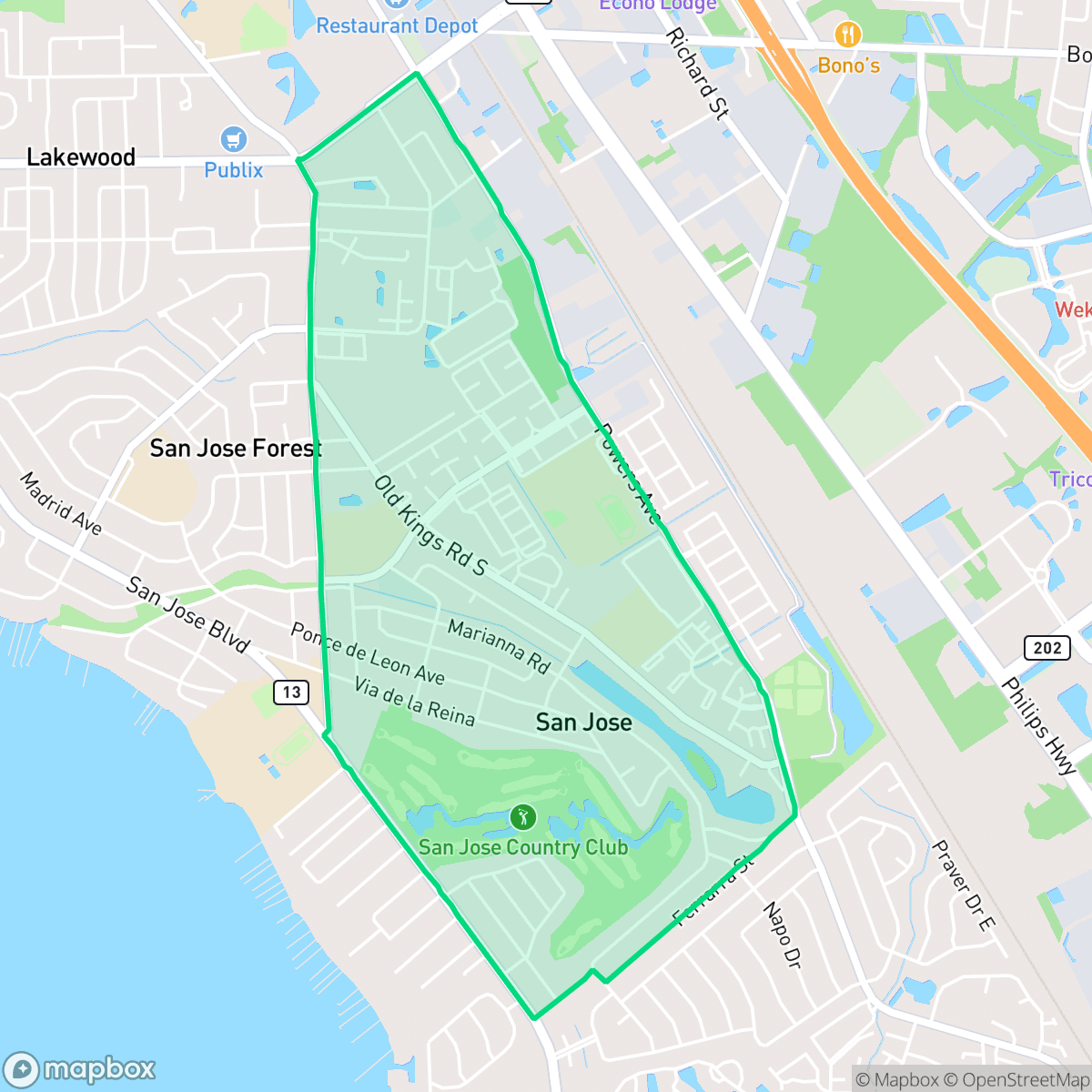
San Jose is a scenic, master-planned community defined by its Mediterranean Revival architecture and abundant green spaces. Residents enjoy high walkability and a quiet, semi-rural atmosphere, though the area experiences noticeable noise from nearby major roadways.
Key Highlights
About San Jose
The San Jose neighborhood in Jacksonville originated as an 18th-century Spanish land grant known as the San Jose Plantation. In 1925, the San Jose Estates Company launched an ambitious master-planned community designed by city planner John Nolen. Intended to be an automobile-oriented suburb, the development featured a radial street pattern and Mediterranean Revival architecture by the firm Marsh & Saxelbye. Although the 1926 economic collapse halted the project, several original landmarks remain, including the San Jose Country Club and the former San Jose Hotel, which now serves as the centerpiece of The Bolles School. The area also encompasses the historic Epping Forest estate, once the residence of Alfred I. and Jessie Ball duPont. Today, the neighborhood retains its historical character through its preserved Mediterranean-style homes and early 20th-century urban planning layout.
The neighborhood offers a distinct blend of upscale suburban aesthetics and natural surroundings, characterized by manicured lakeside properties and significant tree cover. While the area maintains a peaceful, semi-rural feel with plenty of open space, it also serves as a hub for local hospitality and fitness, providing pockets of activity that differentiate it from quieter residential zones. The layout prioritizes pedestrian connectivity, with extensive sidewalk networks that make it easier for residents to navigate between homes and local amenities compared to many other parts of the city. According to iHuus data, the community benefits from high levels of health insurance coverage and a balanced demographic mix, making it a stable environment for a wide range of residents.
Prospective residents should consider the trade-offs associated with the location, particularly regarding acoustic comfort and environmental factors. While the neighborhood is largely free from heavy industry, the proximity to major transit routes results in recurring traffic noise. Additionally, while flood safety is generally favorable, the area remains within a 500-year floodplain, requiring awareness during extreme weather. Families will find themselves within the Duval County School District, which offers access to competitive magnet programs despite ongoing district-wide efforts to manage budget deficits and school consolidations. Overall, the area is best suited for those seeking a visually appealing, walkable environment who are comfortable balancing suburban convenience with the realities of living near major urban transit corridors.
Neighborhood Scores Across 15 Qualities
Residential spacing provides more separation between neighbors than the Jacksonville average. While high-density apartments exist, much of the area features single-family homes with standard yard buffers.
Extensive sidewalk networks connect residential zones to local businesses and schools, providing much better pedestrian connectivity than the Jacksonville average. While internal streets and cul-de-sacs are safe for walking, some larger arterial roads lack dedicated pedestrian separation.
Large homes, manicured lakeside properties, and private pools create a landscape that is significantly more aesthetically pleasing than the Jacksonville average. While some sections feature standard apartment complexes, much of the area offers high-end amenities and proximity to golf courses.
Abundant green spaces, including golf course borders and large public parks, provide significant walking opportunities for pet owners. According to iHuus data, the presence of wide grassy verges and low-traffic residential streets makes this area much more accommodating for dogs than the Jacksonville average.
Frequent open land and scattered homes amidst woodlands create a more semi-rural atmosphere than the typical Jacksonville urban landscape. According to iHuus data, this area features significantly more open space and greenery than the city average.
Varying pockets of high energy and diverse dining options exist alongside much quieter, residential stretches. While some areas function as lively local hotspots for hospitality and fitness, other parts of the neighborhood remain subdued and focused on peaceful residential living, representing a level of activity significantly higher than the city average according to iHuus data.
Frequent sounds from nearby major roadways and transit routes characterize the area. According to iHuus data, acoustic comfort in this neighborhood is lower than the Jacksonville average.
Air quality levels in San Jose fluctuate between acceptable and unhealthy, particularly for sensitive groups. According to iHuus data, the air quality here is notably better than the Jacksonville city average.
Largely residential and commercial in character, this area avoids heavy industrial presence. While some rail logistics and utility facilities exist on the periphery, industrial density remains significantly lower than the Jacksonville average.
Health insurance accessibility is significantly higher in San Jose than the Jacksonville average, according to iHuus data. Most residents in this area have access to comprehensive medical coverage.
Political perspectives in this area are more evenly distributed than the city average, featuring a blend of various viewpoints. According to iHuus data, residents can expect a diverse range of ideological leanings within the local community.
Residents live alongside a varied demographic of young adults, families, and seniors. This age distribution is notably more balanced than the broader Jacksonville area, according to iHuus data.
Flood safety in San Jose is notably higher than the Jacksonville average, though some residual risk remains due to its location within a 500-year floodplain. According to iHuus data, residents should remain aware of potential water accumulation during extreme weather events.
Address-Level Insights for San Jose


iHuus Neighborhood Intelligence Insights
Get address-level neighborhood insights for San Jose
- Street-level scores — see how individual blocks compare, not just neighborhood averages
- Micro-zone boundaries — identify quiet pockets, flood boundaries, and walkable clusters before you visit
- 15 dimensions in full — walkability, noise, air quality, school quality, insurance coverage, population age profile, urban/rural index, and more
- Boundary risk alerts — know if your address sits near a block boundary where scores drop, the kind of detail no listing will ever mention
- School insights — individual school ratings and insights, not just district-level data
- Compare before you commit — side-by-side data across neighborhoods, down to block precision
No credit card required
Compare with Any Neighborhood
| Dimension | San Jose | 29th and Chase |
|---|---|---|
| 🚶 Walkabilityavg 3.96 | ||
| 🔊 Acoustic Comfortavg 4.37 | ||
| 🤫 Privacy Indexavg 4.3 | ||
| 🎨 Visual Appealavg 4.24 | ||
| 🐕 Dog Friendlinessavg 4.28 | ||
| 🗺️ Urban-Rural Indexavg 5.22 | ||
| ✨ Neighborhood Vibeavg 1.5 | ||
| 🏥 Health Insurance Coverageavg 4.35 | ||
| 🌿 Air Qualityavg 3.84 | ||
| 🏭 Industrial Proximityavg 5.11 | ||
| 🌊 Flood Safetyavg 4.01 | ||
| 🗳️ Ideological Leanavg 2.75 | ||
| 👥 Population Age Profileavg 3.26 | ||
| 🔥 Fire Safety | ||
| 🏫 School Quality |
San Jose Rankings
School Districts Serving San Jose
School Insights for San Jose
Below average outcomes; significant attendance and academic challenges.
School Insights
See what's really behind every school rating near San Jose
- Individual school ratings — each school's own score with outcome context, not just a district average
- Enrollment & class size data — student-to-teacher ratio and how it compares to the state average
- Full demographics breakdown — ethnicity and gender composition for every school in the enrollment zone
- Every school in the district — all schools within the enrollment boundary ranked by rating, not just the closest one
- Grade levels & benchmarks — elementary through high school, with below/above state-average flags
No credit card required