Royal Terrace, Jacksonville
Updated · 1,988 residents
Royal Terrace is a quiet, semi-rural community in Northwest Jacksonville defined by its academic street names and deep cultural roots. Residents benefit from higher-than-average health insurance coverage and a peaceful environment with moderate traffic noise and ample greenery.
Key Highlights
About Royal Terrace
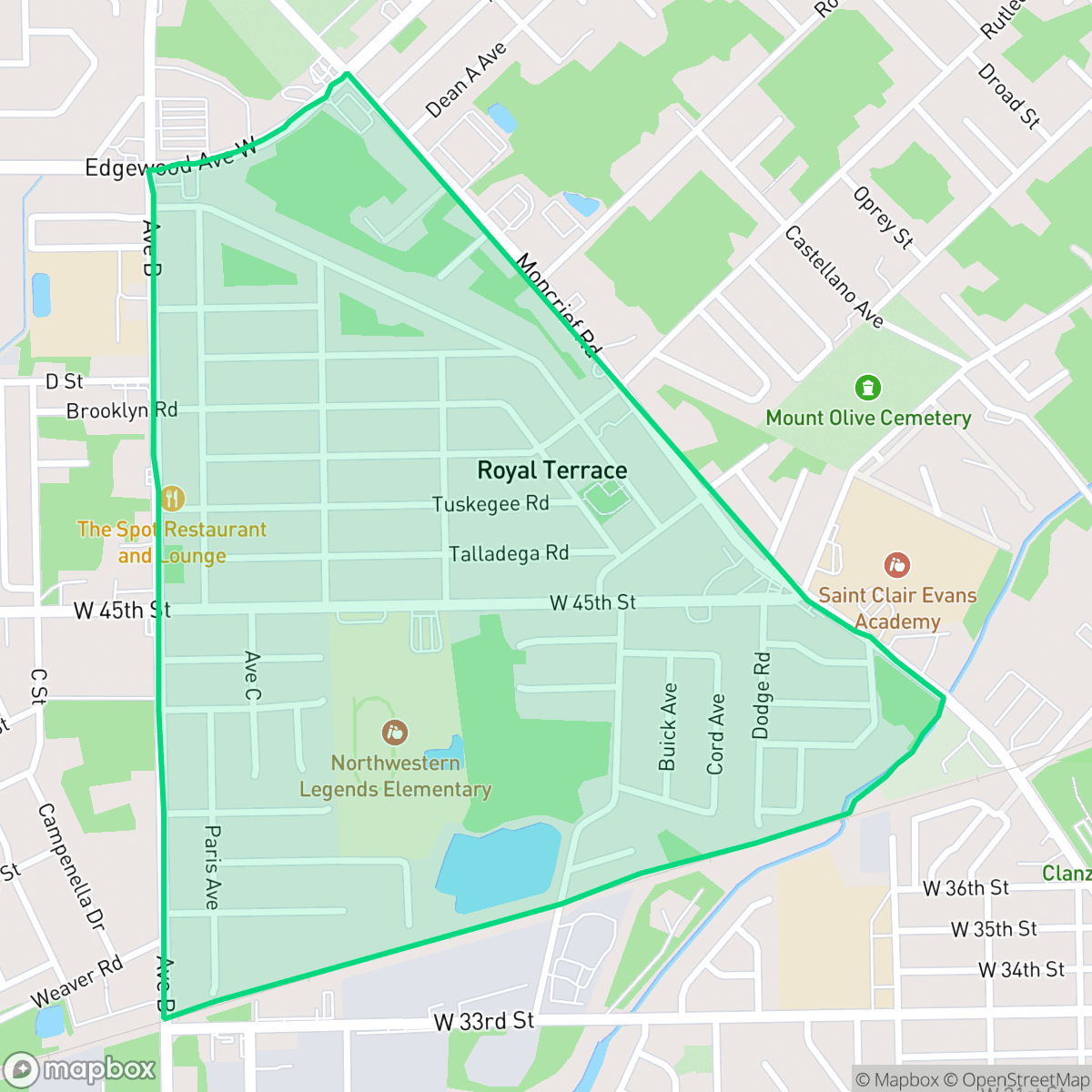
Royal Terrace, a neighborhood in Northwest Jacksonville, developed during the 1940s as an African-American community located outside the city limits of the time. The area is defined by a distinct triangular layout formed by Avenue B, Moncrief Road, and 45th Street, where many streets are named after historic Black colleges and universities, such as Tuskegee, Morehouse, and Spelman. During the Jim Crow era, Royal Terrace became a significant cultural hub, hosting numerous juke joints and venues on the Chitlin Circuit. A notable landmark is the Silver Star, a historic club that once featured live performances from legendary minstrel and blues acts and continues to operate today as the Royal Terrace Men's Club.
The area maintains a semi-rural character, featuring open woodland spaces and a modest residential landscape that offers more privacy than typical urban settings. With a strong sense of community, the neighborhood provides a low-key atmosphere where residents can enjoy quiet streets and consistent tree cover. While commercial activity remains sparse, the neighborhood offers a functional environment for those who prefer a slower pace of life away from the density of central Jacksonville. Prospective residents should consider the trade-offs of living in the area, including a higher-than-average flood risk and the need for careful navigation of the Duval County School District. While the district offers access to prestigious magnet programs, families must contend with ongoing school consolidations and budget challenges. The neighborhood is well-suited for those seeking a quiet, liberal-leaning community with a balance of modest housing and natural space, provided they are prepared for the district's complex educational landscape and the need for flood awareness.
Neighborhood Scores Across 15 Qualities
Residential spacing varies between single-family homes and denser apartment clusters. According to iHuus data, this neighborhood offers more seclusion than the Jacksonville average due to mature trees and wider buffers between many properties.
Low traffic volumes and a low density layout allow for safe walking along residential streets, even though sidewalks are inconsistent. This level of walkability is higher than the Jacksonville average, according to iHuus data.
Standard tract housing and basic apartment complexes define the landscape, which features small yards and simple roof geometries. The visual variety in Royal Terrace is slightly above the Jacksonville average, though it lacks luxury amenities or large private estates.
Large wooded areas and nearby sports fields provide good opportunities for pet exploration, making this area more dog friendly than the Jacksonville average. While some residential streets have narrow verges, iHuus data indicates consistent greenery throughout much of the neighborhood.
Open land and woodland areas are frequent throughout the neighborhood, providing a more semi-rural feel than the denser urban average of Jacksonville. This landscape features scattered homes interspersed with significant tree canopy and open spaces.
Subdued energy characterizes this suburban area, which offers a much more active atmosphere than the Jacksonville average. While commercial activity is sparse, certain blocks provide moderate walkability near local seafood markets and dining options.
Steady traffic sounds from nearby busy streets are present, though acoustic levels are slightly more tranquil than the average for Jacksonville. According to iHuus data, residents can expect a consistent but manageable ambient hum.
Air conditions in Royal Terrace fluctuate between acceptable and unhealthy levels, though the air quality remains notably better than the Jacksonville average according to iHuus data. Sensitive groups should remain aware of occasional days with higher pollutant concentrations.
Heavy industry is largely absent from this area, though residents may notice occasional freight traffic and utility-related noise near storage facilities and rail lines. According to iHuus data, the neighborhood contains more industrial activity than the Jacksonville average, primarily due to local light commercial hubs and a nearby electrical substation.
Health insurance enrollment among residents is notably higher than the Jacksonville average, according to iHuus data.
Voting patterns and census indicators in Royal Terrace show a distinctly liberal leaning, which is significantly more pronounced than the city average according to iHuus data.
Residents live alongside a diverse mix of young adults, families, and seniors. This population spread is significantly more varied than the city average, according to iHuus data.
Flood risk in this area is higher than the Jacksonville average, though current FEMA studies for Royal Terrace remain incomplete. Residents should prepare for undetermined levels of flood vulnerability according to iHuus data.
Address-Level Insights for Royal Terrace


iHuus Neighborhood Intelligence Insights
Get address-level neighborhood insights for Royal Terrace
- Street-level scores — see how individual blocks compare, not just neighborhood averages
- Micro-zone boundaries — identify quiet pockets, flood boundaries, and walkable clusters before you visit
- 15 dimensions in full — walkability, noise, air quality, school quality, insurance coverage, population age profile, urban/rural index, and more
- Boundary risk alerts — know if your address sits near a block boundary where scores drop, the kind of detail no listing will ever mention
- School insights — individual school ratings and insights, not just district-level data
- Compare before you commit — side-by-side data across neighborhoods, down to block precision
No credit card required
Compare with Any Neighborhood
| Dimension | Royal Terrace | 29th and Chase |
|---|---|---|
| 🚶 Walkabilityavg 3.96 | ||
| 🔊 Acoustic Comfortavg 4.37 | ||
| 🤫 Privacy Indexavg 4.3 | ||
| 🎨 Visual Appealavg 4.24 | ||
| 🐕 Dog Friendlinessavg 4.28 | ||
| 🗺️ Urban-Rural Indexavg 5.22 | ||
| ✨ Neighborhood Vibeavg 1.5 | ||
| 🏥 Health Insurance Coverageavg 4.35 | ||
| 🌿 Air Qualityavg 3.84 | ||
| 🏭 Industrial Proximityavg 5.11 | ||
| 🌊 Flood Safetyavg 4.01 | ||
| 🗳️ Ideological Leanavg 2.75 | ||
| 👥 Population Age Profileavg 3.26 | ||
| 🔥 Fire Safety | ||
| 🏫 School Quality |
Royal Terrace Rankings
School Districts Serving Royal Terrace
School Insights for Royal Terrace
Below average outcomes; significant attendance and academic challenges.
School Insights
See what's really behind every school rating near Royal Terrace
- Individual school ratings — each school's own score with outcome context, not just a district average
- Enrollment & class size data — student-to-teacher ratio and how it compares to the state average
- Full demographics breakdown — ethnicity and gender composition for every school in the enrollment zone
- Every school in the district — all schools within the enrollment boundary ranked by rating, not just the closest one
- Grade levels & benchmarks — elementary through high school, with below/above state-average flags
No credit card required