Riverside, Jacksonville
Updated · 8,976 residents
Riverside is a highly walkable community known for its vibrant commercial corridors and diverse architectural character. Residents benefit from excellent access to local parks and a strong progressive identity, though the area experiences noticeable noise from traffic and nearby rail lines.
Key Highlights
About Riverside
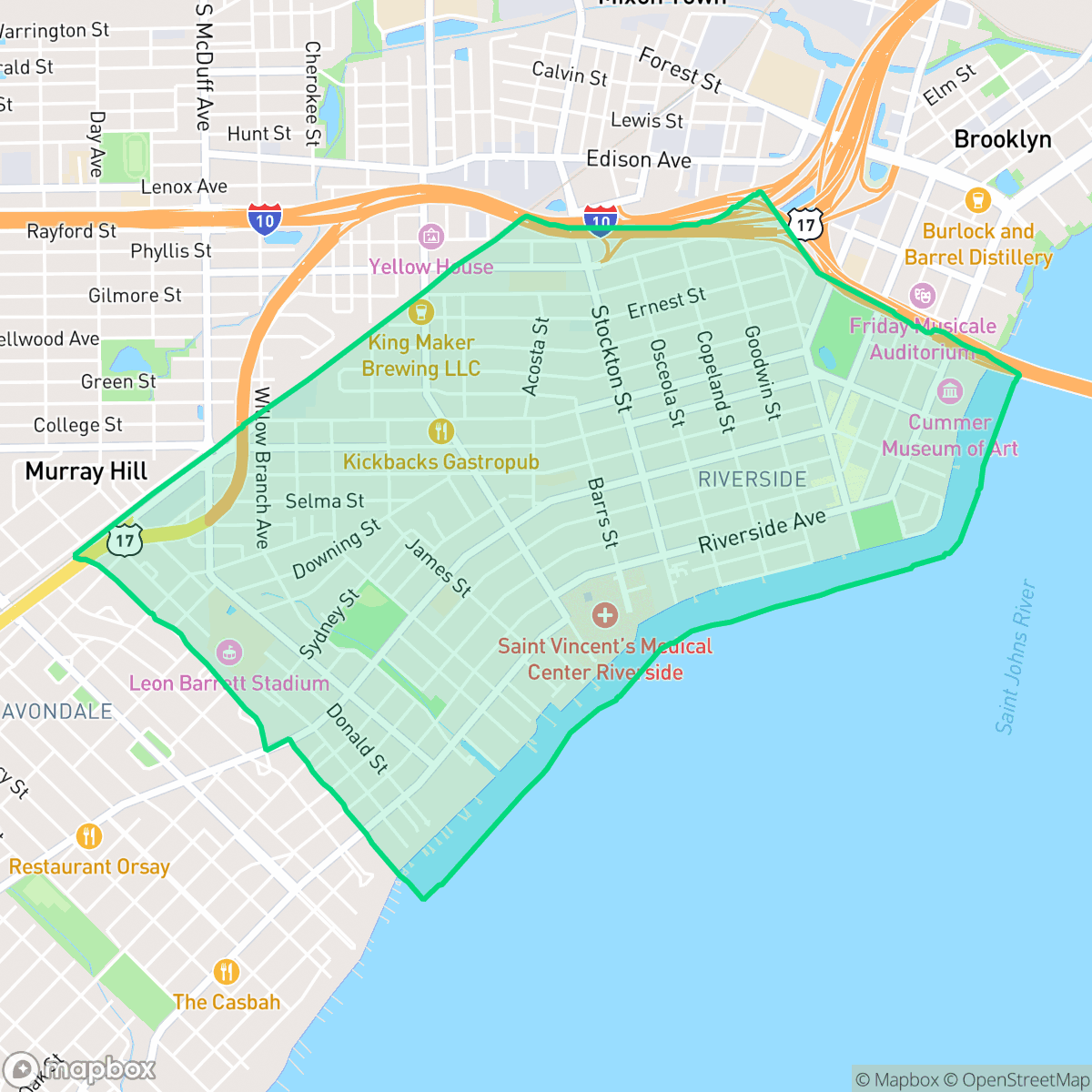
Riverside, first platted in 1868, evolved from plantation land into one of Jacksonville’s most architecturally diverse historic districts. Its development accelerated significantly following the Great Fire of 1901, as displaced residents and the city's elite relocated to the area, constructing an elegant corridor of mansions along the St. Johns River. The neighborhood is renowned for its eclectic mix of architectural styles, including Prairie School, Colonial Revival, and a high concentration of bungalows. Key landmarks include the Cummer Museum of Art and Gardens, situated on a historic riverfront estate, and Memorial Park, designed by the Olmsted Brothers. Today, Riverside is defined by its vibrant Five Points commercial corridor, strong preservation efforts, and a distinct identity as a walkable, arts-centric community that maintains its historic character while serving as a cultural hub for the city.
The area serves as a cultural hub for Jacksonville, blending historic residential streets with a dense, active commercial scene. The neighborhood maintains a notably progressive social atmosphere and a high level of health insurance coverage among its residents. Its traditional grid layout and mature tree canopy make it one of the most accessible areas in the city for pedestrians, fostering a lively street culture that centers around local breweries and diverse dining options. According to iHuus data, the community offers a more balanced mix of age demographics than the broader city, supporting a diverse population of professionals, families, and seniors. Prospective residents should note that the neighborhood experiences higher noise levels due to proximity to major thoroughfares and freight rail activity. While the area offers better flood safety than much of the city, it remains within a floodplain. Families should be aware that the local school district is currently navigating significant budget and consolidation challenges, making access to specialized magnet programs a primary consideration for those with school-aged children.
Neighborhood Scores Across 15 Qualities
Residential spacing provides a balance of urban proximity and buffer, offering more seclusion than the Jacksonville average. While some urban lots are closely packed, many properties feature mature tree screening and larger lot buffers along the river.
Extensive sidewalk networks and a traditional grid layout make pedestrian travel significantly easier than in most parts of Jacksonville. Many residential streets feature mature tree canopies for shade, though large highways can occasionally act as barriers to movement.
Landscape features range from large riverside estates with private pools to standard urban housing blocks. This visual diversity makes the area significantly more aesthetically pleasing than the Jacksonville average, according to iHuus data.
Tree-lined sidewalks and accessible public parks with ponds provide reliable walking opportunities for pets. This level of accessibility is notably higher than the Jacksonville average according to iHuus data.
Residential streets and green spaces exist in roughly equal measure, providing a denser fabric than the Jacksonville average. The area features a blend of single-family homes, small commercial clusters, and significant tree canopy.
Bustling commercial hubs and diverse dining options provide a level of energy and activity that is significantly higher than the Jacksonville average. Residents can expect a mix of high-energy street life near major parks and breweries alongside more subdued, leafy residential pockets.
Frequent sounds from nearby railroad tracks and heavy traffic along major thoroughfares characterize the area. According to iHuus data, acoustic comfort in Riverside is lower than the Jacksonville average.
Air quality levels fluctuate between acceptable and unhealthy, presenting occasional concerns for sensitive groups. This area maintains a better air quality profile than the Jacksonville average according to iHuus data.
Industrial activity is notably lower than the Jacksonville average, consisting primarily of light commercial use and occasional warehouse structures. While most areas are residential, residents near the southern edge or western rail corridor may experience intermittent noise from freight traffic and loading activities.
Health insurance accessibility is significantly higher in Riverside than the Jacksonville average, according to iHuus data. Most residents in this area maintain active coverage.
A liberal majority characterizes the local political landscape, representing a significant departure from the more conservative lean of Jacksonville. According to iHuus data, this area maintains a notably progressive identity compared to the city average.
Residents live alongside a wide variety of age demographics, ranging from young professionals to families and seniors. This population mix is significantly more balanced than the broader Jacksonville area, according to iHuus data.
Residual flood risks exist because parts of this area fall within the 500-year floodplain; however, safety levels remain significantly higher than the Jacksonville average according to iHuus data.
Address-Level Insights for Riverside


iHuus Neighborhood Intelligence Insights
Get address-level neighborhood insights for Riverside
- Street-level scores — see how individual blocks compare, not just neighborhood averages
- Micro-zone boundaries — identify quiet pockets, flood boundaries, and walkable clusters before you visit
- 15 dimensions in full — walkability, noise, air quality, school quality, insurance coverage, population age profile, urban/rural index, and more
- Boundary risk alerts — know if your address sits near a block boundary where scores drop, the kind of detail no listing will ever mention
- School insights — individual school ratings and insights, not just district-level data
- Compare before you commit — side-by-side data across neighborhoods, down to block precision
No credit card required
Compare with Any Neighborhood
| Dimension | Riverside | 29th and Chase |
|---|---|---|
| 🚶 Walkabilityavg 3.96 | ||
| 🔊 Acoustic Comfortavg 4.37 | ||
| 🤫 Privacy Indexavg 4.3 | ||
| 🎨 Visual Appealavg 4.24 | ||
| 🐕 Dog Friendlinessavg 4.28 | ||
| 🗺️ Urban-Rural Indexavg 5.22 | ||
| ✨ Neighborhood Vibeavg 1.5 | ||
| 🏥 Health Insurance Coverageavg 4.35 | ||
| 🌿 Air Qualityavg 3.84 | ||
| 🏭 Industrial Proximityavg 5.11 | ||
| 🌊 Flood Safetyavg 4.01 | ||
| 🗳️ Ideological Leanavg 2.75 | ||
| 👥 Population Age Profileavg 3.26 | ||
| 🔥 Fire Safety | ||
| 🏫 School Quality |
Riverside Rankings
School Districts Serving Riverside
School Insights for Riverside
Below average outcomes; significant attendance and academic challenges.
School Insights
See what's really behind every school rating near Riverside
- Individual school ratings — each school's own score with outcome context, not just a district average
- Enrollment & class size data — student-to-teacher ratio and how it compares to the state average
- Full demographics breakdown — ethnicity and gender composition for every school in the enrollment zone
- Every school in the district — all schools within the enrollment boundary ranked by rating, not just the closest one
- Grade levels & benchmarks — elementary through high school, with below/above state-average flags
No credit card required