Regency, Jacksonville
Updated · 5,699 residents
Regency is a suburban activity hub characterized by a polished aesthetic and a mix of spacious residential properties. While the area provides a semi-rural atmosphere with ample green space, it remains a bustling center for local dining and retail that experiences significant noise from nearby major traffic arteries.
Key Highlights
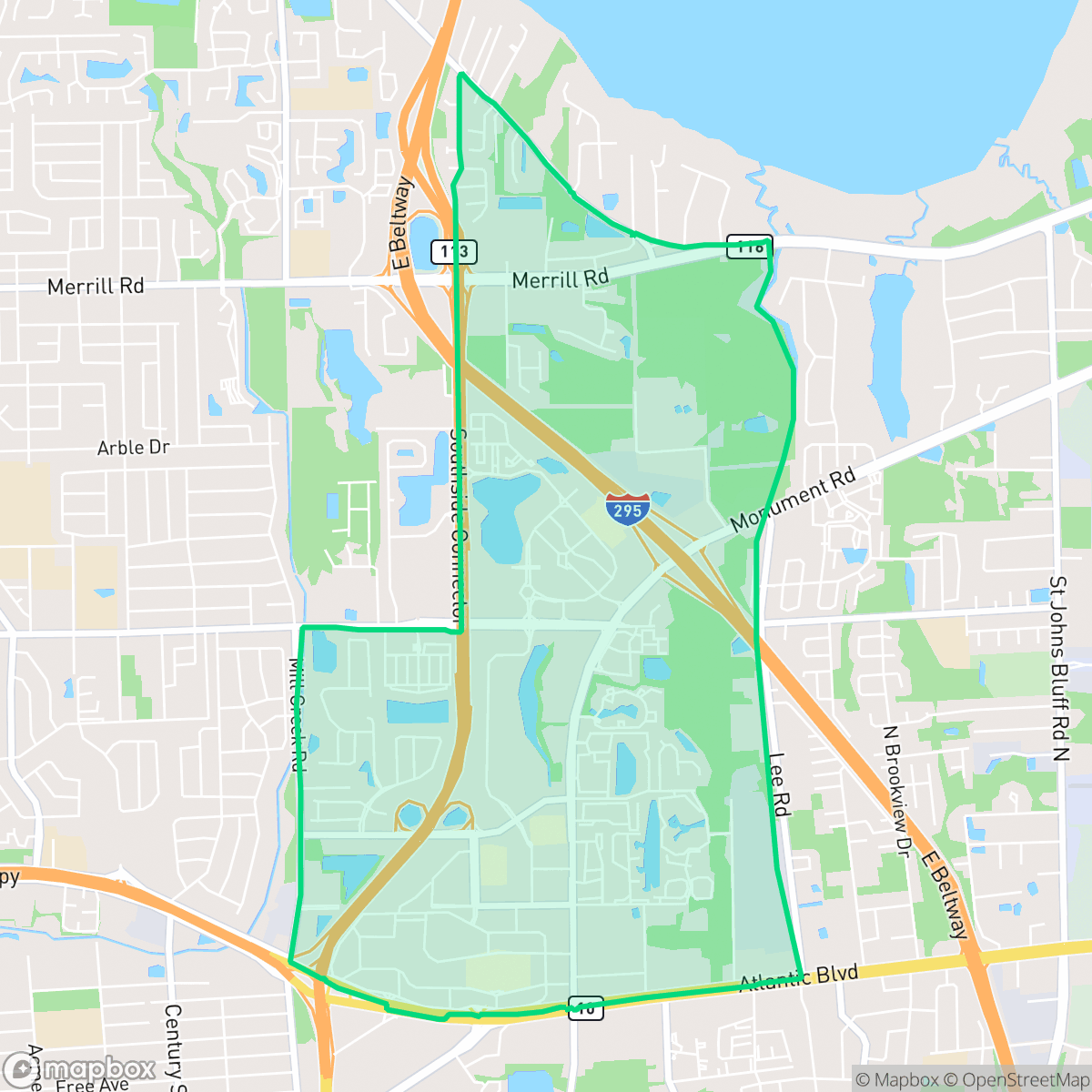
About Regency
The Regency neighborhood in Jacksonville, Florida, is defined by the 1967 opening of Regency Square Mall, which was developed by the Stein family’s Regency Centers. Built on a site formerly characterized by sand dunes, the mall served as a regional retail hub during the rapid suburban expansion of the Arlington area. At its peak in the 1970s, it was one of the most active shopping centers in the Southeast, sparking a surrounding development boom of restaurants, office parks, and retail corridors along Atlantic Boulevard. The neighborhood's identity became deeply intertwined with the mall's rise as a dominant commercial landmark and its subsequent decline in the early 21st century due to shifting retail trends and the emergence of competing shopping centers like the St. Johns Town Center.
The neighborhood features a distinct suburban character that balances active commercial corridors with quiet, well-maintained residential tracts. Residents benefit from a polished aesthetic, with many homes offering spacious driveways and access to wooded areas or ponds that provide a semi-rural feel. This environment is particularly well-suited for those who value local convenience and a diverse community demographic, as the area remains a hub for shopping and dining despite shifting regional retail trends. Regarding livability, the area offers a higher level of residential privacy compared to many other parts of Jacksonville, though this is tempered by the acoustic environment. Frequent traffic from major thoroughfares results in elevated noise levels, which prospective residents should consider. While residential streets are generally suitable for walking, major roads can act as barriers to connectivity. Families living here are served by the Duval County School District, where educational outcomes vary; parents often look toward the district's specialized magnet and advanced studies programs to supplement the standard neighborhood school experience. According to iHuus data, the area maintains better-than-average health insurance coverage and a balanced political landscape, contributing to its stable residential profile.
Neighborhood Scores Across 15 Qualities
Residential spacing ranges from shared-wall apartment blocks to detached houses buffered by dense woods and water. This level of privacy is notably higher than the Jacksonville average, according to iHuus data.
Residential streets and cul-de-sacs provide safe paths for walking, though major arterial roads act as barriers to connectivity. This area offers greater walkability than the Jacksonville average, according to iHuus data.
Upscale amenities and large-scale residences contribute to a visual environment that is noticeably more polished than the Jacksonville average. According to iHuus data, the area features spacious driveways and well-maintained property features across its residential tracts.
Extensive green belts, forested areas, and grassy pond perimeters offer ample space for pets. According to iHuus data, these features make the area notably more dog friendly than much of Jacksonville.
Frequent open land and scattered greenery provide a more semi-rural atmosphere than most of Jacksonville. According to iHuus data, the area features a mix of residential pockets situated near fields and woodland.
Vibrant pockets of retail and dining offer much more local energy than the typical Jacksonville neighborhood. While some residential stretches remain quiet, many areas serve as active destinations with various restaurants, cafes, and independent shops.
Frequent traffic and transit noise from nearby major thoroughfares and infrastructure defines the acoustic environment. According to iHuus data, this area experiences significantly more disturbance than the Jacksonville average.
Air quality in Regency fluctuates between acceptable and unhealthy levels, though it remains significantly better than the Jacksonville average according to iHuus data. Sensitive groups may experience occasional concern on certain days.
Residential life is largely uninterrupted by heavy industry, though some residents may notice increased truck traffic and loading activity near the eastern edge of the neighborhood. This level of industrial proximity is notably lower than the Jacksonville average, according to iHuus data.
Health insurance access within Regency is notably higher than the Jacksonville average. According to iHuus data, a significant portion of the resident population maintains coverage.
Political viewpoints in this area are evenly distributed between conservative and liberal leaning residents. This represents a more moderate ideological landscape than the broader Jacksonville area, according to iHuus data.
Residents live alongside a more varied mix of age demographics than the Jacksonville average. According to iHuus data, the area features a balanced distribution of young adults, families, and older residents.
Residual flood risks exist within this area because it contains portions of the 500-year floodplain; however, the level of safety is notably higher than the Jacksonville city average according to iHuus data.
Address-Level Insights for Regency


iHuus Neighborhood Intelligence Insights
Get address-level neighborhood insights for Regency
- Street-level scores — see how individual blocks compare, not just neighborhood averages
- Micro-zone boundaries — identify quiet pockets, flood boundaries, and walkable clusters before you visit
- 15 dimensions in full — walkability, noise, air quality, school quality, insurance coverage, population age profile, urban/rural index, and more
- Boundary risk alerts — know if your address sits near a block boundary where scores drop, the kind of detail no listing will ever mention
- School insights — individual school ratings and insights, not just district-level data
- Compare before you commit — side-by-side data across neighborhoods, down to block precision
No credit card required
Compare with Any Neighborhood
| Dimension | Regency | 29th and Chase |
|---|---|---|
| 🚶 Walkabilityavg 3.96 | ||
| 🔊 Acoustic Comfortavg 4.37 | ||
| 🤫 Privacy Indexavg 4.3 | ||
| 🎨 Visual Appealavg 4.24 | ||
| 🐕 Dog Friendlinessavg 4.28 | ||
| 🗺️ Urban-Rural Indexavg 5.22 | ||
| ✨ Neighborhood Vibeavg 1.5 | ||
| 🏥 Health Insurance Coverageavg 4.35 | ||
| 🌿 Air Qualityavg 3.84 | ||
| 🏭 Industrial Proximityavg 5.11 | ||
| 🌊 Flood Safetyavg 4.01 | ||
| 🗳️ Ideological Leanavg 2.75 | ||
| 👥 Population Age Profileavg 3.26 | ||
| 🔥 Fire Safety | ||
| 🏫 School Quality |
Regency Rankings
School Districts Serving Regency
School Insights for Regency
Below average outcomes; significant attendance and academic challenges.
School Insights
See what's really behind every school rating near Regency
- Individual school ratings — each school's own score with outcome context, not just a district average
- Enrollment & class size data — student-to-teacher ratio and how it compares to the state average
- Full demographics breakdown — ethnicity and gender composition for every school in the enrollment zone
- Every school in the district — all schools within the enrollment boundary ranked by rating, not just the closest one
- Grade levels & benchmarks — elementary through high school, with below/above state-average flags
No credit card required