Pumpkin Hill, Jacksonville
Updated · 1,205 residents
Key Highlights
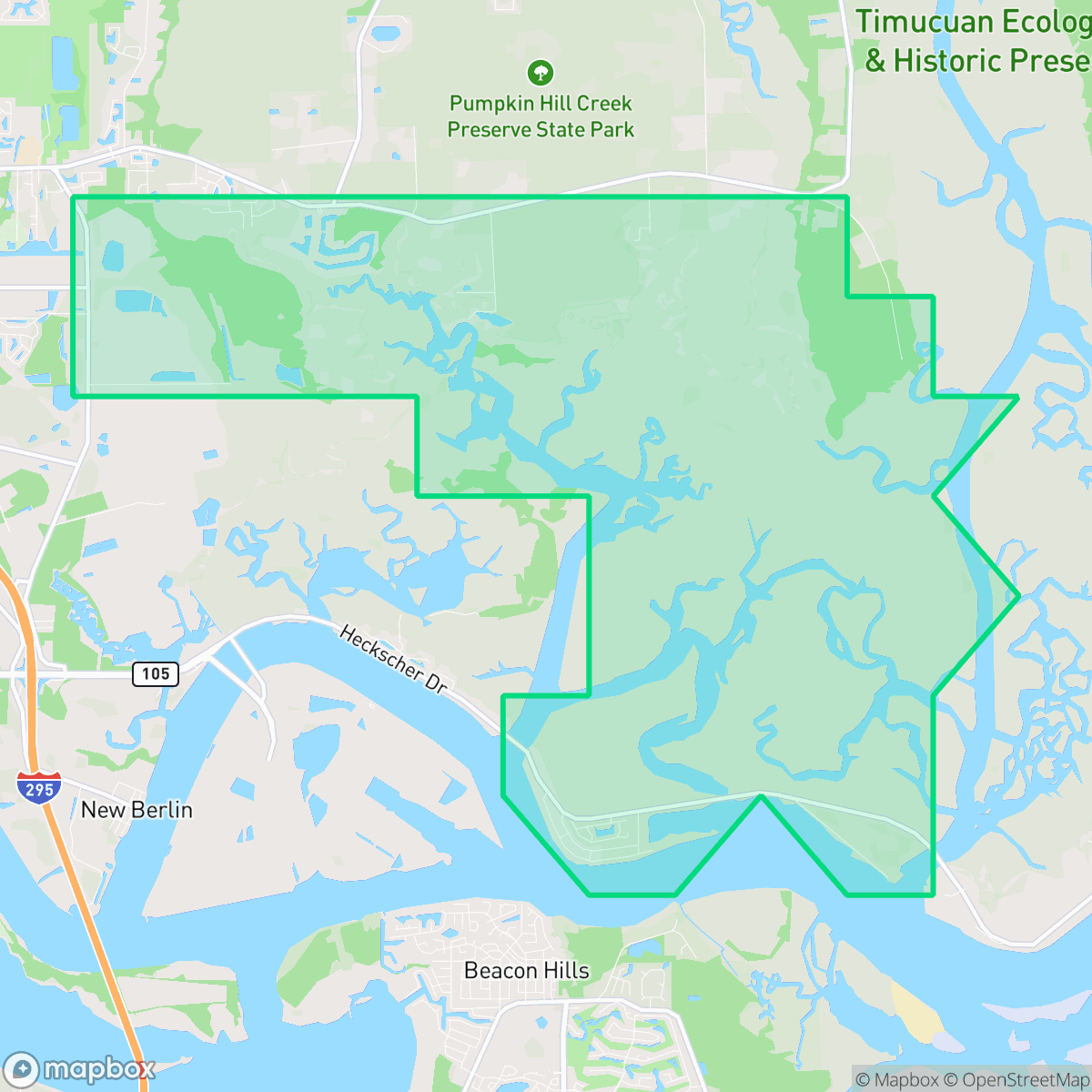
About Pumpkin Hill
Pumpkin Hill, located in northeastern Duval County, takes its name from the wild gourds that flourished in its well-drained, alluvial soil during the 19th century. Historically, the area was home to the Timucua people before becoming a patchwork of small-scale family farms producing cabbage, potatoes, and pumpkins. The landscape still bears traces of the region’s historical turpentine industry, with "cat-face" scars visible on older pine trees from sap extraction. The neighborhood is anchored by the 4,000-acre Pumpkin Hill Creek Preserve State Park, which protects vital salt marshes and pine flatwoods. Once served by a local one-room schoolhouse at the intersection of Pumpkin Hill and Cedar Point roads, the area has evolved from a rural agricultural outpost into a quiet, nature-oriented residential community defined by its proximity to the St. Johns and Nassau River estuaries.
Neighborhood Scores Across 15 Qualities
Residential lots feature closely positioned detached homes with minimal separation between structures. According to iHuus data, this density of housing offers significantly less seclusion than the Jacksonville average.
Limited sidewalk infrastructure and heavy traffic make pedestrian travel difficult. According to iHuus data, walkability in this area is significantly lower than the Jacksonville average.
Dense housing layouts and limited green space characterize the area. According to iHuus data, the visual landscape is notably less developed than the Jacksonville average.
Minimal greenery and narrow street verges make for limited walking opportunities for pets. This area offers significantly fewer pet-friendly features than the Jacksonville average, according to iHuus data.
Sparse development and significant open space characterize this area, which is notably less urbanized than the Jacksonville average. According to iHuus data, the landscape consists primarily of low-rise structures with limited concentrated building density.
Minimal commercial activity and a lack of local landmarks define this peaceful area, which remains significantly more tranquil than the Jacksonville average. Residents can expect a secluded atmosphere with very little street life or nearby amenities.
Ambient noise levels are notably lower than the Jacksonville average, consisting primarily of infrequent distant traffic or occasional trains. According to iHuus data, residents can expect a peaceful environment with minimal disruption from urban sounds.
Frequent unhealthy air quality levels pose a significant risk to sensitive groups. According to iHuus data, conditions in this area are notably worse than the Jacksonville average.
Industrial activity and heavy freight corridors are notably less prevalent here than in the rest of Jacksonville. Most parts of the neighborhood consist of residential streets and light commercial services with very little heavy industry nearby.
Health insurance access among residents is notably lower than the Jacksonville average, according to iHuus data.
Voting patterns and census indicators show a significantly more conservative leaning than the Jacksonville average, according to iHuus data.
Young adults make up the majority of the population here, making the area significantly younger than the Jacksonville average. According to iHuus data, there is a relatively small presence of families or older residents in this neighborhood.
Property within the 100-year floodplain faces a significant risk of flooding, which is much higher than the Jacksonville average. According to iHuus data, residents should prepare for the likely requirement of flood insurance.
Address-Level Insights for Pumpkin Hill


iHuus Neighborhood Intelligence Insights
Get address-level neighborhood insights for Pumpkin Hill
- Street-level scores — see how individual blocks compare, not just neighborhood averages
- Micro-zone boundaries — identify quiet pockets, flood boundaries, and walkable clusters before you visit
- 15 dimensions in full — walkability, noise, air quality, school quality, insurance coverage, population age profile, urban/rural index, and more
- Boundary risk alerts — know if your address sits near a block boundary where scores drop, the kind of detail no listing will ever mention
- School insights — individual school ratings and insights, not just district-level data
- Compare before you commit — side-by-side data across neighborhoods, down to block precision
No credit card required
Compare with Any Neighborhood
| Dimension | Pumpkin Hill | 29th and Chase |
|---|---|---|
| 🚶 Walkabilityavg 3.96 | ||
| 🔊 Acoustic Comfortavg 4.37 | ||
| 🤫 Privacy Indexavg 4.3 | ||
| 🎨 Visual Appealavg 4.24 | ||
| 🐕 Dog Friendlinessavg 4.28 | ||
| 🗺️ Urban-Rural Indexavg 5.22 | ||
| ✨ Neighborhood Vibeavg 1.5 | ||
| 🏥 Health Insurance Coverageavg 4.35 | ||
| 🌿 Air Qualityavg 3.84 | ||
| 🏭 Industrial Proximityavg 5.11 | ||
| 🌊 Flood Safetyavg 4.01 | ||
| 🗳️ Ideological Leanavg 2.75 | ||
| 👥 Population Age Profileavg 3.26 | ||
| 🔥 Fire Safety | ||
| 🏫 School Quality |
Pumpkin Hill Rankings
School Districts Serving Pumpkin Hill
School Insights for Pumpkin Hill
Below average outcomes; significant attendance and academic challenges.
School Insights
See what's really behind every school rating near Pumpkin Hill
- Individual school ratings — each school's own score with outcome context, not just a district average
- Enrollment & class size data — student-to-teacher ratio and how it compares to the state average
- Full demographics breakdown — ethnicity and gender composition for every school in the enrollment zone
- Every school in the district — all schools within the enrollment boundary ranked by rating, not just the closest one
- Grade levels & benchmarks — elementary through high school, with below/above state-average flags
No credit card required