Panama Park, Jacksonville
Updated · 3,119 residents
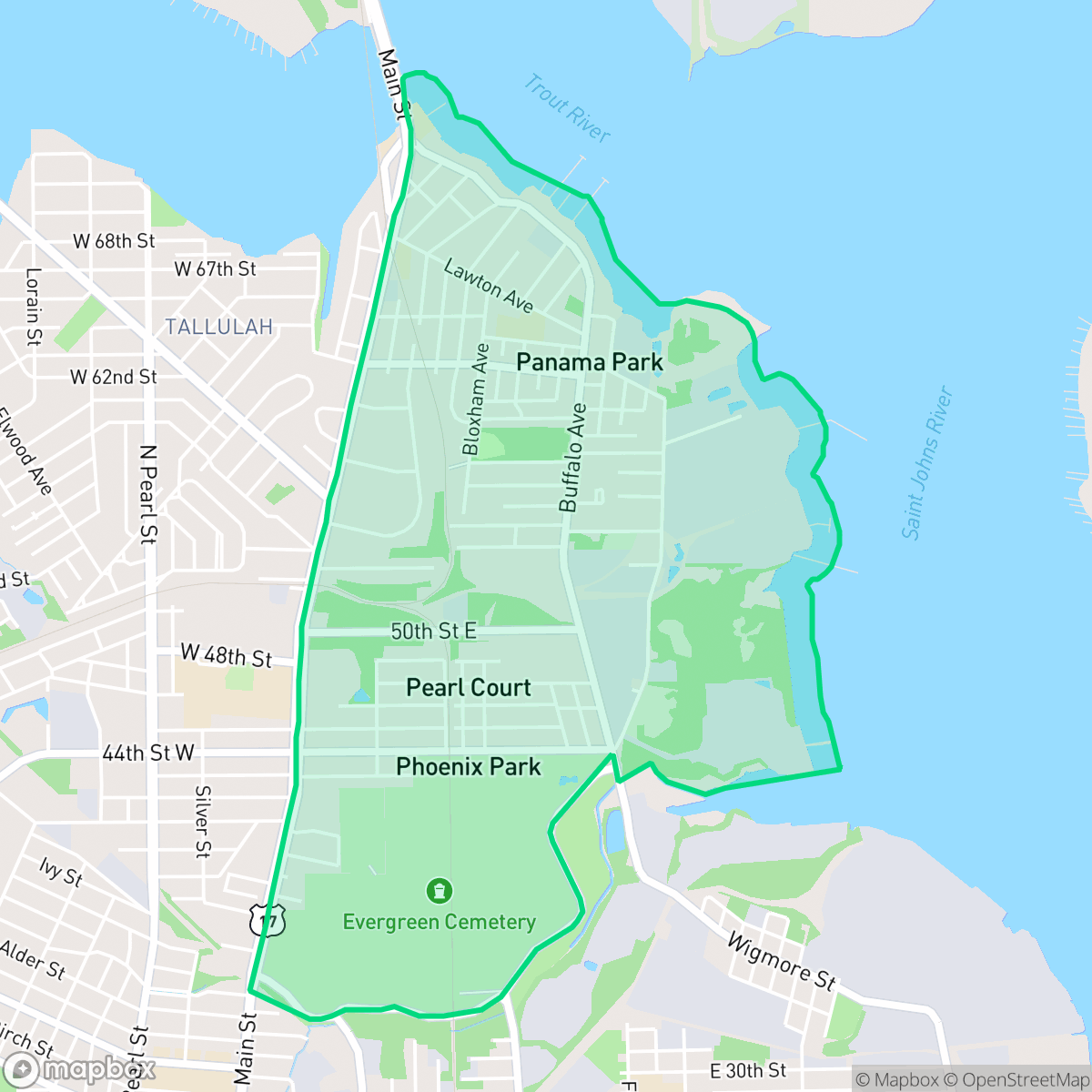
Panama Park is a quiet, historically significant residential community located along the Trout River just north of downtown Jacksonville. The area features a modest, suburban landscape with a mix of established homes and light industrial activity. While residents enjoy a calm atmosphere, pedestrian access remains limited due to inconsistent sidewalk infrastructure.
Key Highlights
About Panama Park
Panama Park, located five miles north of downtown Jacksonville, holds a rich industrial and residential history. Its development traces back to 1828 with the establishment of East Florida’s first steam-powered sawmill, later becoming the site of the massive Cummer Lumber Mill in 1896. First platted in 1879, the neighborhood evolved into an early 20th-century 'railroad suburb' under developer George W. Clark, who marketed it for its modern amenities and proximity to rail and steamboat transit. Panama Park is defined by its working waterfront along the Trout River and notable architecture, including the former Lola M. Culver Elementary School, a Prairie-style design by Henry Klutho. Historically significant as the birthplace of Florida’s 15th Governor, Francis Philip Fleming, the neighborhood remains a distinct community characterized by its long-standing local businesses and traditional Northside identity.
The neighborhood maintains a distinct Northside identity defined by its blend of residential blocks and proximity to the working waterfront. It offers a suburban mix that balances established housing with occasional commercial traffic from nearby warehouses and transit routes. The landscape is primarily composed of modest homes, creating a simple urban environment that remains relatively quiet compared to more densely populated parts of the city. Prospective residents should be aware that the area is situated within a designated floodplain, which may influence insurance requirements. While the neighborhood provides a diverse demographic environment, those looking for high walkability or extensive public green spaces may find the current infrastructure limited. It is best suited for those seeking a settled, quiet community who prioritize proximity to downtown while navigating the trade-offs of a mixed industrial and residential setting.
Neighborhood Scores Across 15 Qualities
Neighboring properties offer a moderate amount of separation, though some denser clusters of apartments and mobile homes exist within the area. According to iHuus data, this level of spacing is slightly higher than the Jacksonville average.
Pedestrian connectivity is inconsistent due to missing sidewalks and dirt shoulders on main roads, though low traffic levels on residential streets make walking possible. According to iHuus data, walkability in this area is slightly higher than the Jacksonville average.
Housing consists primarily of modest, high-density homes and apartment complexes with limited private greenery. According to iHuus data, the area offers less visual variety and fewer luxury amenities than the Jacksonville average.
Limited public park access and narrow street verges define much of the area, though some sections feature baseball fields and grass-lined streets that offer slightly better amenities than the Jacksonville average. Most residential pockets rely heavily on private yards for pet activity according to iHuus data.
A blend of residential houses and commercial strips defines this area, offering a layout that is very similar to the Jacksonville average. According to iHuus data, the neighborhood features an even balance between developed streetscapes and accessible green space.
Primarily characterized by a calm, suburban atmosphere, this area offers more activity than the city average but lacks significant commercial density. Residents will find a subdued landscape of established housing blocks with sparse local amenities and limited points of interest.
Steady traffic sounds from nearby busy streets are present, though the level of acoustic disturbance remains notably lower than the Jacksonville average.
Air quality levels in Panama Park fluctuate between acceptable and unhealthy, though conditions are generally better than the Jacksonville average. Sensitive groups may experience occasional concern during certain periods according to iHuus data.
Active commercial traffic and light industrial utility sites are present alongside residential areas, making the industrial density slightly higher than the Jacksonville average. Residents may encounter increased transit traffic near gas stations and warehouse facilities located along main thoroughfares.
Health insurance access is slightly higher than the Jacksonville average, though a significant portion of the population remains uninsured. Residents should be aware that coverage rates in this area are only moderate according to iHuus data.
Political leanings in Panama Park are notably more liberal than the Jacksonville average, according to iHuus data.
Residents live alongside a varied demographic of young adults, families, and seniors. This population spread is slightly more diverse than the average found across Jacksonville.
Properties in this area are located within a designated floodplain, making them more susceptible to flooding than the average Jacksonville neighborhood. Residents should account for the increased likelihood of needing flood insurance according to iHuus data.
Address-Level Insights for Panama Park


iHuus Neighborhood Intelligence Insights
Get address-level neighborhood insights for Panama Park
- Street-level scores — see how individual blocks compare, not just neighborhood averages
- Micro-zone boundaries — identify quiet pockets, flood boundaries, and walkable clusters before you visit
- 15 dimensions in full — walkability, noise, air quality, school quality, insurance coverage, population age profile, urban/rural index, and more
- Boundary risk alerts — know if your address sits near a block boundary where scores drop, the kind of detail no listing will ever mention
- School insights — individual school ratings and insights, not just district-level data
- Compare before you commit — side-by-side data across neighborhoods, down to block precision
No credit card required
Compare with Any Neighborhood
| Dimension | Panama Park | 29th and Chase |
|---|---|---|
| 🚶 Walkabilityavg 3.96 | ||
| 🔊 Acoustic Comfortavg 4.37 | ||
| 🤫 Privacy Indexavg 4.3 | ||
| 🎨 Visual Appealavg 4.24 | ||
| 🐕 Dog Friendlinessavg 4.28 | ||
| 🗺️ Urban-Rural Indexavg 5.22 | ||
| ✨ Neighborhood Vibeavg 1.5 | ||
| 🏥 Health Insurance Coverageavg 4.35 | ||
| 🌿 Air Qualityavg 3.84 | ||
| 🏭 Industrial Proximityavg 5.11 | ||
| 🌊 Flood Safetyavg 4.01 | ||
| 🗳️ Ideological Leanavg 2.75 | ||
| 👥 Population Age Profileavg 3.26 | ||
| 🔥 Fire Safety | ||
| 🏫 School Quality |
Panama Park Rankings
School Districts Serving Panama Park
School Insights for Panama Park
Below average outcomes; significant attendance and academic challenges.
School Insights
See what's really behind every school rating near Panama Park
- Individual school ratings — each school's own score with outcome context, not just a district average
- Enrollment & class size data — student-to-teacher ratio and how it compares to the state average
- Full demographics breakdown — ethnicity and gender composition for every school in the enrollment zone
- Every school in the district — all schools within the enrollment boundary ranked by rating, not just the closest one
- Grade levels & benchmarks — elementary through high school, with below/above state-average flags
No credit card required