Oceanway, Jacksonville
Updated · 9,489 residents
Oceanway is a quiet, semi-rural community that offers a blend of midcentury ranches and newer residential subdivisions. The neighborhood provides a balanced level of privacy and is notably more walkable than many other parts of Jacksonville, despite inconsistent sidewalk connectivity.
Key Highlights
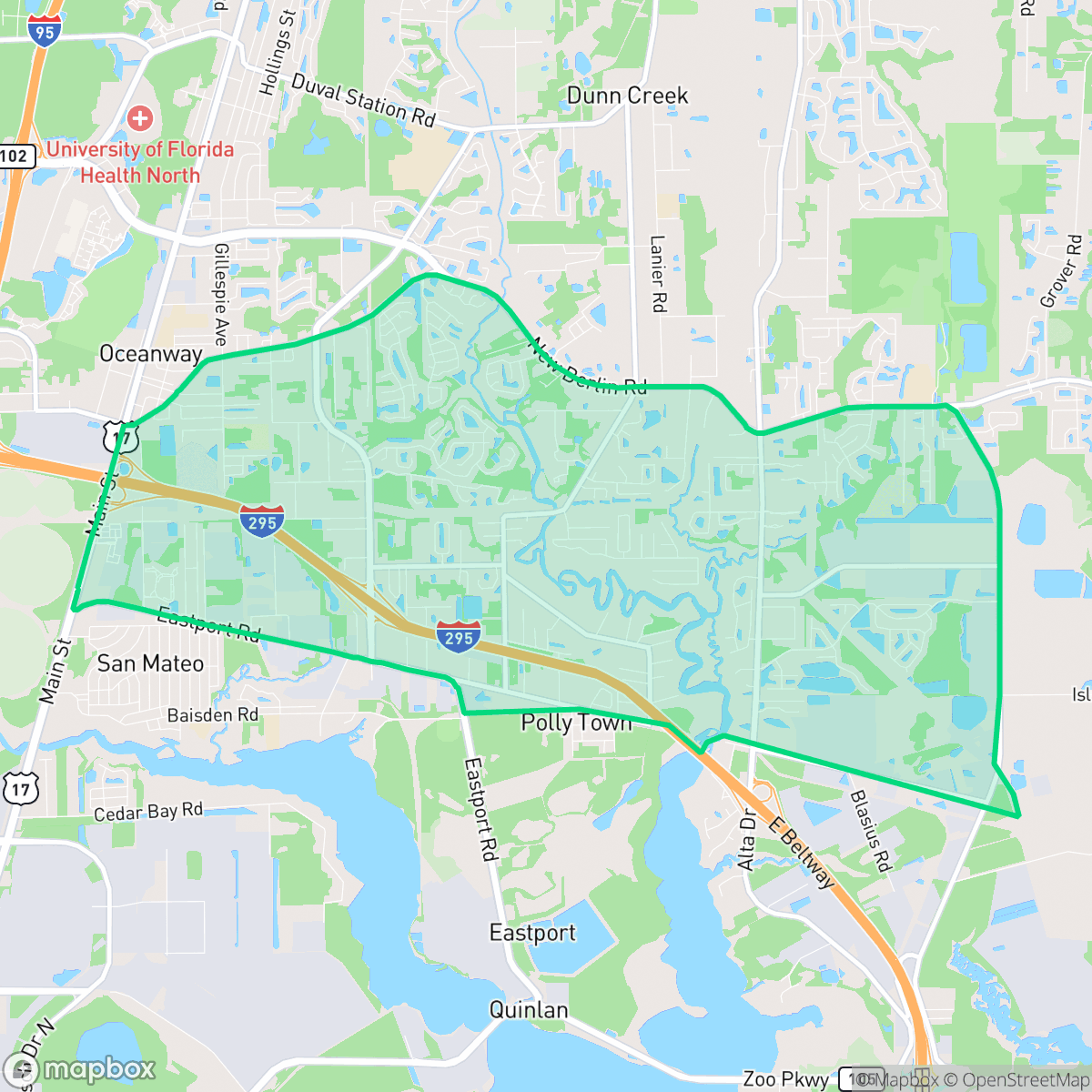
About Oceanway
Originally a rural, wooded area dotted with small farms and isolated houses, Oceanway was historically known as Broward Station and Duval Station, serving as a key transit point for travelers heading to Fernandina Beach or Jacksonville Beach. Its name reflects its location as a common stop for fishermen and beachgoers who frequented local bait and tackle shops before the construction of major highways like I-95. The community's development was significantly influenced by figures like Dr. Gillespie, who promoted the area as an ideal place to live. In 1976, the Oceanway Improvement Council was established to address community needs. Since the early 1980s, the neighborhood has transitioned from a semi-rural landscape into a suburban community, characterized by a mix of midcentury ranches and newer residential subdivisions, while maintaining a strong local identity centered on its schools and community parks.
The area maintains a calm, residential atmosphere defined by its open land and scattered woodland patches. Residents benefit from a lower presence of heavy industry, which contributes to its status as a peaceful retreat from the city center. The housing stock is visually diverse, featuring a mix of established homes and modern developments that offer more architectural variety than many surrounding suburbs. According to iHuus data, the neighborhood provides a balanced level of privacy, with homes often buffered by yards or fencing that offer more seclusion than typical urban layouts.
While the neighborhood is generally quiet, those living near primary thoroughfares may notice a steady hum of local traffic. Families and pet owners often appreciate the accessible green verges and retention ponds that provide space for outdoor activity. Prospective residents should be aware of the moderate flood risk in the region and the occasional air quality challenges. Overall, the area is well-suited for those seeking a suburban lifestyle with a semi-rural character and a balanced demographic profile.
Neighborhood Scores Across 15 Qualities
Residential spacing offers a moderate level of separation between homes, providing more seclusion than the typical Jacksonville neighborhood. Houses are generally buffered by small yards and privacy fences according to iHuus data.
Low traffic volumes and calm cul-de-sacs provide a pleasant environment for walking, even though sidewalk connectivity is inconsistent. This level of walkability is higher than the Jacksonville average.
Standard tract housing characterizes much of the area, though some properties feature large homes with complex rooflines and private pools. This level of visual variety is notably higher than the Jacksonville average, according to iHuus data.
Continuous green verges and accessible retention ponds provide more open space for pets than the Jacksonville average. According to iHuus data, these roadside natural areas offer additional walking opportunities throughout the neighborhood.
Frequent open land and scattered homes among woodlands create a more rural atmosphere than much of Jacksonville. While some areas feature dense suburban layouts, the overall landscape provides significantly more open space than the city average.
Primarily residential in character, this area offers a calm atmosphere with very little commercial activity or street life. The level of local activity is essentially consistent with the city average.
A steady hum of local traffic from a nearby busy street defines the acoustic environment. This level of noise is roughly in line with the average for Jacksonville.
Frequent unhealthy air quality levels pose a significant risk to sensitive groups. According to iHuus data, air conditions in this area are slightly worse than the Jacksonville average.
Primarily residential in nature, this area features mostly local services and light commercial activity with significantly less heavy industry than the Jacksonville average. While most streets are quiet, some residents may experience localized traffic or noise near storage facilities and gas stations.
Health insurance access among residents is notably higher than the Jacksonville average, according to iHuus data. This indicates a well-covered population with greater access to medical services.
Political preferences in Oceanway align with a conservative majority, reflecting a trend that is very similar to the broader Jacksonville area.
A varied demographic of young adults, families, and seniors resides here, representing a more balanced age distribution than the Jacksonville average according to iHuus data.
Flood safety levels in this area are notably higher than the Jacksonville average, though official FEMA studies for this specific location remain incomplete.
Address-Level Insights for Oceanway


iHuus Neighborhood Intelligence Insights
Get address-level neighborhood insights for Oceanway
- Street-level scores — see how individual blocks compare, not just neighborhood averages
- Micro-zone boundaries — identify quiet pockets, flood boundaries, and walkable clusters before you visit
- 15 dimensions in full — walkability, noise, air quality, school quality, insurance coverage, population age profile, urban/rural index, and more
- Boundary risk alerts — know if your address sits near a block boundary where scores drop, the kind of detail no listing will ever mention
- School insights — individual school ratings and insights, not just district-level data
- Compare before you commit — side-by-side data across neighborhoods, down to block precision
No credit card required
Compare with Any Neighborhood
| Dimension | Oceanway | 29th and Chase |
|---|---|---|
| 🚶 Walkabilityavg 3.96 | ||
| 🔊 Acoustic Comfortavg 4.37 | ||
| 🤫 Privacy Indexavg 4.3 | ||
| 🎨 Visual Appealavg 4.24 | ||
| 🐕 Dog Friendlinessavg 4.28 | ||
| 🗺️ Urban-Rural Indexavg 5.22 | ||
| ✨ Neighborhood Vibeavg 1.5 | ||
| 🏥 Health Insurance Coverageavg 4.35 | ||
| 🌿 Air Qualityavg 3.84 | ||
| 🏭 Industrial Proximityavg 5.11 | ||
| 🌊 Flood Safetyavg 4.01 | ||
| 🗳️ Ideological Leanavg 2.75 | ||
| 👥 Population Age Profileavg 3.26 | ||
| 🔥 Fire Safety | ||
| 🏫 School Quality |
Oceanway Rankings
School Districts Serving Oceanway
School Insights for Oceanway
Below average outcomes; significant attendance and academic challenges.
School Insights
See what's really behind every school rating near Oceanway
- Individual school ratings — each school's own score with outcome context, not just a district average
- Enrollment & class size data — student-to-teacher ratio and how it compares to the state average
- Full demographics breakdown — ethnicity and gender composition for every school in the enrollment zone
- Every school in the district — all schools within the enrollment boundary ranked by rating, not just the closest one
- Grade levels & benchmarks — elementary through high school, with below/above state-average flags
No credit card required