Oak Hill, Jacksonville
Updated · 8,723 residents
Oak Hill is a quiet, residential enclave in Jacksonville defined by its mid-century architecture and semi-rural atmosphere. While the area offers residents clean air and pleasant, walkable streets, it is also subject to higher noise levels from nearby rail and highway traffic.
Key Highlights
About Oak Hill
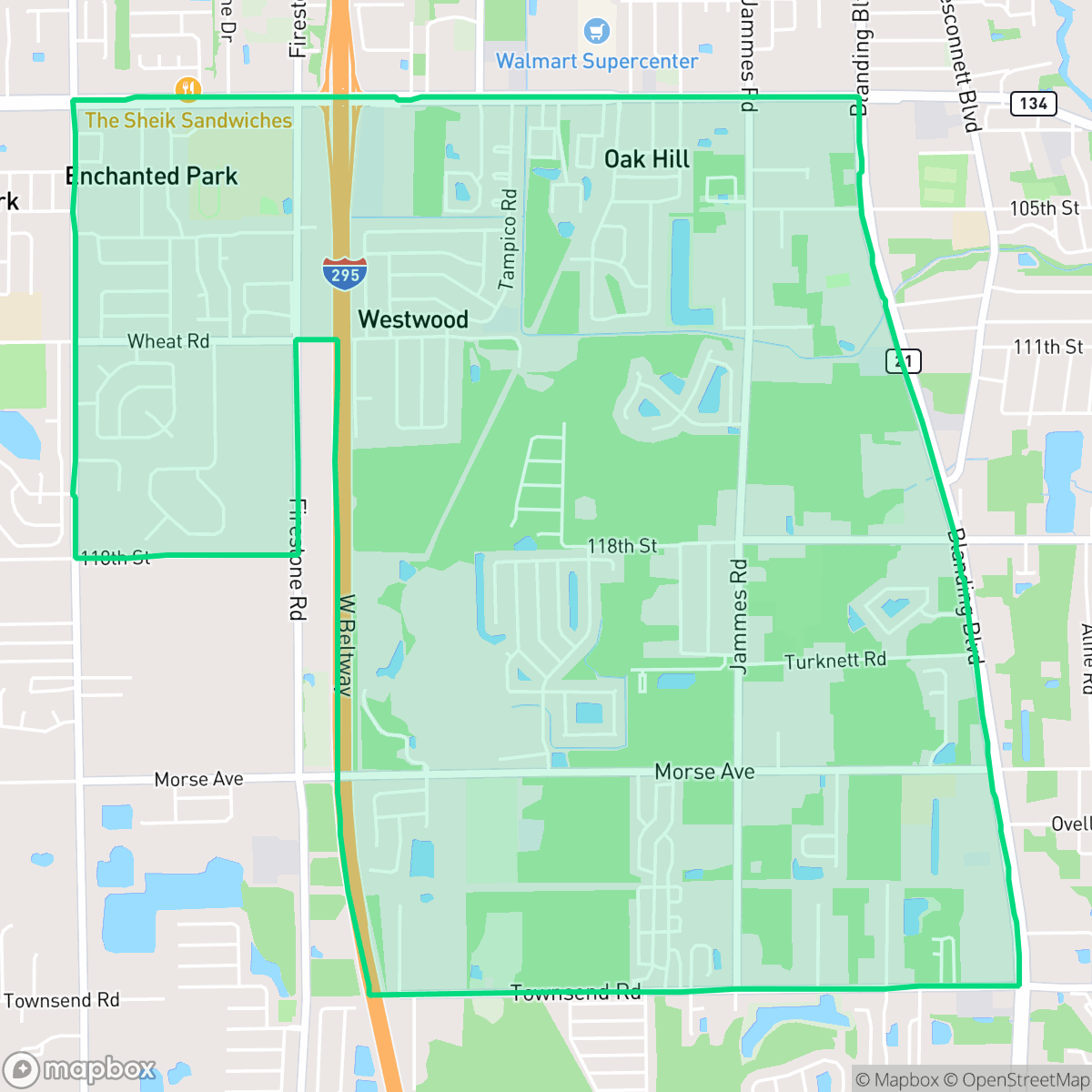
Oak Hill is a residential neighborhood located in the Westside area of Jacksonville, Florida. Historically, the area was part of the Jacksonville Heights Townsite, which was platted in 1909. The neighborhood's character was shaped significantly during the mid-20th century, particularly following the post-World War II suburban expansion in Duval County. The area is defined by its mid-century bungalow and ranch-style housing stock, reflecting the architectural trends of the 1950s and 1960s. Local infrastructure, such as Westwood Park, highlights the neighborhood's development history; the land for the park was sold by Oak Hill developers to the county in 1962 to support growing recreational needs before Jacksonville's 1968 city-county consolidation. Today, the community remains a primarily suburban residential enclave, valued for its proximity to major transit corridors like I-295 and I-10.
The area maintains a distinct character through its blend of mature tree canopies, expansive wetlands, and well-maintained mid-century homes. Residents enjoy a sense of seclusion provided by wooded buffers, which contributes to a more private living environment than many other parts of the city. The neighborhood is particularly well-suited for those who appreciate a quiet, suburban pace of life with easy access to transit corridors like I-295 and I-10. Prospective residents should note the trade-offs regarding noise, as the proximity to active freight rail and major roads creates a consistently louder environment than the Jacksonville average. While the local streets are generally safe and pleasant for walking or exercising pets, sidewalk connectivity can be inconsistent. Families moving to the area will navigate the broader Duval County school system, which offers specialized magnet programs alongside ongoing district-wide efforts to manage budget constraints and campus consolidation.
Neighborhood Scores Across 15 Qualities
Residential spacing varies between dense apartment clusters and single-family homes that feature wooded buffers. This level of separation provides more seclusion than the typical Jacksonville neighborhood according to iHuus data.
Low traffic volumes on residential streets provide a safe environment for walking, even though sidewalk connectivity remains inconsistent across the area. This level of walkability is notably higher than the Jacksonville average according to iHuus data.
Residential scenery features a mix of well-manicured lawns and private pools, providing more visual variety than much of Jacksonville. While some areas consist of standard tract housing with uniform rooflines, the neighborhood offers a more polished appearance than the city average.
Abundant green verges, wooded buffers, and access to lake-adjacent paths provide more opportunities for pet exercise than the Jacksonville average. Many residential areas feature continuous grassy strips and low-traffic cul-de-sacs suitable for walking dogs.
Open landscapes and wooded areas provide a more rural feel than much of Jacksonville. Residents will find significant undeveloped wetlands and mature tree canopies interspersed among suburban residential pockets, according to iHuus data.
Activity levels are significantly higher than the city average, primarily due to scattered pockets of suburban dining and local amenities amidst a mostly subdued landscape. While many areas remain calm and residential with little commercial pulse, certain sections function as active local hubs near transit points.
Frequent noise disturbances from nearby railroad tracks and heavy traffic are common in this area. This level of acoustic disruption is notably higher than the Jacksonville average, according to iHuus data.
Air quality remains consistently good with only rare instances of elevated readings. This level of clarity is significantly higher than the average seen across Jacksonville, according to iHuus data.
Heavy manufacturing and industrial hazards are largely absent from the area, making it significantly cleaner than the Jacksonville average. Most of the neighborhood consists of residential streets and local services, though some residents may encounter light commercial activity or occasional freight traffic near storage facilities.
Health insurance accessibility is notably higher than the Jacksonville average, according to iHuus data. Residents in this area have a significantly greater likelihood of being covered by a health plan compared to most of the city.
Political leanings in this area are notably more liberal than the Jacksonville average, with a significant majority of residents identifying with progressive values.
A varied demographic of young adults, families, and seniors lives here, representing a more balanced age distribution than the city average according to iHuus data.
Some areas within the neighborhood are situated in a zone that may experience residual flooding during extreme weather events. This level of flood safety is notably higher than the average for Jacksonville, according to iHuus data.
Address-Level Insights for Oak Hill


iHuus Neighborhood Intelligence Insights
Get address-level neighborhood insights for Oak Hill
- Street-level scores — see how individual blocks compare, not just neighborhood averages
- Micro-zone boundaries — identify quiet pockets, flood boundaries, and walkable clusters before you visit
- 15 dimensions in full — walkability, noise, air quality, school quality, insurance coverage, population age profile, urban/rural index, and more
- Boundary risk alerts — know if your address sits near a block boundary where scores drop, the kind of detail no listing will ever mention
- School insights — individual school ratings and insights, not just district-level data
- Compare before you commit — side-by-side data across neighborhoods, down to block precision
No credit card required
Compare with Any Neighborhood
| Dimension | Oak Hill | 29th and Chase |
|---|---|---|
| 🚶 Walkabilityavg 3.96 | ||
| 🔊 Acoustic Comfortavg 4.37 | ||
| 🤫 Privacy Indexavg 4.3 | ||
| 🎨 Visual Appealavg 4.24 | ||
| 🐕 Dog Friendlinessavg 4.28 | ||
| 🗺️ Urban-Rural Indexavg 5.22 | ||
| ✨ Neighborhood Vibeavg 1.5 | ||
| 🏥 Health Insurance Coverageavg 4.35 | ||
| 🌿 Air Qualityavg 3.84 | ||
| 🏭 Industrial Proximityavg 5.11 | ||
| 🌊 Flood Safetyavg 4.01 | ||
| 🗳️ Ideological Leanavg 2.75 | ||
| 👥 Population Age Profileavg 3.26 | ||
| 🔥 Fire Safety | ||
| 🏫 School Quality |
Oak Hill Rankings
School Districts Serving Oak Hill
School Insights for Oak Hill
Below average outcomes; significant attendance and academic challenges.
School Insights
See what's really behind every school rating near Oak Hill
- Individual school ratings — each school's own score with outcome context, not just a district average
- Enrollment & class size data — student-to-teacher ratio and how it compares to the state average
- Full demographics breakdown — ethnicity and gender composition for every school in the enrollment zone
- Every school in the district — all schools within the enrollment boundary ranked by rating, not just the closest one
- Grade levels & benchmarks — elementary through high school, with below/above state-average flags
No credit card required