Oak Haven, Jacksonville
Updated · 1,202 residents
Oak Haven is a historic peninsula neighborhood in Jacksonville defined by its mature tree canopy and spacious, upscale residential lots. While the area offers a quiet, semi-rural atmosphere with minimal industrial presence, residents should anticipate higher noise levels due to its proximity to major transit corridors.
Key Highlights
About Oak Haven
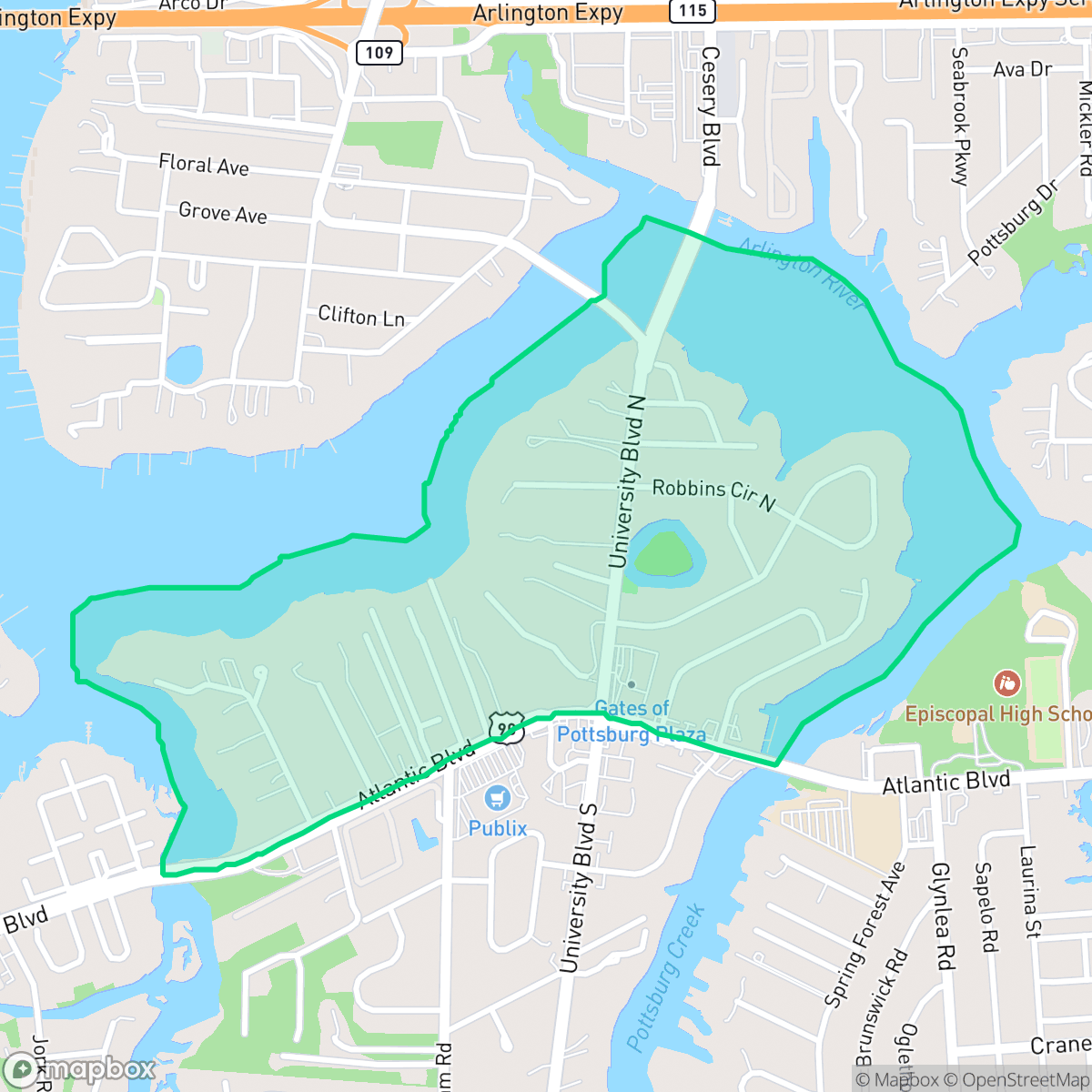
Oak Haven is a historic neighborhood situated on a peninsula defined by the Arlington River and Pottsburg Creeks. It is notably home to 1300 Oak Haven Road, a Gothic-style residence built between 1837 and 1848 for Francis Richard III, which is recognized as the oldest continuously occupied house in Jacksonville. The area’s character was further shaped during the mid-20th century by the H.S. Brownett Company, whose residential developments were specifically designed to preserve the native tree canopy and natural landscape. Historically, the neighborhood is linked to the broader development of the Arlington region and the legacy of the nearby Hope Haven Hospital, an influential pediatric institution that served Northeast Florida for decades. Today, Oak Haven remains defined by its mature natural environment and its deep roots in the city's early plantation and timber-industry history.
The neighborhood maintains a quiet, low-key atmosphere that provides a distinct semi-rural feel despite its central location in Jacksonville. The residential landscape is characterized by a mix of single-family homes on large, wooded lots and medium-density apartment clusters, creating a visual environment that is notably more manicured and expansive than the city average. As a peninsula community, the area offers a unique sense of privacy, with mature greenery providing a natural buffer between properties and private pools contributing to an upscale aesthetic. Residents benefit from a notable lack of heavy industry, allowing the community to remain focused on its residential character.
Living in this area involves balancing its tranquil, wooded environment with the realities of its location near major transportation infrastructure. While the streets are generally calm and suitable for walking, the proximity to highways and rail lines results in higher noise levels that may impact those sensitive to sound. Prospective residents should also consider the broader context of the Duval County School District, which offers access to highly regarded magnet and specialized programs but is currently managing significant budget-related consolidations. The area is well-suited for individuals and families who prioritize a spacious, natural setting and are comfortable navigating the trade-offs associated with urban transit proximity.
Neighborhood Scores Across 15 Qualities
Residential spacing varies between dense multi-family clusters and single-family homes on larger, wooded lots. This level of separation offers more buffer between neighbors than the Jacksonville average, according to iHuus data.
Residential loops offer safe walking paths through mature tree canopies, though sidewalks are primarily limited to main roads. According to iHuus data, the area is more walkable than the Jacksonville average.
Large homes, private pools, and waterfront properties characterize this area. The visual landscape is significantly more manicured and expansive than the Jacksonville average according to iHuus data.
Residential greenery and wide grass verges offer ample room for walking pets, providing more space than the typical Jacksonville neighborhood. While large public parks are limited, the low traffic on cul-de-sacs creates a calm environment according to iHuus data.
Open land and scattered woodland areas create a more rural atmosphere than much of Jacksonville. This landscape features a mix of single-family homes and medium-density apartment clusters according to iHuus data.
Suburban streets offer a calm atmosphere with much more local activity than the typical Jacksonville area. While some blocks serve as small destinations for dining and civic institutions, many parts of the neighborhood remain primarily residential and quiet.
Frequent traffic and transit sounds are common in this area due to proximity to major highways and rail lines. According to iHuus data, acoustic comfort is significantly lower than the Jacksonville average.
Air quality levels in Oak Haven fluctuate between acceptable and unhealthy, particularly for sensitive groups. According to iHuus data, conditions here are notably better than the average found throughout Jacksonville.
Heavy industry is virtually absent in this area, which features a primarily residential landscape with only light commercial services. According to iHuus data, this level of separation from industrial zones is significantly higher than the Jacksonville average.
Health insurance coverage levels in this area are notably higher than the Jacksonville average. According to iHuus data, a moderate portion of the local population maintains active coverage.
Conservative values represent the majority of the community, showing a slightly more conservative leaning than the Jacksonville average according to iHuus data.
A balanced mix of young adults, families, and older residents characterizes the area. This demographic spread is notably more varied than the city average according to iHuus data.
Residual flood risk exists within this area due to its location in a 500-year floodplain. According to iHuus data, the safety level in Oak Haven is notably higher than the average for Jacksonville.
Address-Level Insights for Oak Haven


iHuus Neighborhood Intelligence Insights
Get address-level neighborhood insights for Oak Haven
- Street-level scores — see how individual blocks compare, not just neighborhood averages
- Micro-zone boundaries — identify quiet pockets, flood boundaries, and walkable clusters before you visit
- 15 dimensions in full — walkability, noise, air quality, school quality, insurance coverage, population age profile, urban/rural index, and more
- Boundary risk alerts — know if your address sits near a block boundary where scores drop, the kind of detail no listing will ever mention
- School insights — individual school ratings and insights, not just district-level data
- Compare before you commit — side-by-side data across neighborhoods, down to block precision
No credit card required
Compare with Any Neighborhood
| Dimension | Oak Haven | 29th and Chase |
|---|---|---|
| 🚶 Walkabilityavg 3.96 | ||
| 🔊 Acoustic Comfortavg 4.37 | ||
| 🤫 Privacy Indexavg 4.3 | ||
| 🎨 Visual Appealavg 4.24 | ||
| 🐕 Dog Friendlinessavg 4.28 | ||
| 🗺️ Urban-Rural Indexavg 5.22 | ||
| ✨ Neighborhood Vibeavg 1.5 | ||
| 🏥 Health Insurance Coverageavg 4.35 | ||
| 🌿 Air Qualityavg 3.84 | ||
| 🏭 Industrial Proximityavg 5.11 | ||
| 🌊 Flood Safetyavg 4.01 | ||
| 🗳️ Ideological Leanavg 2.75 | ||
| 👥 Population Age Profileavg 3.26 | ||
| 🔥 Fire Safety | ||
| 🏫 School Quality |
Oak Haven Rankings
School Districts Serving Oak Haven
School Insights for Oak Haven
Below average outcomes; significant attendance and academic challenges.
School Insights
See what's really behind every school rating near Oak Haven
- Individual school ratings — each school's own score with outcome context, not just a district average
- Enrollment & class size data — student-to-teacher ratio and how it compares to the state average
- Full demographics breakdown — ethnicity and gender composition for every school in the enrollment zone
- Every school in the district — all schools within the enrollment boundary ranked by rating, not just the closest one
- Grade levels & benchmarks — elementary through high school, with below/above state-average flags
No credit card required