New Town, Jacksonville
Updated · 1,851 residents
New Town is a historically significant community in the Jacksonville urban core, defined by its deep ties to Edward Waters University and a mix of residential and industrial spaces. The area features a diverse age demographic and a steady rhythm of commerce, though residents should expect noticeable noise from nearby transit infrastructure and limited pedestrian connectivity.
Key Highlights
About New Town
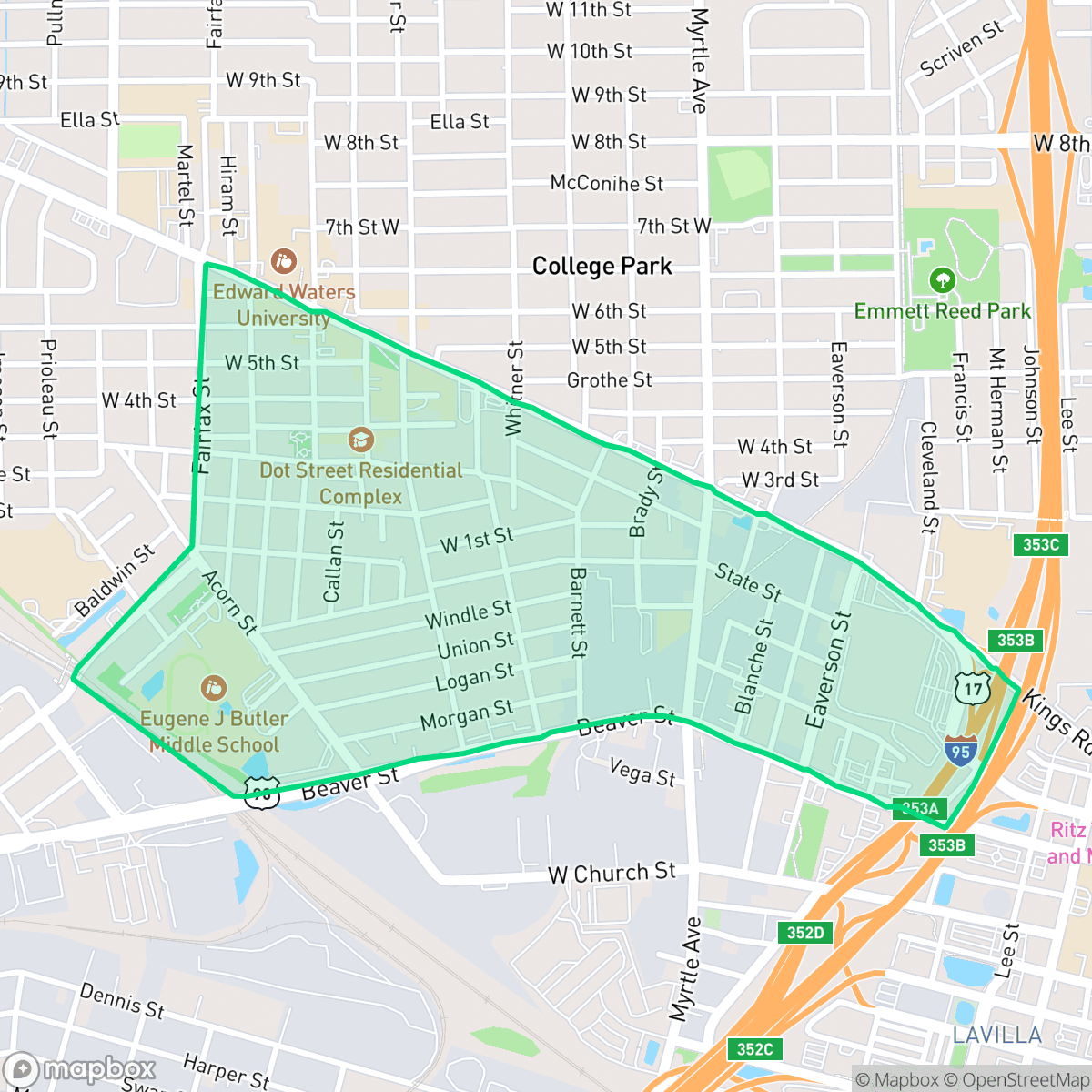
New Town, located in Jacksonville's urban core, emerged in the early 20th century as a vital residential community for African American railroad and industrial workers. Its development was shaped by an unorthodox street grid resulting from the convergence of multiple subdivision plats and the relocation of Edward Waters University, Florida's oldest historically black college, to the area in 1904. The neighborhood is characterized by frame vernacular and shotgun-style architecture, reflecting the craftsmanship of local builders like James Edward Hutchins. Historically significant as a hub for Black enterprise and education, New Town was home to pioneering figures such as A.L. Lewis, founder of the 50-50 Bottling Company. Today, the area remains defined by its deep ties to Edward Waters University and ongoing revitalization efforts, including the New Town Success Zone, which addresses the neighborhood's long-standing economic and social challenges.
The neighborhood functions as a unique blend of residential life and industrial activity, characterized by a semi-rural feel despite its position within the city's urban core. While the presence of warehouses and rail lines contributes to a higher level of ambient noise, the area benefits from a consistent level of social and commercial activity supported by the university. The landscape is marked by modest, uniform housing and open lots, creating a living environment that prioritizes space over density compared to other parts of the city.
Prospective residents will find a community in transition, where ongoing efforts aim to address long-standing economic challenges. Families should consider the local school landscape carefully, as the Duval County Public School district presents a wide range of outcomes between specialized magnet programs and neighborhood campuses. The area is best suited for those seeking a central location with a strong sense of history and a diverse social fabric, provided they are comfortable with the industrial character and moderate noise levels inherent to this part of Jacksonville.
Neighborhood Scores Across 15 Qualities
Residential spacing provides a moderate level of separation between neighbors, which is higher than the typical density found across Jacksonville. According to iHuus data, while some homes are closely positioned in a dense grid, other lots offer more substantial buffers.
Walking is possible on quiet streets, but sidewalk continuity is frequently interrupted by heavy tree cover and industrial traffic. According to iHuus data, the neighborhood offers slightly better walkability than the Jacksonville average despite these intermittent gaps in pedestrian infrastructure.
Residential scenery consists of small, uniform homes with limited private greenery. According to iHuus data, the area features a high density of simple structures near industrial rail yards, which is less visually diverse than the Jacksonville average.
Public greenery and park access are restricted, as most vegetation is located within private fenced yards. According to iHuus data, the lack of wide grass buffers and proximity to industrial zones makes this area less dog friendly than the Jacksonville average.
Open land and woodland areas are more frequent here than in much of Jacksonville. This mix of residential lots and industrial zones creates a landscape that is notably less dense than the city average, according to iHuus data.
Local amenities like cafes, breweries, and university-driven venues provide a notably higher level of activity than the Jacksonville average. While some suburban stretches remain quiet and car-dependent, much of the area maintains a consistent rhythm of commerce and social life.
Frequent noise from nearby heavy transit infrastructure, such as highways and rail lines, makes this area louder than most parts of Jacksonville. Residents may find the acoustic environment less peaceful than the city average according to iHuus data.
Air quality levels in New Town fluctuate between acceptable and unhealthy, presenting occasional concerns for sensitive groups. This neighborhood maintains a better air quality profile than the Jacksonville average, according to iHuus data.
Residential areas coexist with light industrial and commercial facilities, including warehouses and logistics hubs. According to iHuus data, this presence of active transit traffic and loading activity is higher than the Jacksonville average.
Health insurance access for residents is slightly above the Jacksonville average. According to iHuus data, a significant portion of the population remains uninsured.
Political leanings in this area are significantly more liberal than the Jacksonville average, according to iHuus data.
Residents will find a balanced mix of young adults, families, and older individuals. This demographic variety is notably more widespread than the average seen across Jacksonville.
Flood safety levels in New Town are higher than the Jacksonville average, though specific risks remain undetermined because FEMA has not completed a detailed study for this area. Residents should remain aware of potential vulnerabilities according to iHuus data.
Address-Level Insights for New Town


iHuus Neighborhood Intelligence Insights
Get address-level neighborhood insights for New Town
- Street-level scores — see how individual blocks compare, not just neighborhood averages
- Micro-zone boundaries — identify quiet pockets, flood boundaries, and walkable clusters before you visit
- 15 dimensions in full — walkability, noise, air quality, school quality, insurance coverage, population age profile, urban/rural index, and more
- Boundary risk alerts — know if your address sits near a block boundary where scores drop, the kind of detail no listing will ever mention
- School insights — individual school ratings and insights, not just district-level data
- Compare before you commit — side-by-side data across neighborhoods, down to block precision
No credit card required
Compare with Any Neighborhood
| Dimension | New Town | 29th and Chase |
|---|---|---|
| 🚶 Walkabilityavg 3.96 | ||
| 🔊 Acoustic Comfortavg 4.37 | ||
| 🤫 Privacy Indexavg 4.3 | ||
| 🎨 Visual Appealavg 4.24 | ||
| 🐕 Dog Friendlinessavg 4.28 | ||
| 🗺️ Urban-Rural Indexavg 5.22 | ||
| ✨ Neighborhood Vibeavg 1.5 | ||
| 🏥 Health Insurance Coverageavg 4.35 | ||
| 🌿 Air Qualityavg 3.84 | ||
| 🏭 Industrial Proximityavg 5.11 | ||
| 🌊 Flood Safetyavg 4.01 | ||
| 🗳️ Ideological Leanavg 2.75 | ||
| 👥 Population Age Profileavg 3.26 | ||
| 🔥 Fire Safety | ||
| 🏫 School Quality |
New Town Rankings
School Districts Serving New Town
School Insights for New Town
Below average outcomes; significant attendance and academic challenges.
School Insights
See what's really behind every school rating near New Town
- Individual school ratings — each school's own score with outcome context, not just a district average
- Enrollment & class size data — student-to-teacher ratio and how it compares to the state average
- Full demographics breakdown — ethnicity and gender composition for every school in the enrollment zone
- Every school in the district — all schools within the enrollment boundary ranked by rating, not just the closest one
- Grade levels & benchmarks — elementary through high school, with below/above state-average flags
No credit card required