Murray Hill, Jacksonville
Updated · 9,469 residents
Murray Hill is a vibrant, liberal-leaning community known for its active dining and brewery scene along Edgewood Avenue. While the area offers a spacious, tree-lined environment with a diverse mix of residents, prospective buyers should note the higher levels of traffic noise from nearby transit corridors.
Key Highlights
About Murray Hill
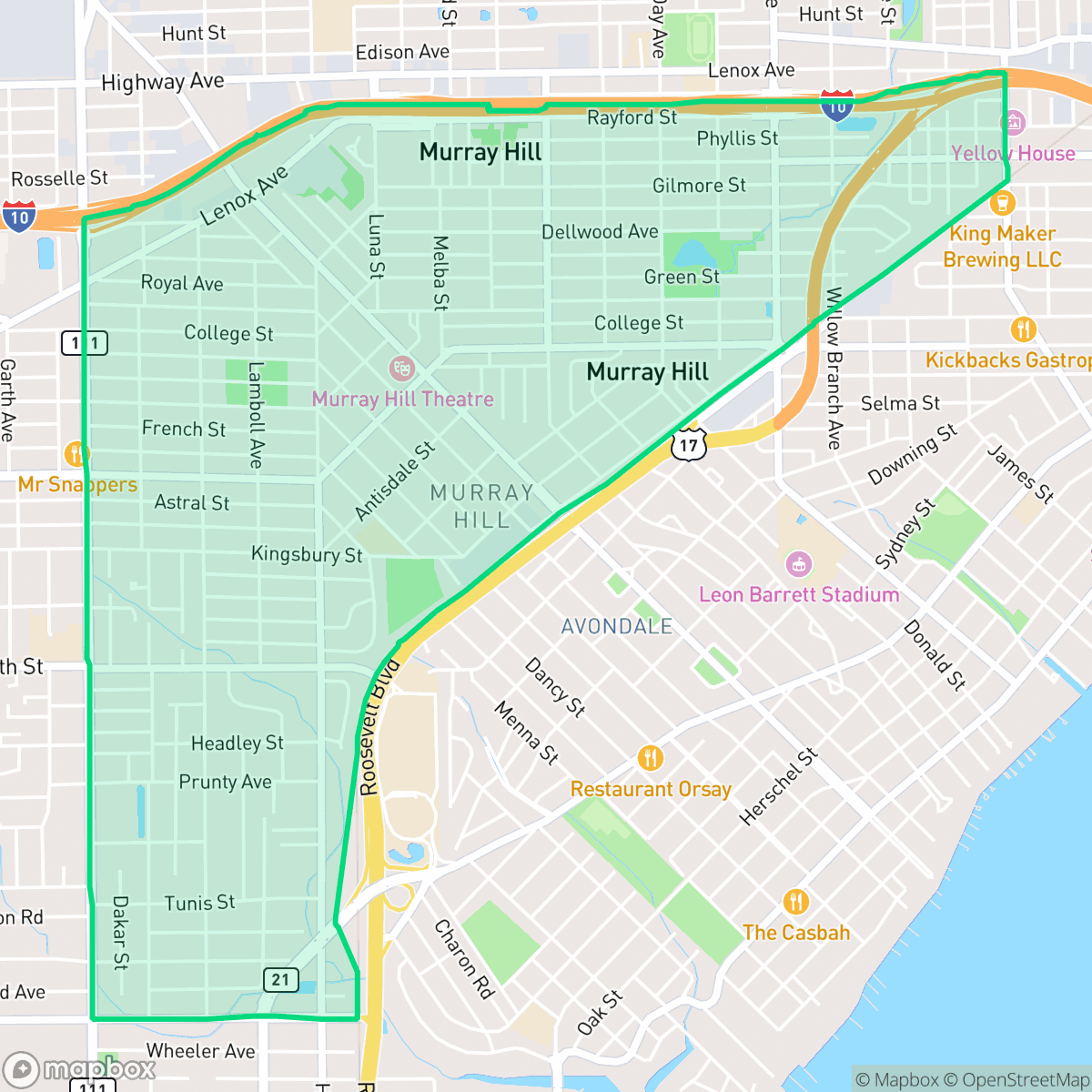
Platted in 1906 on the site of a failed 1880s development, Murray Hill was one of Northeast Florida’s first communities designed for automobile accessibility, featuring paved roads and detached garages. Originally marketed to workers from the nearby Seaboard Air Line Railway shops, the neighborhood incorporated as a town in 1916 before being annexed by Jacksonville in 1925. Its architectural character is defined by a diverse collection of early 20th-century styles, including Craftsman, Bungalow, Prairie School, and Tudor Revival, with a notable concentration of homes designed by Jacksonville’s first female architect, Henrietta Cuttino Dozier. Edgewood Avenue, historically known as the 'Avenue of Progress,' serves as the neighborhood's commercial heart, anchored by long-standing institutions and a walkable, park-rich urban landscape that reflects its origins as a streetcar suburb.
The area fosters an active, mixed-use atmosphere that stands out within the city. Residents enjoy a diverse social scene anchored by local breweries and eateries, which creates a steady rhythm of activity. The demographic profile is notably balanced, attracting a blend of young adults, families, and seniors who appreciate the community's semi-rural feel and mature tree canopy. This environment provides a more spacious residential experience than many surrounding parts of the city, characterized by simple, modest homes and a consistent grid layout.
When considering the neighborhood, it is important to weigh the benefits of its central location against certain livability trade-offs. The area experiences higher ambient noise levels due to its proximity to major highways and rail lines, and residents should be aware of a moderate risk of flooding. While the neighborhood is generally more walkable than the city average, pedestrian paths can be occasionally hindered by mature vegetation or infrastructure. Families looking to move here will find themselves in a district where educational success often depends on accessing specialized magnet programs, as the local school system manages a complex landscape of consolidation and budget adjustments.
Neighborhood Scores Across 15 Qualities
Residential spacing provides more separation between neighbors than the Jacksonville average. Houses feature a mix of standard urban lots and occasional wooded buffers that offer moderate privacy.
Quiet residential streets and a consistent grid layout provide better walking options than the Jacksonville average. While many sidewalks are partially obscured by heavy tree canopy or interrupted by major highways, low traffic levels on interior roads allow for relatively safe pedestrian movement.
Standard tract housing and small yards characterize this area, providing a more varied visual landscape than much of the city average. According to iHuus data, the neighborhood features simple roof geometries and lacks large luxury estates or private pools.
Public parks and continuous green verges provide decent walking areas for pets, though accessibility is slightly above the Jacksonville average. While some parts of the neighborhood feature central athletic fields and ponds, other residential sections offer limited public greenery beyond private fenced yards.
Open land and a mature tree canopy create a more semi-rural atmosphere than much of Jacksonville. Residents will experience a lower density environment characterized by scattered homes and significant greenery, according to iHuus data.
Local dining, breweries, and cultural venues provide a steady rhythm of activity that is significantly more vibrant than the Jacksonville average. Residents can experience a diverse blend of lively social hubs and quiet, tree-lined residential streets.
Frequent noise from nearby railroad tracks and major freeways characterizes this area. Acoustic levels are notably higher than the Jacksonville average, according to iHuus data.
Air quality levels fluctuate between acceptable and unhealthy, presenting occasional concerns for sensitive groups. According to iHuus data, the air quality in Murray Hill remains notably better than the Jacksonville city average.
Heavy industry is largely absent, though some residents may experience noise from nearby highways, rail lines, and warehouse loading activity. This level of industrial presence is notably higher than the Jacksonville average due to localized commercial yards and utility infrastructure.
Health insurance access for residents in Murray Hill is significantly higher than the Jacksonville average, according to iHuus data.
Political leanings in this area are notably more liberal than the Jacksonville average. According to iHuus data, residents here represent a liberal majority with a modest opposing presence.
A diverse range of age groups resides here, providing a more balanced demographic spread than the typical Jacksonville profile. According to iHuus data, the area lacks a heavy concentration of any single age bracket, offering a blend of young adults, families, and seniors.
Flood risk in this area is higher than the Jacksonville average, though a detailed FEMA study has not yet been finalized for this specific zone. Residents should remain aware of potential vulnerabilities according to iHuus data.
Address-Level Insights for Murray Hill


iHuus Neighborhood Intelligence Insights
Get address-level neighborhood insights for Murray Hill
- Street-level scores — see how individual blocks compare, not just neighborhood averages
- Micro-zone boundaries — identify quiet pockets, flood boundaries, and walkable clusters before you visit
- 15 dimensions in full — walkability, noise, air quality, school quality, insurance coverage, population age profile, urban/rural index, and more
- Boundary risk alerts — know if your address sits near a block boundary where scores drop, the kind of detail no listing will ever mention
- School insights — individual school ratings and insights, not just district-level data
- Compare before you commit — side-by-side data across neighborhoods, down to block precision
No credit card required
Compare with Any Neighborhood
| Dimension | Murray Hill | 29th and Chase |
|---|---|---|
| 🚶 Walkabilityavg 3.96 | ||
| 🔊 Acoustic Comfortavg 4.37 | ||
| 🤫 Privacy Indexavg 4.3 | ||
| 🎨 Visual Appealavg 4.24 | ||
| 🐕 Dog Friendlinessavg 4.28 | ||
| 🗺️ Urban-Rural Indexavg 5.22 | ||
| ✨ Neighborhood Vibeavg 1.5 | ||
| 🏥 Health Insurance Coverageavg 4.35 | ||
| 🌿 Air Qualityavg 3.84 | ||
| 🏭 Industrial Proximityavg 5.11 | ||
| 🌊 Flood Safetyavg 4.01 | ||
| 🗳️ Ideological Leanavg 2.75 | ||
| 👥 Population Age Profileavg 3.26 | ||
| 🔥 Fire Safety | ||
| 🏫 School Quality |
Murray Hill Rankings
School Districts Serving Murray Hill
School Insights for Murray Hill
Below average outcomes; significant attendance and academic challenges.
School Insights
See what's really behind every school rating near Murray Hill
- Individual school ratings — each school's own score with outcome context, not just a district average
- Enrollment & class size data — student-to-teacher ratio and how it compares to the state average
- Full demographics breakdown — ethnicity and gender composition for every school in the enrollment zone
- Every school in the district — all schools within the enrollment boundary ranked by rating, not just the closest one
- Grade levels & benchmarks — elementary through high school, with below/above state-average flags
No credit card required