Monterey, Jacksonville
Updated · 2,574 residents
Monterey is a quiet, wooded residential enclave in Arlington defined by its mid-century architectural charm and a structured, suburban layout. Residents benefit from a balanced environment that offers better pedestrian accessibility and more green space for pets than the average Jacksonville neighborhood.
Key Highlights
About Monterey
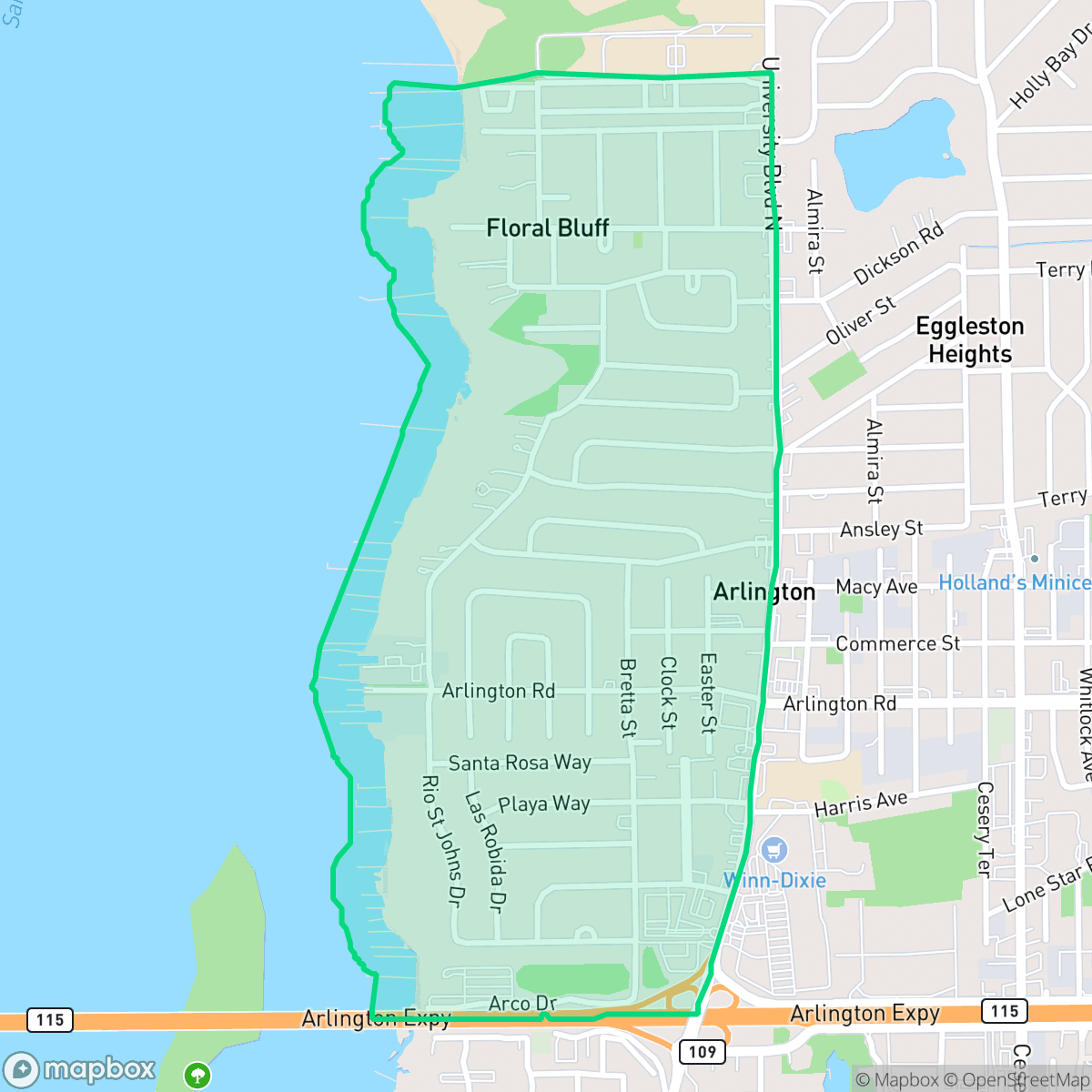
Located in Jacksonville’s Arlington region, the Monterey neighborhood is bounded by the St. Johns River, Jacksonville University, University Boulevard, and the Arlington Expressway. While the area encompasses remnants of late 19th and early 20th-century communities like Floral Bluff and Arlington Heights, the modern neighborhood emerged primarily as a mid-century development following the 1953 opening of the Mathews Bridge. Characterized by its mid-century modern aesthetic, the area features a mix of American Ranch-style houses, split-level residences, and custom-built homes. Today, Monterey serves as a quiet, wooded residential enclave that retains its mid-century architectural identity while maintaining proximity to the retail corridors and educational institutions of the broader Arlington area.
The area maintains a distinct, tidy visual identity characterized by modest yards and uniform rooflines that reflect its mid-century roots. It functions as a diverse community where young professionals and seniors live side by side, creating a varied age profile. The neighborhood successfully integrates local amenities like cafes with residential streets, providing a level of engagement that exceeds the city average while maintaining a calm, functional atmosphere. Prospective residents should consider the local environmental and infrastructure landscape. While the area offers a more moderate traffic noise profile than much of the city, proximity to major thoroughfares remains a factor. The neighborhood is situated within a floodplain, necessitating awareness of residual flood risks. Families should also note that educational options are managed by the Duval County School District, where access to specialized magnet programs often provides the best outcomes despite ongoing district-wide consolidation efforts.
Neighborhood Scores Across 15 Qualities
Residential spacing offers a balanced level of separation between neighbors, which is slightly higher than the Jacksonville average. While detached houses maintain moderate distances, some apartment and retail areas within Monterey feature higher density.
Quiet residential streets offer safe walking conditions, though some major roads lack continuous sidewalks. According to iHuus data, the area provides better pedestrian accessibility than the Jacksonville average.
Typical tract-style housing defines the landscape, featuring modest yards and uniform rooflines. According to iHuus data, the visual environment is notably more structured and tidy than much of Jacksonville.
Residential blocks feature consistent green verges and front yards that offer more space for walking pets than the Jacksonville average. Some areas also include a small lake near the edge of the neighborhood.
Residential streets and green spaces are balanced with commercial strips, creating a suburban layout more developed than the Jacksonville average. This area offers a mix of single-family homes and large-scale retail as noted in iHuus data.
Local activity levels are notably higher than the Jacksonville average, characterized by a mix of calm residential pockets and more active suburban hubs near transit corridors. While some areas remain semi-rural with minimal street life, other sections offer steady engagement through local cafes, universities, and diverse dining options.
Steady traffic sounds from nearby busy streets are present, though the area remains quieter than the Jacksonville average according to iHuus data.
Air quality levels fluctuate between acceptable and unhealthy, with occasional concerns for sensitive groups. This area maintains a better air quality profile than the Jacksonville average according to iHuus data.
Light commercial units and local amenities like cafes are integrated with residential areas, though proximity to a nearby Superfund site may present environmental considerations. This level of industrial presence is roughly in line with the Jacksonville average.
Health insurance enrollment levels in Monterey are slightly lower than the Jacksonville average, according to iHuus data.
Political views in Monterey are evenly divided between conservative and liberal leanings, representing a more moderate landscape than the broader Jacksonville area according to iHuus data.
Residents live alongside a wide variety of age groups, ranging from young adults to seniors. According to iHuus data, this population distribution is more varied than the typical age profile found across Jacksonville.
Residual flood risk exists within this area due to its location in a floodplain, though safety levels remain significantly higher than the Jacksonville average according to iHuus data.
Address-Level Insights for Monterey


iHuus Neighborhood Intelligence Insights
Get address-level neighborhood insights for Monterey
- Street-level scores — see how individual blocks compare, not just neighborhood averages
- Micro-zone boundaries — identify quiet pockets, flood boundaries, and walkable clusters before you visit
- 15 dimensions in full — walkability, noise, air quality, school quality, insurance coverage, population age profile, urban/rural index, and more
- Boundary risk alerts — know if your address sits near a block boundary where scores drop, the kind of detail no listing will ever mention
- School insights — individual school ratings and insights, not just district-level data
- Compare before you commit — side-by-side data across neighborhoods, down to block precision
No credit card required
Compare with Any Neighborhood
| Dimension | Monterey | 29th and Chase |
|---|---|---|
| 🚶 Walkabilityavg 3.96 | ||
| 🔊 Acoustic Comfortavg 4.37 | ||
| 🤫 Privacy Indexavg 4.3 | ||
| 🎨 Visual Appealavg 4.24 | ||
| 🐕 Dog Friendlinessavg 4.28 | ||
| 🗺️ Urban-Rural Indexavg 5.22 | ||
| ✨ Neighborhood Vibeavg 1.5 | ||
| 🏥 Health Insurance Coverageavg 4.35 | ||
| 🌿 Air Qualityavg 3.84 | ||
| 🏭 Industrial Proximityavg 5.11 | ||
| 🌊 Flood Safetyavg 4.01 | ||
| 🗳️ Ideological Leanavg 2.75 | ||
| 👥 Population Age Profileavg 3.26 | ||
| 🔥 Fire Safety | ||
| 🏫 School Quality |
Monterey Rankings
School Districts Serving Monterey
School Insights for Monterey
Below average outcomes; significant attendance and academic challenges.
School Insights
See what's really behind every school rating near Monterey
- Individual school ratings — each school's own score with outcome context, not just a district average
- Enrollment & class size data — student-to-teacher ratio and how it compares to the state average
- Full demographics breakdown — ethnicity and gender composition for every school in the enrollment zone
- Every school in the district — all schools within the enrollment boundary ranked by rating, not just the closest one
- Grade levels & benchmarks — elementary through high school, with below/above state-average flags
No credit card required