Mixon Town, Jacksonville
Updated · 1,792 residents
Mixon Town is a historically significant community defined by its utilitarian architecture and proximity to active commercial zones. While the area offers a steady local energy with breweries and dining, residents should expect frequent noise from nearby rail and highway corridors.
Key Highlights
About Mixon Town
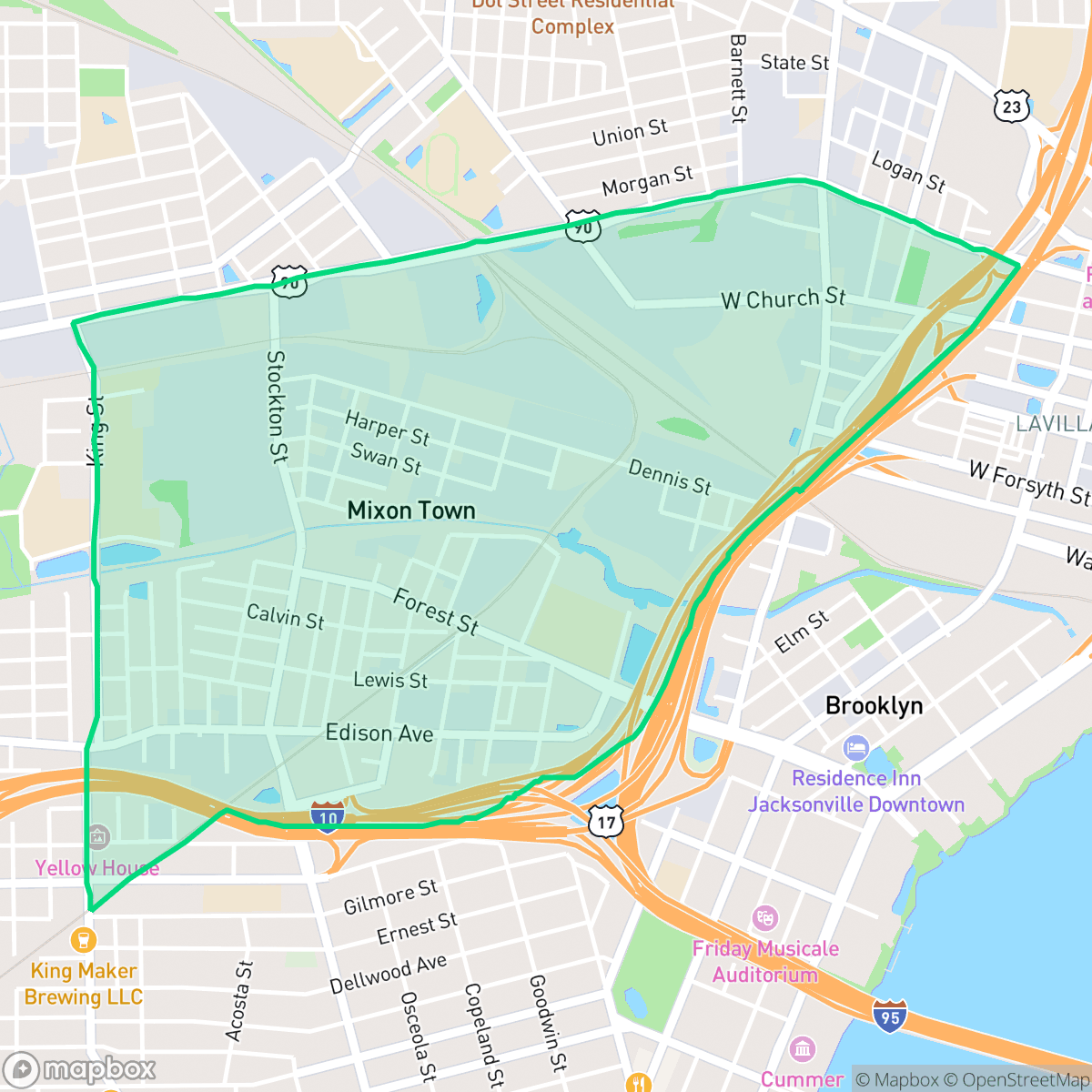
Mixon Town, historically known as West Lewisville, is a landmark African American neighborhood in Jacksonville established in the late 1880s. Serving as a westward expansion of communities like LaVilla and Brooklyn, the area flourished as a working-class streetcar suburb following the Great Fire of 1901. Its architectural character is defined by modest one-story shotgun houses and bungalow courts, such as the historic Oneida Bungalow Court. Historically, the neighborhood was deeply intertwined with industrial operations, including rail yards, meat packing plants, and the Draper's Egg & Poultry Company, which contributed to its economic base but also led to significant environmental challenges along McCoys Creek. The construction of Interstates 95 and 10 in the mid-20th century physically bisected the community, altering its urban fabric and separating it from neighboring districts like Riverside and Brooklyn.
The area maintains a distinct character through its blend of modest housing and active commercial spaces, including local breweries and printing services. The landscape is characterized by a semi-rural feel with scattered woodlands and open lots, providing a different atmosphere than typical dense urban neighborhoods. Residents benefit from air quality that generally outperforms the city average, though the presence of industrial activity and major transit routes creates a utilitarian visual environment.
Living here involves navigating specific trade-offs, such as limited pedestrian infrastructure and high levels of ambient noise from nearby transit corridors. While the community supports a diverse age range and holds a strongly liberal ideological leaning, potential residents should consider the moderate flood risk and the challenges of limited public park space for pets. Families are served by the Duval County School District, which offers access to specialized magnet programs alongside ongoing efforts to manage district-wide school consolidations.
Neighborhood Scores Across 15 Qualities
Residential lots feature a mix of density levels with some buffer between homes, providing more separation than the Jacksonville average. According to iHuus data, property spacing varies from tightly packed clusters to larger, gap filled lots.
Walking is possible due to low traffic levels on residential streets, but significant barriers like heavy rail crossings and highway bisecting the area make navigating the neighborhood difficult. While some grid layouts include sidewalks, their presence is inconsistent across the district according to iHuus data.
Simple roof geometries and small, unpaved yards characterize this area. The landscape features industrial proximity and a lack of lush greenery, resulting in a visual profile that is slightly below the Jacksonville average.
Narrow sidewalks and a lack of public parks make frequent outdoor walks difficult. Most greenery is confined to private yards, which means the area provides less accessible space for dogs than the Jacksonville average.
Open land and woodlands are more frequent here than in most parts of Jacksonville. Residents will find a mix of scattered homes and larger industrial zones situated among less dense terrain.
A notable amount of activity exists here due to a mix of breweries, dining, and cultural venues. This level of liveliness is significantly higher than the city average for Jacksonville.
Persistent sound from nearby transit corridors and rail lines makes this area significantly louder than the Jacksonville average. Residents may experience frequent disturbances from heavy traffic and industrial activity according to iHuus data.
Air quality levels typically fluctuate between acceptable and unhealthy ranges, though conditions remain notably better than the Jacksonville city average according to iHuus data. Sensitive groups should monitor local reports for days when pollution levels may cause concern.
Active commercial uses, such as breweries and printing services, sit alongside residential areas. According to iHuus data, this creates a higher presence of light industrial activity and transit traffic than seen in most parts of Jacksonville.
Health insurance coverage among Mixon Town residents is higher than the Jacksonville average. According to iHuus data, a significant portion of the population remains uninsured.
Voting patterns and census indicators in Mixon Town reflect a significantly more liberal leaning than the Jacksonville average, according to iHuus data.
Residents will find a balanced mix of young adults, families, and older individuals. This demographic spread is notably more varied than the typical age profile seen across Jacksonville.
Flood risk levels in Mixon Town are higher than the Jacksonville average, though current FEMA assessments lack a detailed study to determine precise vulnerability. Residents should remain aware of potential uncertainty regarding water levels during extreme weather events according to iHuus data.
Address-Level Insights for Mixon Town


iHuus Neighborhood Intelligence Insights
Get address-level neighborhood insights for Mixon Town
- Street-level scores — see how individual blocks compare, not just neighborhood averages
- Micro-zone boundaries — identify quiet pockets, flood boundaries, and walkable clusters before you visit
- 15 dimensions in full — walkability, noise, air quality, school quality, insurance coverage, population age profile, urban/rural index, and more
- Boundary risk alerts — know if your address sits near a block boundary where scores drop, the kind of detail no listing will ever mention
- School insights — individual school ratings and insights, not just district-level data
- Compare before you commit — side-by-side data across neighborhoods, down to block precision
No credit card required
Compare with Any Neighborhood
| Dimension | Mixon Town | 29th and Chase |
|---|---|---|
| 🚶 Walkabilityavg 3.96 | ||
| 🔊 Acoustic Comfortavg 4.37 | ||
| 🤫 Privacy Indexavg 4.3 | ||
| 🎨 Visual Appealavg 4.24 | ||
| 🐕 Dog Friendlinessavg 4.28 | ||
| 🗺️ Urban-Rural Indexavg 5.22 | ||
| ✨ Neighborhood Vibeavg 1.5 | ||
| 🏥 Health Insurance Coverageavg 4.35 | ||
| 🌿 Air Qualityavg 3.84 | ||
| 🏭 Industrial Proximityavg 5.11 | ||
| 🌊 Flood Safetyavg 4.01 | ||
| 🗳️ Ideological Leanavg 2.75 | ||
| 👥 Population Age Profileavg 3.26 | ||
| 🔥 Fire Safety | ||
| 🏫 School Quality |
Mixon Town Rankings
School Districts Serving Mixon Town
School Insights for Mixon Town
Below average outcomes; significant attendance and academic challenges.
School Insights
See what's really behind every school rating near Mixon Town
- Individual school ratings — each school's own score with outcome context, not just a district average
- Enrollment & class size data — student-to-teacher ratio and how it compares to the state average
- Full demographics breakdown — ethnicity and gender composition for every school in the enrollment zone
- Every school in the district — all schools within the enrollment boundary ranked by rating, not just the closest one
- Grade levels & benchmarks — elementary through high school, with below/above state-average flags
No credit card required