Miramar, Jacksonville
Updated · 3,574 residents
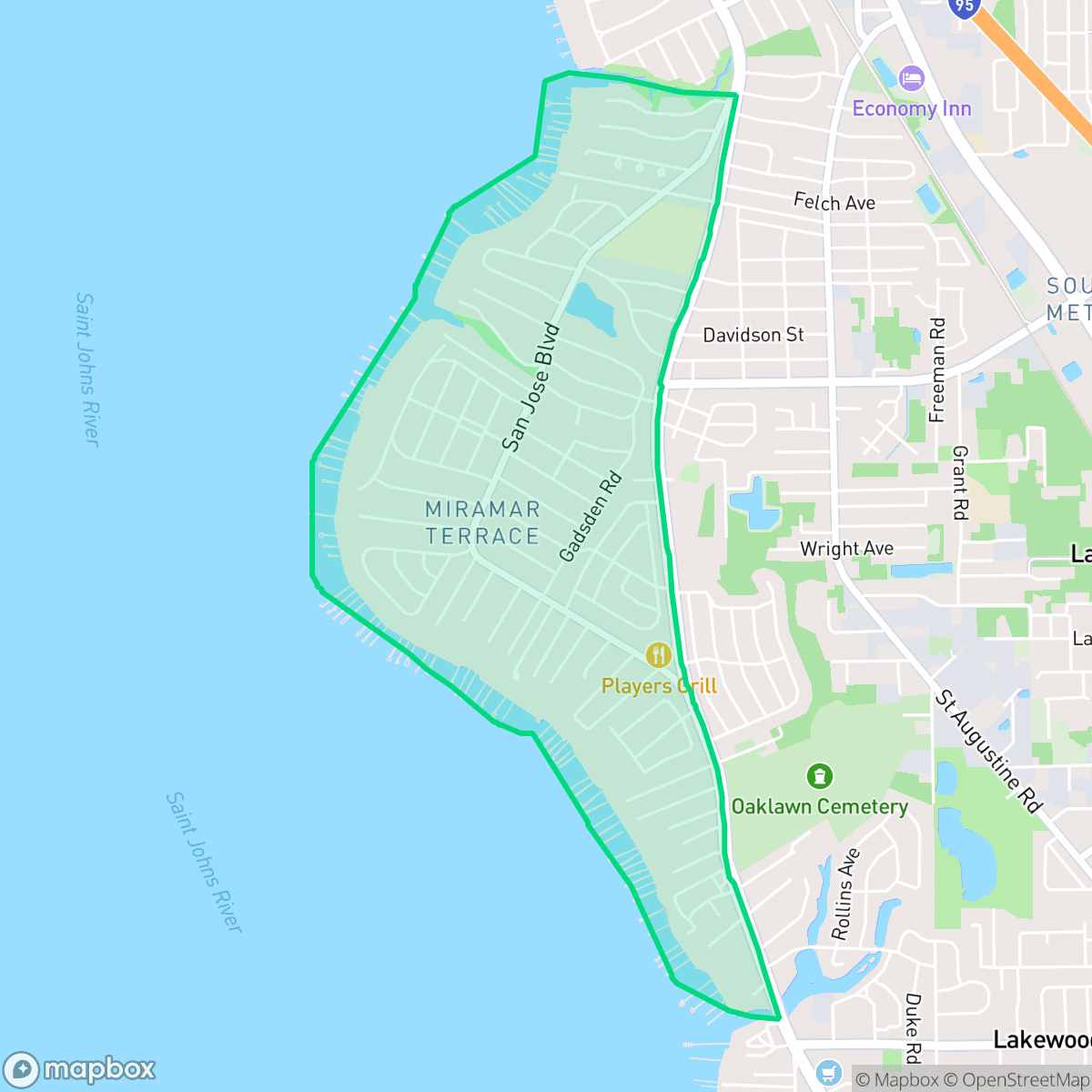
Miramar is a quiet, upscale residential enclave characterized by expansive lots, mature trees, and a mix of traditional and mid-century architecture. Located south of San Marco along the Hendricks Avenue corridor, the area offers a peaceful, semi-rural atmosphere with high levels of privacy and residential tranquility.
Key Highlights
About Miramar
Miramar, a residential neighborhood south of San Marco, is rooted in the 1793 "Red Bank" plantation land. The area was owned by prominent Jacksonville figures, including Isaiah D. Hart and Isaac Hendricks, the latter of whom is the namesake for Hendricks Avenue, the neighborhood’s commercial spine. The historic Red Bank Plantation House, built in 1854 using local red clay bricks, remains a significant landmark and is one of the oldest residences in Jacksonville. Following the mid-20th-century decline of the surrounding Philips settlement, the area evolved into a residential enclave known for a diverse architectural mix of traditional and mid-century modern homes. Today, Miramar retains a distinct character defined by its historic links to early plantation life and its transition into a well-established, tree-lined suburban community.
The neighborhood serves as a tranquil escape from the urban core, featuring a spacious layout that emphasizes privacy and visual appeal. Residents benefit from a semi-rural feel where woodland areas and open spaces are common, creating a buffer between homes that exceeds typical suburban density. The environment is notably quiet, with minimal industrial presence and low traffic noise, making it a stable and calm choice for those seeking a retreat within Jacksonville.
While the area lacks the high-intensity energy of downtown, it provides a stable environment for a diverse population ranging from young professionals to seniors. Accessibility is a key feature, as the community maintains high levels of health insurance coverage and a safe, walkable street network despite a lack of formal sidewalks. Families should note that school zoning within the Duval County district is a primary factor for consideration, as access to specialized magnet programs varies significantly. The neighborhood is best suited for those who prioritize a quiet, well-manicured suburban lifestyle over proximity to nightlife or dense commercial activity.
Neighborhood Scores Across 15 Qualities
Residential spacing provides a moderate level of separation between homes, offering more buffer between neighbors than the typical Jacksonville area. According to iHuus data, standard suburban setbacks ensure buildings are not directly adjacent.
Low traffic volumes and narrow residential loops provide a safe environment for walking, even though many streets lack dedicated sidewalks. According to iHuus data, this level of walkability is notably higher than the Jacksonville average.
Large waterfront estates and frequent private pools contribute to a visual landscape that is significantly more manicured than the Jacksonville average. According to iHuus data, the area features prominent upscale amenities and expansive residential lots.
Wide green verges along residential streets offer ample space for dog walking, making this area more pet-friendly than much of Jacksonville. However, the lack of visible public parks and presence of narrow grass strips in certain sections may limit options for off-leash exercise.
Open land and woodland areas are more prevalent here than in the typical Jacksonville neighborhood. Residents will find a mix of scattered homes and dense suburban pockets along major commercial roads, according to iHuus data.
Subdued residential pockets and parks define the area, providing a much more active atmosphere than the typical Jacksonville average. While some corridors near universities offer local dining and cultural interest, much of the neighborhood remains low-key and centered around quiet, car-oriented suburban living.
Acoustic levels are significantly lower than the Jacksonville average, characterized by infrequent sounds from distant trains or passing vehicles. Residents can expect a calm environment with only sporadic noise from far-off traffic.
Air quality levels fluctuate between acceptable and unhealthy periods, presenting occasional concerns for sensitive groups. This neighborhood maintains a noticeably better air quality profile than the Jacksonville average according to iHuus data.
Residential tranquility is a hallmark of this area, as it lacks the heavy industry and industrial hazards found more frequently elsewhere in Jacksonville. Most streets consist of quiet residential pockets and light commercial services like cafes or shops, though some segments near rail lines may experience moderate truck traffic.
Health insurance access is significantly higher than the Jacksonville average. According to iHuus data, a substantial majority of residents in this area maintain coverage.
Political leanings in this area are split relatively evenly between conservative and liberal perspectives. This presents a more moderate ideological landscape than the broader Jacksonville average, according to iHuus data.
Residents encounter a balanced distribution of young professionals, families, and seniors. According to iHuus data, this demographic variety is notably more diverse than the broader Jacksonville area.
Residual flood risks exist as parts of the area fall within a 500-year floodplain. According to iHuus data, the level of safety from flooding in Miramar is notably higher than the Jacksonville city average.
Address-Level Insights for Miramar


iHuus Neighborhood Intelligence Insights
Get address-level neighborhood insights for Miramar
- Street-level scores — see how individual blocks compare, not just neighborhood averages
- Micro-zone boundaries — identify quiet pockets, flood boundaries, and walkable clusters before you visit
- 15 dimensions in full — walkability, noise, air quality, school quality, insurance coverage, population age profile, urban/rural index, and more
- Boundary risk alerts — know if your address sits near a block boundary where scores drop, the kind of detail no listing will ever mention
- School insights — individual school ratings and insights, not just district-level data
- Compare before you commit — side-by-side data across neighborhoods, down to block precision
No credit card required
Compare with Any Neighborhood
| Dimension | Miramar | 29th and Chase |
|---|---|---|
| 🚶 Walkabilityavg 3.96 | ||
| 🔊 Acoustic Comfortavg 4.37 | ||
| 🤫 Privacy Indexavg 4.3 | ||
| 🎨 Visual Appealavg 4.24 | ||
| 🐕 Dog Friendlinessavg 4.28 | ||
| 🗺️ Urban-Rural Indexavg 5.22 | ||
| ✨ Neighborhood Vibeavg 1.5 | ||
| 🏥 Health Insurance Coverageavg 4.35 | ||
| 🌿 Air Qualityavg 3.84 | ||
| 🏭 Industrial Proximityavg 5.11 | ||
| 🌊 Flood Safetyavg 4.01 | ||
| 🗳️ Ideological Leanavg 2.75 | ||
| 👥 Population Age Profileavg 3.26 | ||
| 🔥 Fire Safety | ||
| 🏫 School Quality |
Miramar Rankings
School Districts Serving Miramar
School Insights for Miramar
Below average outcomes; significant attendance and academic challenges.
School Insights
See what's really behind every school rating near Miramar
- Individual school ratings — each school's own score with outcome context, not just a district average
- Enrollment & class size data — student-to-teacher ratio and how it compares to the state average
- Full demographics breakdown — ethnicity and gender composition for every school in the enrollment zone
- Every school in the district — all schools within the enrollment boundary ranked by rating, not just the closest one
- Grade levels & benchmarks — elementary through high school, with below/above state-average flags
No credit card required