Marietta, Jacksonville
Updated · 3,652 residents
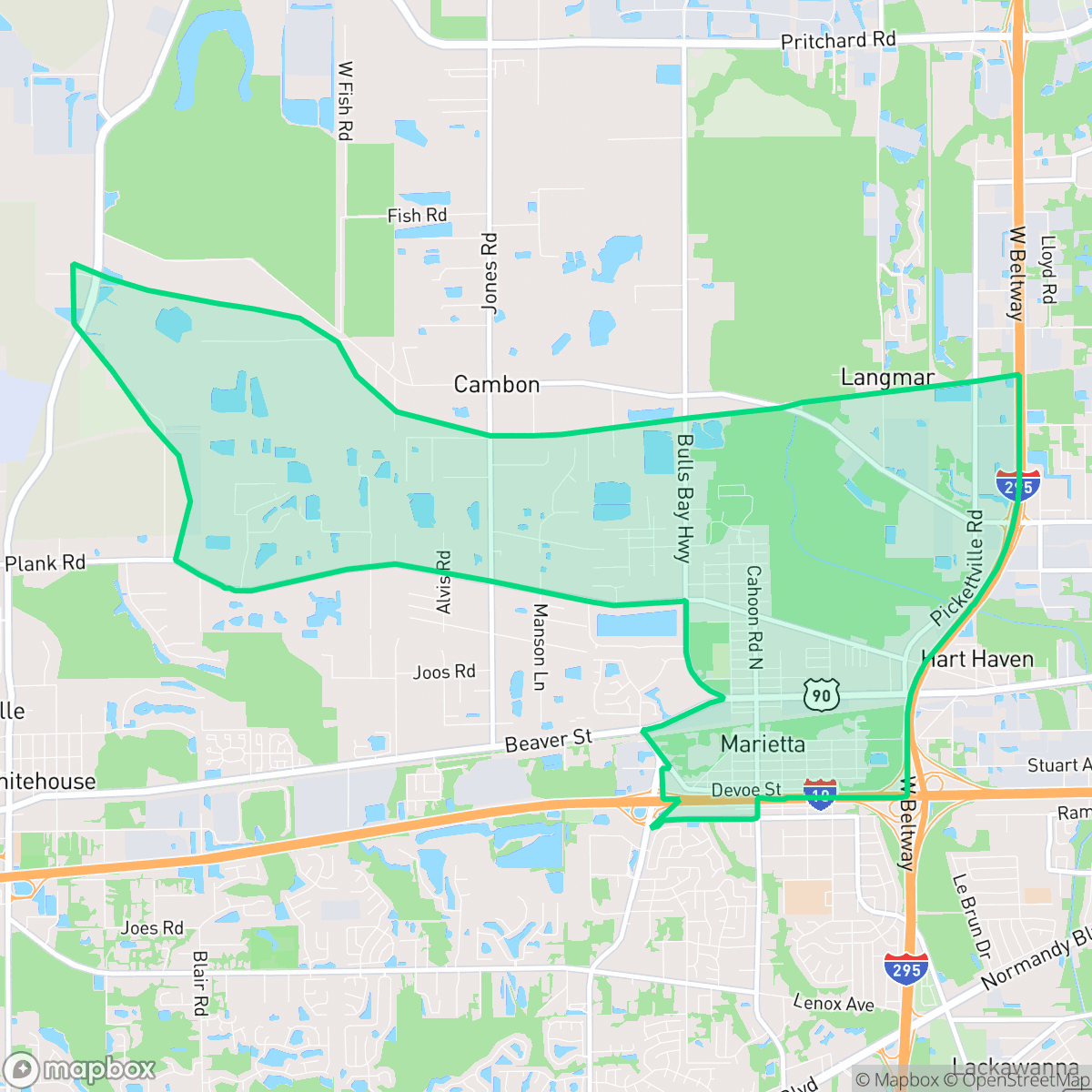
Marietta is a quiet, semi-rural community on Jacksonville's Westside characterized by single-family homes on spacious lots. While the area offers a peaceful environment with more privacy than typical urban neighborhoods, it has limited pedestrian infrastructure and minimal commercial activity.
Key Highlights
About Marietta
Marietta, located on Jacksonville’s Westside, possesses a history rooted in the 1820s as the site of Isaiah Hart’s 2,000-acre Paradise Plantation. By 1856, the area was known as "Harts." During the Civil War, the community hosted Camp Finegan, a vital Confederate staging ground and railroad link, which was later repurposed as Camp Shaw, a site for training United States Colored Troops, including the 54th Massachusetts. Following the war, Marietta evolved into an unincorporated community defined by a thriving dairy industry. While the neighborhood experienced significant residential expansion during the 1940s and 1950s, its roadway grid was later bisected by the construction of Interstate 10 and Interstate 295. Today, Marietta retains a semi-rural character, characterized by single-family homes on larger parcels of land.
The neighborhood maintains a semi-rural feel with frequent open land and woodlands, providing a buffer between residences. The layout is defined by standard tract housing and larger parcels, which creates a sense of seclusion for residents. While the area is generally quiet, it is situated near major thoroughfares, leading to moderate traffic noise.
The area is best suited for those who prioritize a low-density environment over proximity to retail or walkability. Residents should be aware of the mixed industrial presence, which can introduce occasional freight noise and utility odors. Educational options fall under the Duval County School District, where families often navigate a landscape of specialized magnet programs and ongoing district-wide facility consolidations.
Neighborhood Scores Across 15 Qualities
Residential spacing provides a moderate amount of buffer between neighbors, offering more seclusion than the typical Jacksonville neighborhood. According to iHuus data, density levels are mixed throughout the area.
Quiet residential streets allow for easy walking, though the lack of sidewalks makes navigating the area slightly less pedestrian-friendly than much of Jacksonville. According to iHuus data, the walkability level is roughly comparable to the city average.
Standard tract housing defines the area, characterized by simple rooflines and small yards. This level of visual variety is slightly above the Jacksonville average according to iHuus data.
Pet owners have access to some green spaces and public parks, offering more opportunities for outdoor activity than the Jacksonville average. According to iHuus data, the area lacks extensive continuous walking trails or widespread manicured verges.
Frequent open land and scattered homes amidst woodlands provide a more spacious, semi-rural environment compared to the more densely developed Jacksonville average. This landscape offers significant greenery and unbuilt areas according to iHuus data.
Primarily residential in nature, this area features very sparse commercial activity and few local destinations. According to iHuus data, the neighborhood's level of activity is slightly lower than the city average.
Steady traffic sounds from nearby thoroughfares are common here, though the area remains slightly quieter than much of Jacksonville according to iHuus data.
Air quality levels in Marietta fluctuate between acceptable and unhealthy periods, though conditions remain better than the Jacksonville average. Sensitive groups may experience occasional concern during certain weather patterns according to iHuus data.
Light commercial activity and storage facilities bring more daytime transit traffic and utility odors to the area than is typically found across Jacksonville. While heavy industry is largely absent, residents may encounter occasional freight movement and loading dock noise near certain residential pockets.
Health insurance coverage among residents is slightly below the Jacksonville average, according to iHuus data.
Conservative voting patterns and census indicators are significantly more pronounced here than in the rest of Jacksonville, according to iHuus data.
Residents live alongside a more varied mix of age groups than is typically found across Jacksonville. According to iHuus data, this area lacks the heavy concentration of a single demographic and instead features a balanced spread of young adults, families, and seniors.
Flood risk in this area remains difficult to assess because FEMA has not yet finished a detailed study for the neighborhood. According to iHuus data, the level of risk is slightly higher than the Jacksonville average.
Address-Level Insights for Marietta


iHuus Neighborhood Intelligence Insights
Get address-level neighborhood insights for Marietta
- Street-level scores — see how individual blocks compare, not just neighborhood averages
- Micro-zone boundaries — identify quiet pockets, flood boundaries, and walkable clusters before you visit
- 15 dimensions in full — walkability, noise, air quality, school quality, insurance coverage, population age profile, urban/rural index, and more
- Boundary risk alerts — know if your address sits near a block boundary where scores drop, the kind of detail no listing will ever mention
- School insights — individual school ratings and insights, not just district-level data
- Compare before you commit — side-by-side data across neighborhoods, down to block precision
No credit card required
Compare with Any Neighborhood
| Dimension | Marietta | 29th and Chase |
|---|---|---|
| 🚶 Walkabilityavg 3.96 | ||
| 🔊 Acoustic Comfortavg 4.37 | ||
| 🤫 Privacy Indexavg 4.3 | ||
| 🎨 Visual Appealavg 4.24 | ||
| 🐕 Dog Friendlinessavg 4.28 | ||
| 🗺️ Urban-Rural Indexavg 5.22 | ||
| ✨ Neighborhood Vibeavg 1.5 | ||
| 🏥 Health Insurance Coverageavg 4.35 | ||
| 🌿 Air Qualityavg 3.84 | ||
| 🏭 Industrial Proximityavg 5.11 | ||
| 🌊 Flood Safetyavg 4.01 | ||
| 🗳️ Ideological Leanavg 2.75 | ||
| 👥 Population Age Profileavg 3.26 | ||
| 🔥 Fire Safety | ||
| 🏫 School Quality |
Marietta Rankings
School Districts Serving Marietta
School Insights for Marietta
Below average outcomes; significant attendance and academic challenges.
School Insights
See what's really behind every school rating near Marietta
- Individual school ratings — each school's own score with outcome context, not just a district average
- Enrollment & class size data — student-to-teacher ratio and how it compares to the state average
- Full demographics breakdown — ethnicity and gender composition for every school in the enrollment zone
- Every school in the district — all schools within the enrollment boundary ranked by rating, not just the closest one
- Grade levels & benchmarks — elementary through high school, with below/above state-average flags
No credit card required